


Over half of online recruitment in the Canadian job market now relies on advanced digital platforms, putting small businesses in direct competition with American firms for top talent. In a climate where every qualified candidate counts, even a single weak job posting can mean missing out on the perfect hire. This guide reveals actionable strategies that make your online job listings stand out, so your company attracts the talent you need to grow and thrive.
Table of Contents
- Online Job Posting Explained For Employers
- Key Benefits In The Canadian Job Market
- Types Of Online Job Platforms Compared
- Legal Obligations And 2026 Compliance Rules
- Risks, Costs, And Common Mistakes
- Strategies To Maximize Recruitment Success
Key Takeaways
| Point | Details |
|---|---|
| Online Job Postings Enhance Recruitment | Leveraging online platforms provides Canadian employers access to broader talent pools and advanced screening processes. |
| Key Legal Changes Coming in 2026 | Employers must prepare for new transparency and fairness regulations in job postings to ensure compliance. |
| Strategic Use of Job Platforms | Diversifying recruitment across various online job platforms optimizes candidate exposure and boosts hiring success. |
| Focus on Clear Job Descriptions | Crafting detailed and compelling job descriptions is essential for attracting suitable candidates while reflecting company culture. |
Online Job Posting Explained for Employers
Online job postings have transformed recruitment strategies for Canadian employers, offering unprecedented access to talent pools across diverse professional sectors. Labour market information systems now enable companies to communicate skill requirements with precision and efficiency, bridging critical gaps between employer needs and candidate capabilities.
The digital recruitment landscape provides employers multiple strategic advantages. Online platforms allow businesses to reach a broader audience, target specific skill sets, and streamline candidate screening processes. Employers can now post detailed job descriptions, specify exact qualification requirements, and quickly filter applicants based on predetermined criteria – all without the traditional constraints of physical job advertisements.
Effective online job postings require thoughtful strategy. Successful employers craft compelling job descriptions that clearly outline role responsibilities, required qualifications, and organizational culture. Key elements include:
- Precise job title and level
- Comprehensive role responsibilities
- Required technical and soft skills
- Compensation range or benefits overview
- Company mission and values
- Application instructions
Pro tip: Use concise, action-oriented language and include specific keywords relevant to your industry to improve candidate matching and visibility.
Key Benefits in the Canadian Job Market
Online job postings have become a critical component of recruitment strategies across Canada, offering employers unprecedented insights into workforce dynamics. Online job market analysis reveals how these digital platforms are transforming talent acquisition by providing real-time data on emerging skill demands and industry trends.

The Canadian job market benefits from online postings through multiple strategic advantages. These digital platforms enable employers to expand their talent reach far beyond traditional recruitment methods. Businesses can now access diverse candidate pools, target specific skill sets, and quickly screen potential employees with unprecedented efficiency. The ability to instantly publish detailed job descriptions, outline precise qualification requirements, and implement advanced filtering mechanisms represents a significant evolution in recruitment technology.
Key benefits of online job postings in the Canadian context include:
- Nationwide talent accessibility
- Precise skill matching capabilities
- Reduced recruitment time and costs
- Enhanced candidate screening processes
- Direct integration with federal employment resources
- Real-time labor market insights
Employers leveraging these platforms gain substantial competitive advantages by understanding complex workforce dynamics and aligning their recruitment strategies with current market demands. Federal employment resources further support these efforts by providing additional infrastructure and support for job market integration.
Pro tip: Optimize your online job postings by incorporating specific industry keywords and clearly articulating both technical skills and cultural fit requirements to attract the most suitable candidates.
Types of Online Job Platforms Compared
The Canadian online job market offers employers a diverse array of platforms, each with unique features and targeting specific recruitment needs. Government-sponsored job platforms like Job Bank represent a critical resource for employers seeking comprehensive and legitimate recruitment channels across the nation.
Online job platforms can be categorized into several distinct types, each serving different recruitment strategies and organizational requirements. General job boards provide broad reach and accessibility, while specialized industry-specific platforms offer targeted talent acquisition. Professional networking sites enable direct candidate engagement, and niche platforms cater to specific skill sets or professional domains.
Key categories of online job platforms include:
- Government Platforms
- Job Bank (official federal platform)
- Provincial employment websites
- Immigrant worker recruitment channels
- General Job Boards
- Nationwide coverage
- Multiple industry listings
- Broad candidate pools
- Professional Networking Sites
- Direct professional connections
- Skill-based candidate matching
- Industry-specific networking
- Specialized Industry Platforms
- Targeted talent acquisition
- Sector-specific candidate pools
- Advanced skill filtering
Each platform type offers distinct advantages, enabling employers to strategically select recruitment channels that align with their specific hiring objectives and organizational requirements.
Here’s a comparison of the main online job platform types and their ideal use cases:
| Platform Type | Ideal Employer Type | Best For |
|---|---|---|
| Government Platforms | Large enterprises, public sector | Broad national reach, regulatory trust |
| General Job Boards | SMEs, startups, agencies | Fast posting, diverse applicant pool |
| Professional Networking | Corporations, industry leaders | Passive search, professional engagement |
| Specialized Industry Sites | Niche firms, technical recruiters | Unique skills, targeted candidate pool |
Pro tip: Diversify your recruitment strategy by utilizing multiple job platforms to maximize candidate exposure and increase the probability of finding ideal talent.
Legal Obligations and 2026 Compliance Rules
The Canadian job market is experiencing significant regulatory changes that will dramatically transform employer recruitment practices. New legislative requirements set to take effect in 2026 mandate unprecedented transparency and fairness in job posting protocols, particularly in Ontario.
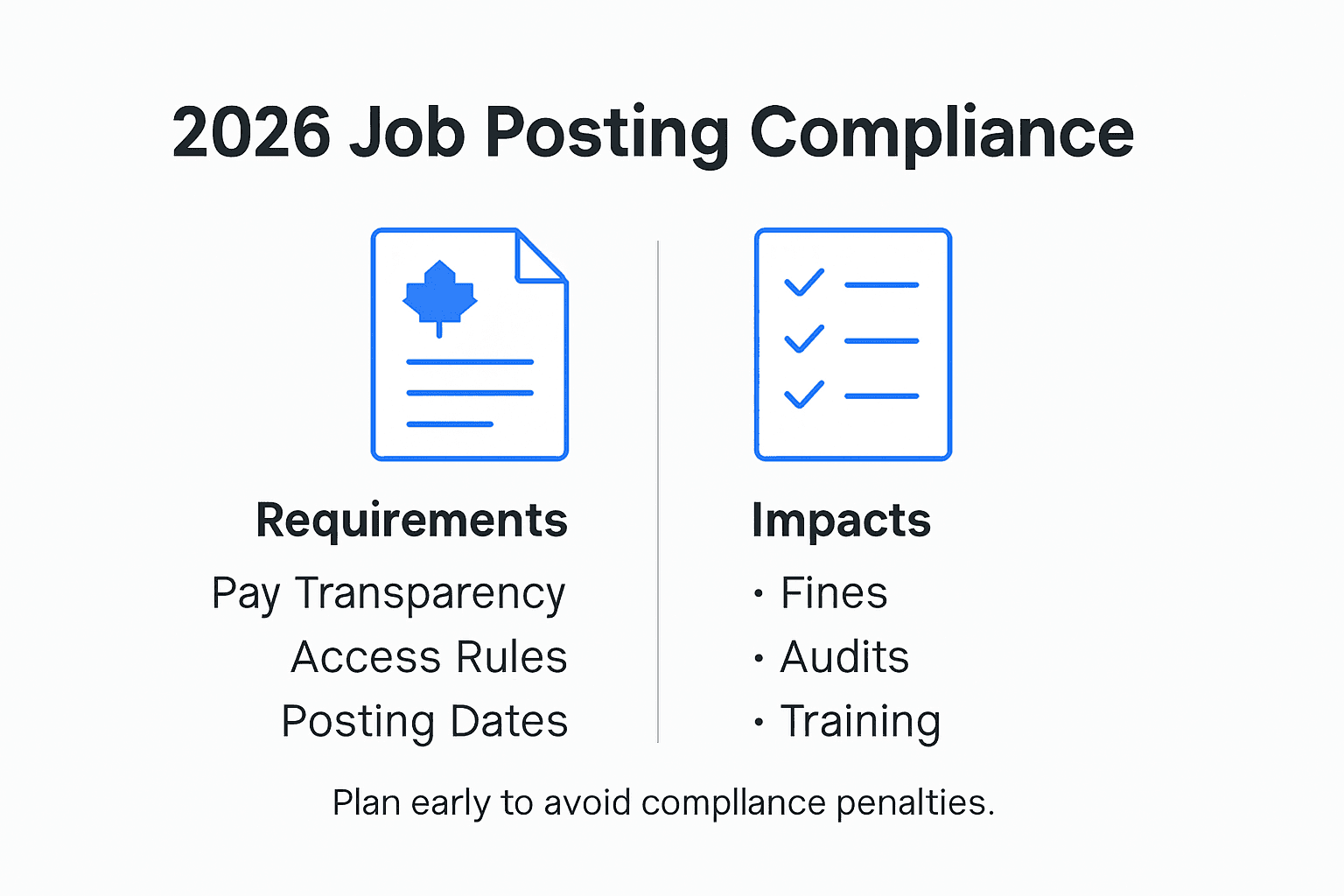
Comprehensive job posting regulations introduce six critical rules designed to enhance workplace equity and candidate protection. These new standards apply specifically to employers with 25 or more employees and represent a significant shift in recruitment transparency.
Key legal obligations for employers include:
- Salary Transparency
- Mandatory disclosure of compensation range
- Full salary information must be publicly visible
- Prohibits withholding payment details
- Artificial Intelligence Disclosure
- Required notification of AI use in recruitment
- Detailed explanation of AI screening processes
- Transparency about algorithmic candidate assessment
- Experience Requirements
- Prohibition of Canadian experience mandates
- Elimination of discriminatory screening practices
- Focus on skills and qualifications over geographic experience
- Documentation and Retention
- Three-year record retention requirement
- Comprehensive documentation of posting details
- Audit-ready recruitment documentation
These regulations signify a substantial commitment to creating more equitable and transparent recruitment environments across Canadian workplaces.
The following summary highlights how new compliance rules impact employers’ recruitment operations:
| Compliance Rule | Operational Impact | Preparation Action |
|---|---|---|
| Salary Transparency | Revises public job postings | Update templates, train HR staff |
| AI Disclosure | Requires tech and HR coordination | Document AI processes, update policies |
| Experience Mandate Ban | Changes screening methods | Review and revise role requirements |
| Record Retention | Increases documentation workload | Implement data management systems |
Pro tip: Develop a comprehensive compliance checklist and conduct internal training to ensure your organization meets all new job posting regulations before the 2026 implementation date.
Risks, Costs, and Common Mistakes
Employer compliance risks in online job posting represent a complex landscape of potential legal and financial challenges. Organizations must navigate intricate regulatory requirements while managing potential financial and reputational exposure associated with recruitment practices.
New hiring regulations introduce significant administrative complexity that can overwhelm unprepared employers. The financial implications extend beyond immediate compliance costs, potentially impacting long-term recruitment strategies and organizational budgeting.
Key risks and potential mistakes include:
- Compliance Violations
- Inaccurate salary range disclosures
- Incomplete AI usage documentation
- Insufficient record retention practices
- Financial Risks
- Legal penalty assessments
- Potential lawsuit expenses
- Recruitment process redesign costs
- Operational Challenges
- Staff retraining requirements
- Technology system updates
- Workflow process modifications
- Candidate Relationship Risks
- Transparency perception issues
- Potential discrimination claims
- Reduced candidate trust
Successful navigation of these challenges requires proactive planning, comprehensive staff training, and systematic approach to regulatory adaptation.
Pro tip: Conduct a comprehensive internal audit of current job posting practices and develop a step-by-step implementation plan at least six months before the 2026 regulatory changes take effect.
Strategies to Maximize Recruitment Success
Maximizing recruitment success in the Canadian job market requires a multifaceted and strategic approach that goes beyond traditional hiring methods. Employers must develop comprehensive strategies that leverage digital platforms, advanced screening techniques, and targeted candidate engagement approaches.
Successful recruitment strategies encompass several critical dimensions. These include creating compelling job descriptions, utilizing advanced candidate matching technologies, implementing robust screening processes, and developing a strong employer brand that attracts top talent. The goal is to not just fill positions, but to build a talent pipeline that supports long-term organizational growth.
Key strategies for recruitment optimization include:
- Comprehensive Job Descriptions
- Clear and detailed role expectations
- Highlight unique company culture
- Specify required and preferred qualifications
- Advanced Candidate Screening
- Implement skills-based assessment tools
- Use AI-powered matching algorithms
- Create multi-stage evaluation processes
- Employer Branding
- Develop compelling company narrative
- Showcase workplace values
- Highlight career development opportunities
- Multichannel Recruitment
- Utilize diverse job posting platforms
- Leverage professional networking sites
- Engage with industry-specific recruitment channels
- Candidate Experience Optimization
- Streamline application processes
- Provide timely communication
- Create transparent recruitment workflows
Pro tip: Develop a standardized recruitment scorecard that objectively evaluates candidates across multiple dimensions, ensuring consistent and fair candidate assessment.
Unlock the Power of Online Job Posting to Transform Your Canadian Recruitment
The challenge facing Canadian employers today is clear: navigating new compliance rules and reaching the right candidates efficiently while maintaining transparency and fairness. The article highlights critical pain points like salary transparency, AI disclosure, and eliminating Canadian experience mandates that require precise job posting strategies. Employers also need to address complex recruitment workflows and legal obligations without losing speed or candidate quality. Finding the ideal platform to post jobs online that caters to these evolving demands is key to overcoming these hurdles.
Gohires.com is designed to help Canadian employers take control of their recruitment process. With user-friendly job posting capabilities, visibility across diverse employment types, and tools tailored to meet modern compliance expectations, Gohires offers a centralized solution to post jobs for free and attract qualified applicants nationwide. Experience advanced filtering, keyword-driven candidate matching, and the opportunity to build your employer brand all within one trusted platform.
Discover how Gohires.com can streamline your hiring journey starting today.
Ready to post your jobs online with confidence and reach the talent that fits your needs while staying compliant with Canadian regulations? Visit Gohires.com now to get started and transform your recruitment strategy with an easy, transparent, and powerful platform.
Frequently Asked Questions
What are the benefits of posting jobs online?
Posting jobs online allows employers to reach a larger, more diverse audience, target specific skill sets, and streamline the candidate screening process, ultimately reducing recruitment time and costs.
How can I optimize my online job postings to attract better candidates?
To optimize your job postings, use concise and action-oriented language, incorporate specific industry keywords, clearly outline job responsibilities and qualifications, and provide insights into your company’s culture.
What types of online job platforms are available for employers?
Employers can choose from various online job platforms, including government-sponsored platforms, general job boards, professional networking sites, and specialized industry platforms, each catering to different recruitment needs.
What legal obligations should employers be aware of when posting jobs online?
Employers must comply with regulations like salary transparency, AI disclosure, and experience requirements, especially with upcoming changes in job posting protocols, ensuring equitable practices and protecting candidates.
Recommended
- The Best Job Search Websites for Immigrants in Canada – GoHires
- How to Use LinkedIn Effectively to Land a Job in Canada – GoHires
- How to Get a Job in Canada Before You Immigrate – GoHires
- The Role of Recruitment Agencies in Finding Jobs for Immigrants: How to Leverage Them to Land Your First Job – GoHires
- Role of Websites in Construction – Driving Growth Online – ResponsiveWebsiteDesign