


Scrolling endless job boards can leave you wondering if you are missing out on better options right in your own backyard. For Canadian job seekers, job banks offer a host of advantages that set them apart from commercial platforms. Understanding the difference between a government-supported job bank and a typical job board is the first step toward refining your employment strategy. This guide will clarify what job banks really are, address common misconceptions, and highlight how they help you compete for opportunities across Canada.
Table of Contents
- Job Banks Defined And Common Misconceptions
- Major Types Of Job Banks In Canada
- How Job Banks Function For Job Seekers
- Security, Legitimacy, And Data Privacy
- Comparing Job Banks To Private Job Boards
- Common Pitfalls And Success Tips For Users
Key Takeaways
| Point | Details |
|---|---|
| Job Banks vs. Private Boards | Job banks, like the Canadian Job Bank, are government-operated platforms providing vetted job listings, while private boards operate for profit and may contain unverified postings. |
| Effective Job Search Strategy | Use a combination of job banks and niche platforms tailored to your industry to maximize job opportunities. |
| Profile and Alerts | Create a detailed profile and set up job alerts to receive personalized job matches based on your skills and preferences. |
| Data Privacy Awareness | Understand the data protection laws governing job banks to ensure your personal information is handled securely. |
Job Banks Defined and Common Misconceptions
A job bank is an organized database of employment opportunities maintained by government agencies or third-party organizations. Think of it as a centralized hub where employers post open positions and job seekers can search for work across entire regions or countries. In Canada, the most prominent example is the Canadian Job Bank, operated by Employment and Social Development Canada. It functions as a public employment website providing access to thousands of job listings across virtually every Canadian province and territory. Unlike general job boards you might use, job banks typically focus on official labor market data and aim to reduce barriers to employment access.
One major misconception is that job banks are just like the commercial job sites you’re already familiar with. People often assume they work identically to platforms you browse casually, but that’s not accurate. The Canadian Job Bank, for instance, requires account setup with sensitive personal information, which frustrates some users. Another widespread myth is that job banks provide comprehensive coverage of all available positions in your area. The reality is more nuanced. While they capture many listings, particularly government and publicly posted roles, some employers prefer posting directly on their own websites or through private recruitment agencies. Geographic specificity can also vary, with some provincial job banks offering more localized results than the federal system.
Another common misconception centers on job bank exclusivity. Many people think you must use only a job bank for your search, when the truth is they work best as one component of a broader job search strategy. Job banks excel at providing reliable, vetted listings and labor market information, but they shouldn’t replace other search methods. Some users also mistakenly believe that applying through a job bank carries more weight or improves their chances compared to applying directly to employers. That’s simply not how it works. A strong resume and genuine fit for the role matter far more than where you discovered the posting.
Understanding what job banks actually are and what they’re not helps you use them effectively. They’re government-supported resources designed to improve employment outcomes, not fancy tech platforms competing for your attention. The Canadian Job Bank, for example, provides reliable data on job trends, salary information, and skill requirements alongside listings. This additional information can inform career decisions that pure job boards don’t offer. The key is approaching job banks as legitimate tools that complement other resources like networking, company websites, and recruiter outreach.
Pro tip: Create your job bank profile early in your search and set up job alerts for your target roles and locations, then combine this with direct applications to company websites and meaningful networking to maximize your employment opportunities.
Major Types of Job Banks in Canada
Canada’s employment landscape includes several distinct types of job banks, each serving different purposes and geographic regions. The federal government operates the primary Canadian Job Bank, which serves as the central repository for employment opportunities across the country. However, this isn’t the only option available to you. Under Canada’s Labour Market Development Agreements, provinces contribute listings to the federal system, but many provinces also maintain their own dedicated job banks. This dual structure means you’ll encounter multiple platforms when searching for work, and understanding which ones matter for your situation is crucial.
Provincial job banks represent the second major category. These are government-operated employment databases specific to individual provinces or territories. Alberta, for example, operates its own system, while Saskatchewan maintains SaskJobs as a dedicated provincial resource. These regional platforms often provide more localized job listings and may include positions that don’t make it to the federal Job Bank. The advantage here is specificity. If you’re targeting work in a particular province, the provincial job bank usually offers better geographic filtering and may list roles from smaller employers who prefer advertising locally. Some provinces have integrated their systems more closely with the federal Job Bank, creating a seamless search experience, while others maintain completely separate databases.
Beyond government-operated systems, private job boards and niche websites form the third category of employment platforms. Unlike official job banks, these are operated by commercial companies and often specialize in particular industries, professions, or worker populations. You might find boards dedicated to healthcare, technology, trades, or immigrant workers. These platforms don’t receive mandatory provincial listings like the federal Job Bank does, but they often attract employers seeking specialized talent. The distinction matters because private boards and niche sites operate with different business models. They may charge employers to post or charge candidates for premium features, whereas government job banks are typically free to use.
When deciding which job banks to use, consider your specific situation. Recent graduates and career changers benefit from exploring both federal and provincial resources, since these capture a broad range of entry level and transition roles. If you’re targeting a specific industry or demographic category, niche platforms and specialized job boards might yield better results than general job banks. The reality is that most successful Canadian job seekers use a combination of all three types. Your search strategy shouldn’t rely exclusively on any single platform. The federal Job Bank provides comprehensive coverage, provincial banks offer regional specificity, and private boards connect you with industry expertise and specialized opportunities.
Here’s a practical comparison of the three main types of job search platforms in Canada:
| Platform Type | Coverage Area | Typical Users | Unique Benefits |
|---|---|---|---|
| Federal Job Bank | Nationwide | All job seekers in Canada | National listings, labor market info |
| Provincial Job Bank | Specific province/region | Local job seekers | Local roles, smaller employer postings |
| Private Job Board | Varies, often national | Industry specialists, general | Industry focus, more private listings |
Pro tip: Register with your province’s dedicated job bank first, then add the federal Job Bank and one or two niche boards relevant to your industry to create a well rounded job search approach that captures opportunities across all platforms.
How Job Banks Function for Job Seekers
Job banks operate as digital employment platforms designed to simplify your job search process. The mechanics are straightforward: you create a profile, specify your job preferences, and the system matches you with relevant openings. The Canadian Job Bank functions as an employment platform allowing users to search for jobs, create profiles, and receive tailored job matches based on your skills, experience, and career goals. Unlike general job boards that simply display listings, job banks use matching algorithms to proactively identify opportunities aligned with your background. This personalized approach saves time because you’re not sifting through hundreds of irrelevant postings. You’re instead receiving curated suggestions that actually fit your qualifications and preferences.
The core workflow begins with profile creation. When you register with a job bank, you’ll input information about your education, work experience, certifications, and employment preferences. This data becomes the foundation for everything that follows. Once your profile is complete, you can set up job alerts that notify you when positions matching your criteria appear. These alerts can be customized by industry, location, job title, salary range, and employment type. If you’re looking for part-time work in Toronto while you finish your degree, you can specify exactly that. The job bank will then send you notifications whenever relevant positions are posted, eliminating the need to check manually every single day. This automation is one of the biggest advantages job banks offer compared to scrolling through random job boards.

Job banks also provide resources beyond job listings. The Canadian Job Bank, for instance, offers information on job standards, employment rights, and career planning tools that help you make informed decisions. You can research salary ranges for specific roles, learn about in-demand skills in your field, and understand industry trends. This contextual information helps you position yourself more effectively and identify areas where additional training might boost your competitiveness. Many job banks include labor market information showing which sectors are hiring, which skills employers value most, and what compensation looks like for different positions. This intelligence allows you to make strategic career moves rather than reactive ones.
The platform also facilitates direct connections with employers. When you find a position that interests you, you can apply directly through the job bank using your profile information. Some job banks allow employers to view your profile and reach out directly if you match their requirements. This two way communication creates opportunities you might never discover through traditional applications. Additionally, job banks serve all Canadians, including recent graduates, career changers, newcomers, and temporary foreign workers, making them genuinely inclusive platforms. The search and matching features work equally well whether you’re entering your first career or transitioning industries. The accessibility of these platforms means you’re competing on merit and qualifications, not on connections or insider knowledge.
Pro tip: Complete your job bank profile thoroughly with specific skills and keywords, then set up multiple job alerts with different criteria to capture diverse opportunities while allowing the matching algorithm to work on your behalf.
Security, Legitimacy, and Data Privacy
When you register for a job bank and share personal information, you’re rightfully concerned about where that data goes and how it’s protected. Government-operated job banks in Canada operate with real accountability. The Canadian Job Bank, for instance, is subject to federal privacy laws that govern how your information is collected, stored, and used. Canadian privacy law, including the Privacy Act and PIPEDA, establishes explicit rights to privacy and sets standards for handling personal data. This means the government agencies operating job banks must follow strict protocols. They can’t simply sell your data to marketers or use your information for purposes beyond employment matching. This regulatory framework exists to protect you, and understanding it should give you confidence when registering.
PIPEDA, which stands for the Personal Information Protection and Electronic Documents Act, specifically governs how private sector organizations handle personal information. If you’re using a private job board rather than a government-operated job bank, this legislation still applies. PIPEDA requires organizations to collect, use, and disclose personal information in a lawful and transparent manner, protect data with adequate safeguards, and provide individuals rights to access and correct their information. What this means in practical terms is that job portals must tell you exactly what information they’re collecting and why. They must use reasonable security measures to prevent unauthorized access to your resume, contact details, and employment history. You also have the right to request what information they hold about you and correct any errors. These aren’t suggestions—they’re legal requirements with real consequences for non-compliance.
The legitimacy distinction matters significantly. Government job banks like the Canadian Job Bank have transparency built into their structure. They’re operated by Employment and Social Development Canada, a federal department with oversight and accountability mechanisms. If something goes wrong with your data, there are channels to report it and seek remedies. Private job boards vary more in their trustworthiness. Before registering with any platform, check their privacy policy. Look for statements about encryption, data retention periods, and whether they share information with third parties. Reputable platforms will clearly explain their security measures. If a job board is vague about how it protects your information, that’s a red flag. You should also verify that any platform asking for sensitive information uses HTTPS encryption, indicated by a padlock icon in your browser’s address bar.
Practical protection strategies start with being selective about what you share. You don’t need to provide your full Social Insurance Number to a job bank for employment matching. Stick to professional information—your name, contact details, education, work experience, and skills. Be cautious about job banks requesting excessive personal details unrelated to employment. Additionally, use a dedicated email address for job searching if possible, separate from your personal email. This limits exposure if a platform is compromised. Change your job bank password regularly and use strong, unique passwords that combine uppercase letters, numbers, and symbols. Never share your login credentials with anyone, including supposed recruiters or job bank representatives.
Pro tip: Review the privacy policy of any job bank before registering, verify they use HTTPS encryption, and provide only work-related information rather than unnecessary personal details to minimize your digital exposure.
To enhance your security when using job banks, compare these key privacy features across platform types:
| Platform Type | Data Protection Law | Data Storage Control | User Accountability Route |
|---|---|---|---|
| Government Job Bank | Federal Privacy Act | Canadian government servers | Formal complaint procedures |
| Private Job Board | PIPEDA | Varies by company | Varies; contact company |
| Niche/Small Boards | PIPEDA or none | Often cloud-based, third-party | Limited recourse options |
Comparing Job Banks to Private Job Boards
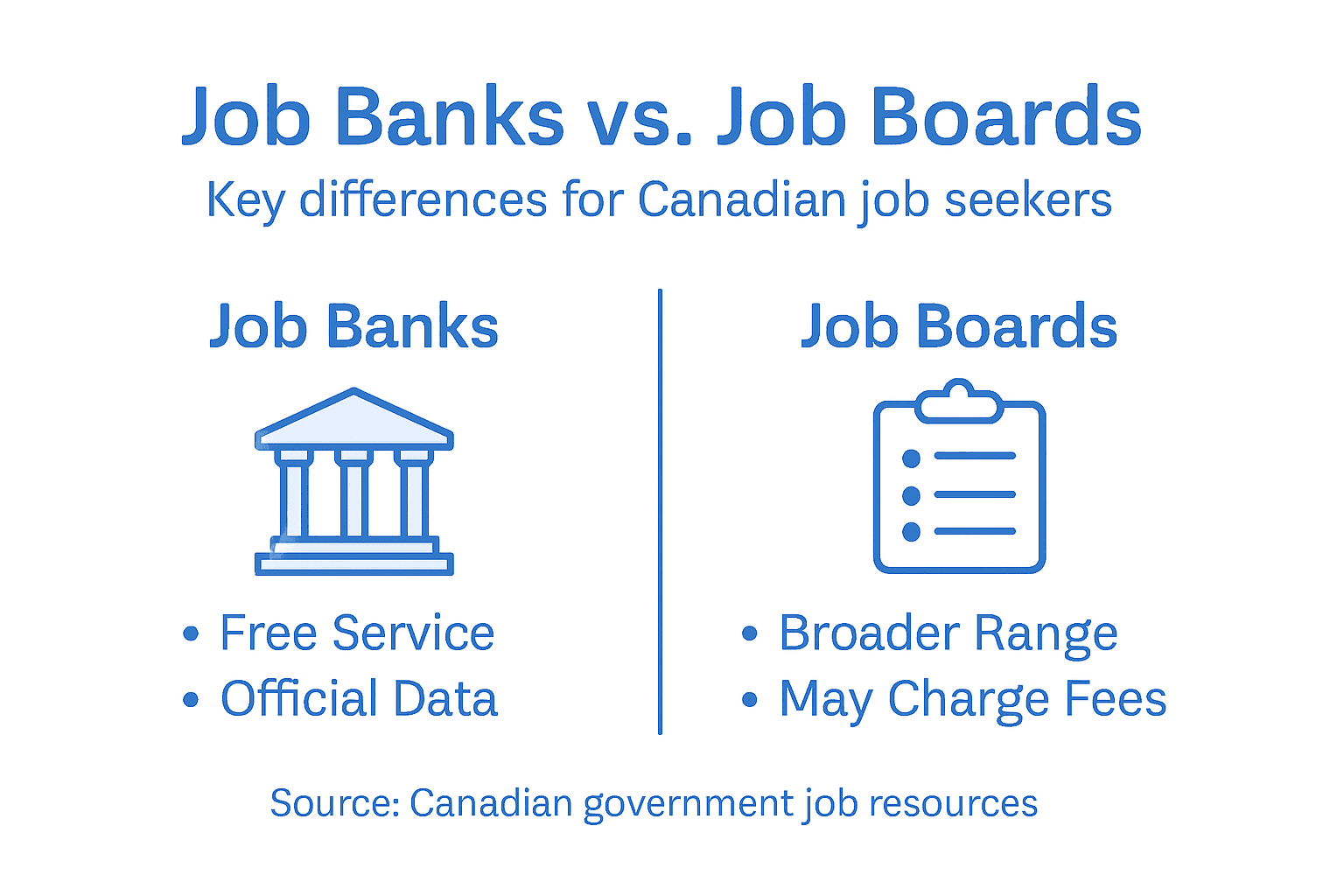
The job search landscape includes two distinct categories of platforms, each with fundamentally different operating models. Government job banks like the Canadian Job Bank are publicly funded and operated by federal or provincial governments. They consolidate listings from public sector employers and provincial partners into a single, free-to-use database. Private job boards, by contrast, are commercial enterprises operating for profit. Platforms like Indeed, Monster, and LinkedIn operate business models centered on generating revenue through job postings, premium features, or advertising. Understanding these structural differences helps you make informed decisions about which platforms deserve your time and attention.
The Canadian Job Bank consolidates public sector and provincial listings into a federally managed platform, whereas private boards like Indeed accept listings from any employer willing to pay or use their free posting options. This creates a fundamental difference in content curation. Job banks prioritize official, government-vetted positions and tend to exclude scams because they have institutional accountability. Private boards cast a wider net and accept virtually any employer posting, which gives you access to more opportunities but also introduces risk. Some private boards require you to verify job legitimacy yourself, whereas government job banks handle that screening upfront. This doesn’t mean private boards are inherently unsafe, but it does mean you need additional caution when applying through them.
Cost structures differ significantly between these platform types. Government job banks are completely free to use for job seekers. You can post your profile, search listings, set up alerts, and apply to positions without paying a single dollar. Some private job boards offer free job searching, but many charge subscription fees for premium features like seeing who viewed your profile, advanced resume tools, or priority application status. Employers face different pricing models too. Posting to a government job bank is typically free or extremely low cost, while private boards can charge substantial fees per listing. This cost difference influences which employers use which platforms. Smaller companies and nonprofits may rely more heavily on government job banks because they can’t afford the posting fees on private boards. Larger corporations with recruitment budgets often post on both.
Security and legitimacy represent another crucial distinction. Government job banks operate under strict federal oversight and privacy regulations. If something goes wrong, you have recourse through government channels and ombudsman offices. Private boards vary widely in their trustworthiness and security practices. While major platforms like Indeed have strong security measures, smaller private boards may not. Additionally, private job boards are more attractive targets for scammers because they attract large numbers of job seekers. Job bank fraud exists but is less common because government oversight creates accountability. When evaluating any platform, remember that the presence of detailed search filters or attractive design doesn’t guarantee legitimacy. A job bank’s simplicity reflects its focus on job matching, not its lack of sophistication.
The smart approach is using both types complementarily. Start with your provincial job bank and the federal Canadian Job Bank to access government positions and vetted listings. Then expand to private boards where you’ll find additional opportunities, particularly in specialized industries or with private sector employers. This combination captures the broadest possible range of positions while maintaining focus on legitimate opportunities. Recent graduates benefit especially from this dual approach because government job banks often feature entry level and apprenticeship positions, while private boards showcase corporate roles and industry specific positions. Career changers similarly should use both types to understand labor market trends and identify opportunities across different employer categories.
Pro tip: Start your job search with your provincial and federal job banks for verified listings, then add one or two major private job boards like GoHires or Indeed to expand your reach without limiting yourself to either platform exclusively.
Common Pitfalls and Success Tips for Users
Most job seekers make predictable mistakes that sabotage their search results. The biggest culprit is procrastination. You create a job bank profile with the best intentions, then weeks pass without checking it or applying to anything. Your alerts pile up in your email inbox unread. Meanwhile, positions get filled by candidates who actually took action. Common pitfalls for job seekers include procrastination, perfectionism, and failing to follow through on applications. Perfectionism compounds this problem. You spend hours crafting the ideal cover letter for one position while ignoring 20 other opportunities that would be good fits. You delay submitting your profile because you want to rewrite your work experience descriptions one more time. This paralysis kills momentum. The job market doesn’t reward perfection. It rewards action. Someone with an 80 percent polished application submitted today beats someone with a 100 percent perfect application submitted next month.
Another critical mistake is treating your job bank search as passive. You register, set up alerts, and expect opportunities to land in your lap. That’s not how successful job searching works. The candidates who get hired actively engage with job banks multiple times weekly. They refine their searches based on what they’re learning about the market. They update their profiles to reflect new skills or certifications they’ve acquired. They follow up on applications and reach out to recruiters. Passive job searching feels comfortable because it requires minimal effort, but it yields minimal results. Active job searching means spending at least 30 minutes daily on your search. You’re reading job descriptions to understand what employers actually want. You’re noting patterns in required skills. You’re tailoring your application materials to specific positions rather than sending identical materials everywhere.
Strategic targeting separates successful job seekers from those who struggle. Instead of applying to every position remotely similar to what you want, focus on roles that genuinely fit your background and goals. Read job descriptions thoroughly to understand what hiring managers prioritize. When you find a strong match, customize your resume and cover letter to address their specific requirements. This approach takes more time per application but generates significantly higher callback rates. You’ll spend more energy on fewer applications, but those applications will be far more competitive. Many job seekers spread themselves too thin by applying to 30 positions in one week with generic materials. Better to apply to 5 positions with customized, thoughtful materials that demonstrate you’ve actually read what the employer is seeking.
Success also requires persistence combined with strategic evaluation. You should expect rejection. Most job applications don’t result in interviews. This isn’t personal. Hiring managers review hundreds of applications for single positions. Some rejections mean your qualifications don’t match. Others mean someone else’s background was slightly stronger. Keep applying regardless. Every application is practice. Every interview is experience. But periodically step back and evaluate whether your overall approach is working. After applying to 20 positions with minimal response, something needs adjustment. Maybe your resume isn’t clearly communicating your value. Maybe you’re targeting positions too senior for your background. Maybe you need additional training in a particular area. The difference between persistence and stubbornness is willingness to learn and adjust based on results. Persistent job seekers who aren’t getting results make changes. Stubborn ones keep doing the same thing and expect different outcomes.
Building Momentum Through Structured Effort
Create a specific, written job search plan rather than winging it. Document how many applications you’ll submit weekly, which job banks you’ll use, what time you’ll dedicate to searching, and what improvements you’re making to your materials. This structure transforms job searching from an overwhelming, vague task into manageable daily actions. You’re not trying to “find a job.” You’re completing five targeted applications by Wednesday while also updating your LinkedIn profile by Friday. Small, concrete actions compound into results.
Pro tip: Set a weekly goal of submitting five customized applications to roles that genuinely match your qualifications, then spend 30 minutes monthly reviewing which types of positions generated interviews to refine your targeting strategy.
Unlock More Opportunities Beyond Job Banks with Gohires
Navigating the Canadian job market through government job banks can be overwhelming and sometimes limiting due to complex registration processes and incomplete listings. Many job seekers face challenges like setting up detailed profiles, relying only on one platform, or missing out on specialized roles. Gohires.com understands these pain points and offers a simplified, comprehensive job search platform that complements traditional job banks by providing thousands of verified job listings across Canada. Whether you are seeking full-time, part-time, internships, or freelance positions, Gohires enables you to search by keywords, location, and employment type without unnecessary hassle.
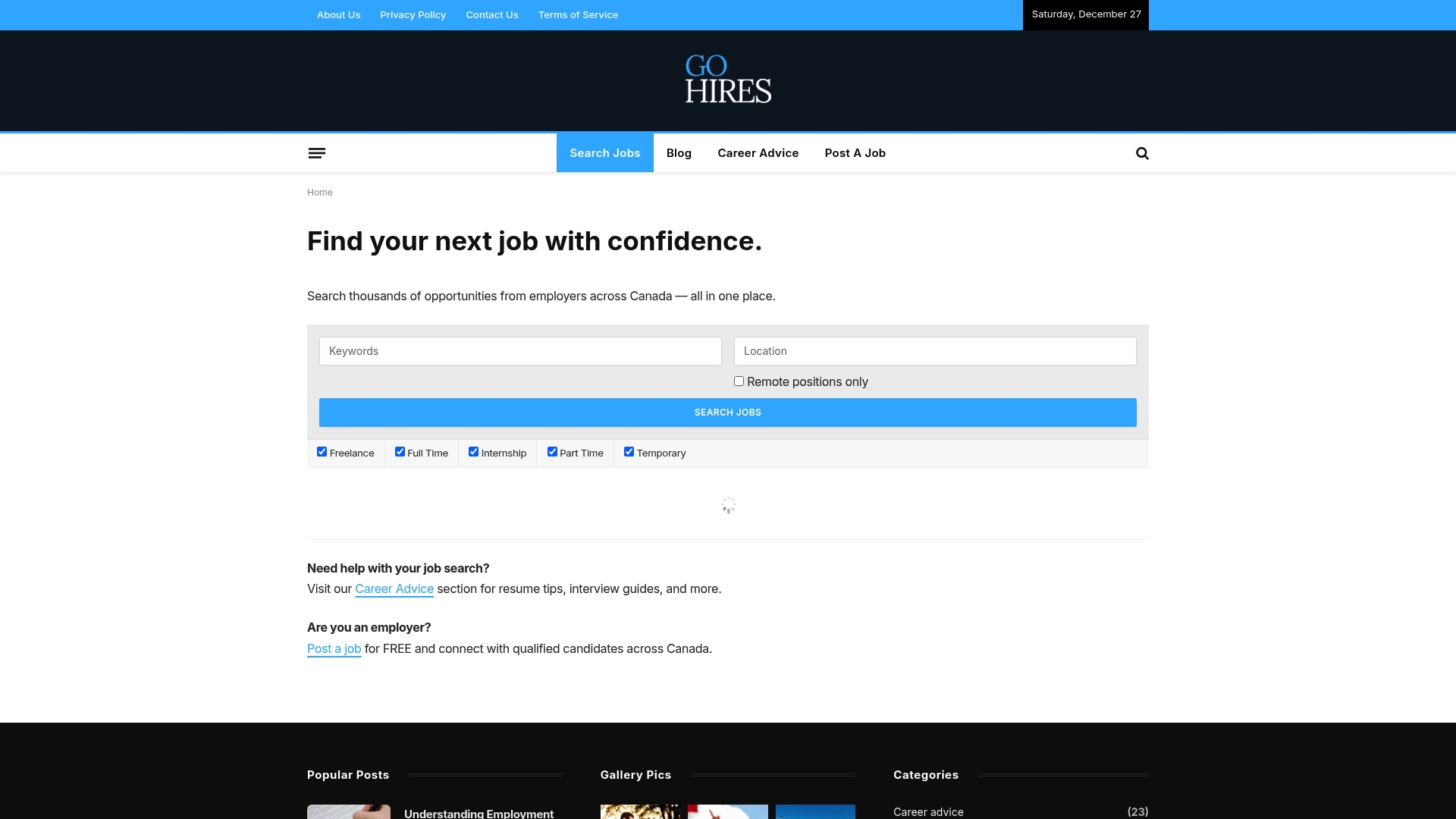
Ready to take control of your employment journey and find opportunities that fit your unique skills and goals? Visit Gohires.com today and explore a platform designed with job seekers in mind. Create your profile, browse trusted openings, and access helpful career resources to make your job search active and effective now.
Frequently Asked Questions
What is a job bank?
A job bank is an organized database of employment opportunities maintained by government agencies or third-party organizations, serving as a centralized hub where employers post job openings and job seekers can search for available positions.
How do job banks differ from regular job boards?
Job banks typically focus on official labor market data and require user registrations that include sensitive personal information. In contrast, regular job boards often feature a broader range of listings that may not be verified or vetted by government standards.
What types of positions can I find on a job bank?
Job banks provide access to a wide variety of positions, particularly those in the public and government sectors, though they may not capture every job available in a specific region, as some employers post jobs directly on their websites or through private agencies.
How can I maximize my job search using a job bank?
To maximize your job search, create a comprehensive profile, set up job alerts for positions matching your criteria, and combine job bank use with direct applications to company websites and networking to enhance your visibility and opportunities.




1 Comment
Pingback: What Is Labour Market Information? A 2026 Career Guide