

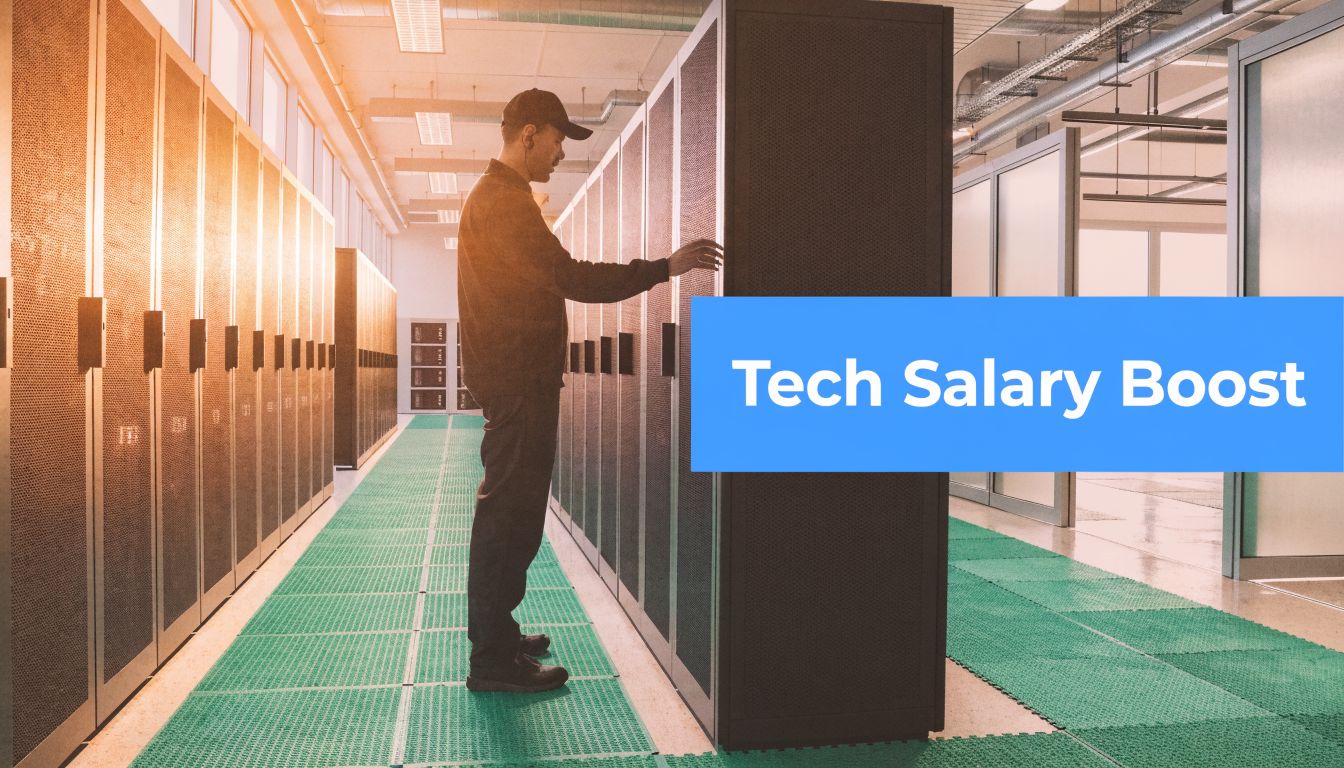
A 43% salary surge over the past three years as of 2025 changed the way many professionals should think about the data center technician salary conversation, especially as AI infrastructure buildouts and talent shortages keep pushing demand higher (Work in Data Center salary guide). This is no longer a narrow facilities job. It sits at the point where cloud operations, power systems, physical infrastructure, and uptime discipline meet.
For international job seekers, that matters because data center work is both local and global at the same time. The servers are on-site. The hiring competition, compensation benchmarks, and career paths are increasingly international. If you want to compare the United States with Canada, the UK, Australia, or the UAE, you need labor market context as much as salary data, which is why understanding labour market information is essential before making a relocation or training decision.
Table of Contents
- The Booming Demand for Data Center Technicians
- Data Center Technician Salary Benchmarks Across Global Markets
- Key Factors That Drive Your Salary Higher
- Salary Progression by Experience Level and Title
- Comparing Pay Across Top Hiring Sectors
- Understanding Your Total Compensation Package
- How to Negotiate Your Salary and Advance Your Career
- Frequently Asked Questions About Data Center Careers
The Booming Demand for Data Center Technicians
The strongest signal in this market isn't a hiring slogan. It's pay. The data center technician salary has climbed sharply because operators need people who can keep physical infrastructure stable while AI and cloud workloads expand. The role has become harder to fill precisely because it combines hands-on technical work with discipline under pressure.
Entry points remain accessible, but the upside is better than many people assume. Entry-level positions start at $45,000 to $57,000 annually, while senior technicians with deeper experience move into materially higher ranges, and lead or principal paths go higher still (Work in Data Center salary guide).
Why this job has become more valuable
A data center doesn't care whether the outage happens at noon or 3 a.m. Someone still has to respond. That creates demand for technicians who can troubleshoot hardware, monitor facility conditions, document incidents, and work cleanly inside strict uptime procedures.
Three forces are shaping the role:
- AI infrastructure growth: More compute means more racks, more thermal management, and more operational risk.
- 24/7 operational requirements: Employers need technicians who can handle shift-based environments without losing accuracy.
- Cross-disciplinary work: The best technicians don't just swap hardware. They understand networking basics, facilities behavior, escalation paths, and documentation standards.
The fastest-growing technical roles often aren't the most visible. They're the roles companies can't scale without.
Why international readers should pay attention
For professionals in Canada, the UK, Australia, and the UAE, the global lesson isn't that every market pays the same. It doesn't. The lesson is that data center experience travels well when it's tied to recognizable skills, certifications, and operating discipline.
That makes this field unusually practical for people planning a move, switching from adjacent IT work, or building a long-term infrastructure career.
Data Center Technician Salary Benchmarks Across Global Markets
A technician earning around the US median of $65,500 can see a meaningfully different pay outcome by crossing either a state line or a national border. That is the central salary fact in this occupation. The title travels well, but the market rate depends heavily on data center density, employer mix, and how each country prices shift-based infrastructure work.
The US remains the clearest benchmark because the available salary data is deeper and easier to verify. For Canada, the UK, Australia, and the UAE, a useful comparison still exists if you treat US pay as an anchor and then adjust for local hiring concentration, compensation norms, and cost structure rather than waiting for perfectly matched datasets that often do not exist.
What the US benchmark actually tells you
The national midpoint gives you a starting price for the role. The bigger lesson is dispersion. Secondary US markets tend to pay less than major infrastructure hubs, while hyperscale-heavy regions price the same title higher because operators compete for technicians who can work safely, document accurately, and respond on shift without slowing uptime-sensitive work.
That pattern matters internationally. A technician evaluating Toronto, London, Sydney, Dubai, Indianapolis, or Northern Virginia should focus less on the job title and more on market maturity. Mature markets usually have more facilities, more specialized teams, and more employers bidding for the same proven skill set.
2026 Median Data Center Technician Salary by Experience and Location
| Country/Region | Entry-Level (0-2 Yrs) | Mid-Level (3-6 Yrs) | Senior (7+ Yrs) |
|---|---|---|---|
| United States national benchmark | $45,000-$57,000 | $61,593 | $70,833 to $99,200 |
| United States secondary market example, Indianapolis | Below national benchmark | Below national benchmark | Below major hub levels |
| United States primary hub example, San Jose market | Above national benchmark | Above national benchmark | Premium above national benchmark |
| Canada | Lower than top US hubs, often strongest near Toronto, Montreal, and major colocation corridors | Tracks local infrastructure concentration and employer scale | Can approach lower-to-mid US ranges at larger operators |
| United Kingdom | Often moderated by local pay norms, with stronger pricing near London and major interconnection sites | Better at providers with 24/7 operations and larger estates | Senior pay improves most in dense enterprise and colocation clusters |
| Australia | Stronger in Sydney and Melbourne, where facility demand is concentrated | Mid-career pay benefits from limited talent supply in major metros | Senior technicians can command clear premiums in high-uptime environments |
| UAE | Frequently shaped by expat hiring, allowance structures, and large project-based demand in Dubai and Abu Dhabi | Mid-level compensation varies sharply by operator and package design | Senior roles can compare well once housing or transport support is included |
The non-US rows are directional by design. They are not placeholders. They reflect how these labor markets usually price infrastructure operations relative to the better-documented US benchmark, while avoiding fake precision.
How to read this as a global job seeker
International comparison gets more accurate when you separate cash salary from market structure. Canada and Australia often reward technicians in a smaller number of concentrated metros. The UK can look softer on base pay, but dense interconnection markets still support better senior opportunities. The UAE needs a different lens altogether because allowances, tax treatment, and relocation support can change the actual value of an offer more than the headline salary.
That is why two offers with similar base pay can produce very different career outcomes.
Use four filters before you compare countries or cities:
- Market concentration: More facilities in one corridor usually means more hiring options and better salary power.
- Operator type: Hyperscalers, colocation firms, and enterprise sites often pay differently for similar hands-on work.
- Promotion path: A market with clearer steps into senior technician, facilities, or network-support work can outperform a slightly higher starting salary.
- Mobility value: Skills tied to cabling standards, incident response, hardware deployment, and security discipline tend to transfer best across borders. Strong documentation habits and practical IT security tips also matter more than many candidates expect.
A sensible next step is to compare local openings against broader compensation references such as a complete salary database for cross-market pay research so you can spot whether an offer reflects the city, the employer, or a shortage in a niche skill area.
Practical rule: Markets with higher critical infrastructure density, heavier shift coverage, and stronger hyperscale presence usually give technicians more negotiating power.
Key Factors That Drive Your Salary Higher
Salary growth usually follows risk, complexity, and scarcity. Employers pay more when a technician can keep critical infrastructure stable, solve incidents with less supervision, and cover work that is expensive to leave unfilled across major data center markets such as the US, Canada, the UK, Australia, and the UAE.

Certifications reduce hiring risk
Certifications often raise pay because they give employers faster evidence of capability. A CCNA, vendor hardware credential, or facilities-related certification signals that you can work within documented standards, troubleshoot under pressure, and communicate in the language used by network and operations teams.
The bigger point is not the certificate itself. It is the reduction in perceived risk.
That matters more in larger data center markets, where operators hire at scale and need consistent screening signals. It also helps with cross-border mobility. A technician moving from the US or Canada into roles in the UK, Australia, or the UAE often finds that recognizable certifications travel better than employer-specific job titles.
Scarce technical scope raises your ceiling
Technicians who stay limited to basic rack-and-stack work tend to face a lower pay ceiling than those who add harder-to-source skills. The strongest premiums usually show up in work tied to networking, power, cooling, structured troubleshooting, and incident response because mistakes in those areas carry higher operational cost.
A useful way to judge your market value is to ask which failure points you can handle without waiting for escalation. If you can validate ports, trace cabling faults, support hardware deployment, read facility dependencies, and document corrective actions clearly, you become more useful on busy shifts and more competitive for higher-paid roles.
These skill areas usually matter most:
- Networking depth: Switch configuration basics, port validation, cabling standards, and fault isolation.
- Critical environment awareness: UPS behavior, cooling dependencies, maintenance windows, and escalation discipline.
- Change control and documentation: Accurate asset logs, clean handoffs, and incident notes that reduce repeat errors.
- Security judgment: Access control, chain of custody, and safe operating habits. Employers increasingly value technicians who pair physical-site discipline with practical IT security tips.
Shift structure and site complexity affect pay more than title alone
A "data center technician" title does not describe one standard job globally. A technician in a hyperscale site with 24/7 coverage, strict service levels, and dense hardware turnover is often doing more difficult work than someone with the same title in a smaller enterprise environment.
That difference shows up in compensation over time. Hard-to-fill night coverage, higher incident volume, stricter uptime requirements, and exposure to multiple infrastructure layers all tend to support stronger pay. This helps explain why two roles with similar titles can diverge meaningfully across countries and employers, even before bonuses or allowances are considered.
Employer type shapes long-term earnings
Hyperscalers, colocation operators, telecom infrastructure firms, and enterprise data centers do not reward the same profile in the same way. Large operators often pay more for process discipline and scale readiness. Smaller environments may offer broader hands-on exposure, which can improve your next salary step even if the first offer is lower.
For career planning, the best choice is often the role that compounds transferable experience. A technician who can point to audited procedures, incident participation, hardware refresh cycles, and cross-team coordination usually has stronger bargaining power in international hiring markets than someone who stayed in a narrower support function.
Salary Progression by Experience Level and Title
A long data center career usually pays better, but the pay curve is moderate until scope changes. Coursera's salary analysis places 0 to 1 year data center technicians at $54,726 and professionals with 15+ years at $70,833, which is a 29% increase across the experience range (Coursera salary analysis). That gap matters, but the larger jumps often come from title changes and responsibility expansion rather than tenure alone.

A practical career ladder
Across the US, Canada, UK, Australia, and UAE, employers use different titles for similar work. The pattern is still consistent. Pay rises fastest when a technician moves from task execution into independent fault isolation, then into shift ownership or site-level coordination.
| Title | Typical focus | Salary signal from verified data |
|---|---|---|
| Entry-Level Technician | Rack and stack, cabling, basic swaps, monitoring, documentation | Entry-level benchmark starts around $45,000 to $57,000 and averages $54,726 in the cited entry comparison |
| Mid-Level Technician | Independent troubleshooting, incident participation, cross-team coordination | Coursera's experience breakdown shows higher averages as technicians move beyond the first few years and take on broader operational work (Coursera salary analysis) |
| Senior Technician | Escalation handling, training juniors, deeper infrastructure ownership | Coursera lists 10 to 14 years at $65,536 and 15+ years at $70,833, reflecting stronger pay for technicians trusted with wider operational responsibility (Coursera salary analysis) |
| Lead or Principal Technician | Shift leadership, operational oversight, higher-stakes responsibility | Lead and principal roles usually sit above senior technician because employers are paying for judgment, coordination, and accountability, not only hardware skill |
| Day Engineer | Broad operational accountability in demanding environments | DataX Connect places Day Engineer compensation at $105,000 in its market data for data center roles (DataX Connect salary guide) |
The title ladder is not perfectly standardized internationally. A senior technician in one market may be close to a lead in another, especially in the UAE or at large colocation campuses where shift ownership starts earlier. For relocation planning, compare the actual duties first, then the title.
What changes at senior level
Senior pay follows risk control. Employers pay more when a technician can resolve incidents with less supervision, write clean handoffs, work confidently in DCIM and ticketing systems, and reduce repeat failures by spotting patterns early.
This is why many technicians plateau after the first few years.
Someone who stays limited to swaps, escorts, and basic monitoring can add experience without adding much salary power. Someone who can show evidence of incident response, maintenance coordination, vendor management, MOP adherence, and junior mentoring is easier for hiring managers to place into higher bands across multiple countries.
For international mobility, this distinction matters even more. Titles translate poorly across borders. Documented responsibilities travel well. If you are targeting the US, Canada, the UK, Australia, or the UAE, keep a record of outage participation, shift coverage, change work, audit exposure, and any responsibility for critical environment procedures. Those details make your experience legible to foreign employers and strengthen your case for a higher starting offer.
Comparing Pay Across Top Hiring Sectors
Sector choice shapes pay because employers value different kinds of risk, uptime exposure, and operational complexity. A technician at a hyperscale site is usually supporting larger volumes of equipment, stricter change control, and higher incident pressure than someone in a smaller enterprise environment. Those differences affect both salary ceilings and the type of experience that carries well across borders.

Hyperscale versus colocation versus enterprise
Hyperscale employers often pay more for operational intensity. The work is narrower in some roles, but the environment is demanding. Technicians are expected to handle high ticket volume, strict procedural compliance, and fast recovery expectations in facilities where downtime costs are significant.
Colocation providers usually offer a different tradeoff. Pay can be competitive, and the skill mix is often broader because technicians support multiple customer setups, remote hands requests, and varied hardware standards. That variety can be useful for career mobility, especially for candidates targeting moves between the US, Canada, the UK, Australia, and the UAE, where employers may use different titles for similar work but consistently value evidence of broad site exposure.
Enterprise roles tend to be more stable and more limited in scope. They can suit technicians who prefer predictable stakeholder relationships and lower operational volatility. The tradeoff is that salary growth may be slower if the role does not include meaningful incident ownership, vendor coordination, or critical environment work.
Cross-industry data also shows that data center pay is not confined to pure technology companies. Glassdoor sector comparisons for data center technicians show higher reported total pay in industries such as financial services, staffing, and real estate, which reflects how widely these skills are used beyond cloud and colocation environments (Glassdoor data center technician salary by industry).
A practical way to compare sectors
Use the operating model, not the brand name, as your filter:
- Choose hyperscale if you want exposure to large-scale operations, stricter process discipline, and stronger long-term upside in senior technical or site operations paths.
- Choose colocation if you want wider hardware exposure, customer interaction, and experience that transfers well across employers and countries.
- Choose enterprise if you want a steadier environment and a role that may align better with internal infrastructure or facilities-focused careers.
A useful test is to ask what the job will let you prove after 18 to 24 months. If the answer is faster incident handling, better change execution, cleaner documentation, and more responsibility during critical events, the role is likely to improve your market value. If the answer is mainly routine swaps and monitoring, the sector may be stable but less effective for salary growth.
The highest-paying sector on paper is not always the best move. The stronger choice is the one that builds experience other employers can price at a higher rate in your next market.
Understanding Your Total Compensation Package
A technician offer can look average on base pay and still be the better financial move. In high-cost, high-demand markets, a large share of earnings often comes from overtime, bonuses, equity, and employer-funded benefits rather than the salary line alone.
The San Jose example shows why this matters. Indeed's data center technician salary benchmark for the San Francisco Bay Area reports average total compensation of $157,659, far above the U.S. norm. For technicians comparing U.S. hubs with markets such as Toronto, London, Sydney, or Dubai, that gap is a reminder to compare whole packages, local costs, and tax treatment together rather than treating headline salary as the full answer.
Why base salary can distort the comparison
Data center work is operational by nature. Sites run 24/7, outages carry business risk, and employers often pay for schedule flexibility, urgent coverage, and retention in hard-to-staff locations.
That means two offers with similar base pay can produce very different first-year earnings.
A U.S. hyperscale role may include stock and bonus upside. A UAE offer may rely more heavily on cash pay and allowances. In Canada, the UK, and Australia, the package may look less aggressive on variable pay but stronger on leave, retirement contributions, or schedule quality. For international job seekers, this is the practical question: not which number is highest on paper, but which package leaves you with the strongest net value after taxes, housing, transport, and career progression.
How to assess the full package
Review each offer in layers:
- Base salary: Fixed cash pay and the benchmark employers use for raises.
- Overtime and on-call earnings: Often a major income driver in 24/7 environments.
- Bonus structure: Ask whether it is guaranteed, discretionary, or tied to site and company performance.
- Equity or stock awards: More common at large U.S. technology employers than in other markets.
- Shift design: Nights, weekends, compressed schedules, and travel time all affect the actual value of the role.
- Benefits: Health insurance, pension or retirement match, visa support, paid leave, and training budgets can materially change the package.
- Relocation terms: For cross-border moves, housing support, flights, temporary accommodation, and immigration costs matter as much as salary.
Use a data center salary calculator to model the package before you compare offers across cities or countries.
One more filter improves the decision. Separate immediate pay from future pricing power. A role with slightly lower cash compensation may still be stronger if it gives you documented incident ownership, vendor coordination, DCIM exposure, or experience supporting higher-availability environments. Those skills tend to transfer across employers and across borders more effectively than a short-term pay premium.
Assess the package in three parts: what you earn now, what you keep after local costs, and what this role lets you command in your next market.
How to Negotiate Your Salary and Advance Your Career
Most technicians under-negotiate because they describe tasks instead of business value. Employers don't pay more because you "worked hard." They pay more when your experience lowers risk, shortens recovery time, improves documentation quality, or lets a site trust you with more responsibility.

Negotiate with evidence not emotion
Build your case around role fit and market alignment. If you're certified, working in a high-demand hub, or moving toward specialized facility or network responsibilities, say so directly and tie it to the market benchmark that matches your profile.
A useful preparation checklist:
- Benchmark your current level: Compare your pay to verified ranges for entry, senior, lead, or specialized roles.
- Translate duties into outcomes: Mention incident ownership, escalation handling, DCIM familiarity, or cross-functional coordination.
- Price the whole package: Don't negotiate base salary in isolation.
- Know your walk-away point: If the site offers weak progression, that matters as much as the first-year number.
If you want a quick way to frame numbers before a conversation, a salary calculator can help you organize location, role, and compensation inputs.
Use your next role to set up the one after that
Promotion strategy matters. A role that adds better systems exposure can be worth more than a slightly higher starting figure.
This short video offers a useful mindset for career growth in technical environments:
Aim for one move at a time. First become the technician people trust with critical work. Then become the technician who can coordinate it. Then move toward lead, day engineer, or operations management if that track fits you.
Frequently Asked Questions About Data Center Careers
Across the five markets covered in this guide, one pattern holds: data center work rewards technical reliability, shift flexibility, and skills that transfer across employers and borders. These questions address the practical issues that usually shape entry, pay growth, and relocation decisions.
Common Questions for Data Center Technicians
| Question | Answer |
|---|---|
| 1. Is data center technician a good career? | Yes, especially for people who want a direct path into infrastructure without waiting for a long credential cycle. The role can lead to better-paid work in operations, networking, facilities, cloud support, or site leadership once you build a record in uptime-critical environments. |
| 2. Do I need a degree? | A degree helps in some larger employers, but it is rarely the main screening factor for technician roles. Hiring managers usually put more weight on hardware handling, ticket discipline, safety awareness, and proof that you can work reliably in a 24/7 operation. |
| 3. Which certification helps most with pay? | No single certification raises pay in every market. In practice, the best return usually comes from the credential that matches the work you want next: networking certifications for cable and switch-heavy roles, vendor or facility training for critical environment work, and structured operations credentials for employers that value process control. |
| 4. Is the work remote? | Core technician work is primarily on-site because servers, racks, power systems, and physical incidents need hands-on support. Remote options are more common in coordination, monitoring, documentation, or higher-level infrastructure roles. |
| 5. Is the job physically demanding? | Often, yes. The work can involve lifting equipment, tracing cabling, standing for long periods, and moving through hot or noisy environments while following strict access and safety procedures. |
| 6. What schedules are common? | Shift patterns are standard because data centers run continuously. Depending on the employer and country, that can mean rotating shifts, overnight coverage, weekend work, and on-call responsibilities tied to incidents or maintenance windows. |
| 7. Which markets pay the most? | Pay is usually strongest in markets where data center capacity, cloud investment, and cost of labor are all high. In this article's cross-country comparison, the US tends to offer the highest ceiling, while Canada, Australia, the UK, and the UAE each have different trade-offs in taxes, allowances, overtime practices, and progression speed. For relocation decisions, base salary alone is not enough. |
| 8. Can this lead to higher roles? | Yes. Common next steps include senior technician, lead technician, day engineer, facilities specialist, network-focused support roles, and operations management. The fastest progression usually goes to technicians who add ownership, not just years served. |
| 9. Does AI threaten this job? | AI changes demand more than it removes demand. As AI workloads expand, employers need more power, cooling, hardware deployment, maintenance discipline, and site uptime support. That tends to increase the value of technicians who can work in high-density environments. |
| 10. Can I use this role to move internationally? | Yes, if your experience is portable and clearly documented. Employers across the US, Canada, the UK, Australia, and the UAE tend to recognize incident response, rack and stack work, structured maintenance, DCIM exposure, vendor coordination, and compliance-focused operating habits more easily than internal job titles. |
International mobility depends on translation as much as experience. If you plan to move countries, rewrite your resume around tasks and systems that another employer can verify quickly, such as ticket volumes handled, maintenance routines followed, uptime-sensitive work, and equipment types supported.
Go Hires helps professionals compare international job markets with clearer salary benchmarks, role analysis, and career planning tools. If you're evaluating your next move in data center operations, cloud infrastructure, or technical facilities work, explore Go Hires for research-driven insights that support smarter global career decisions.
1 Comment
Pingback: AI Data Centre Careers in Canada: Jobs, Pay & Skills