

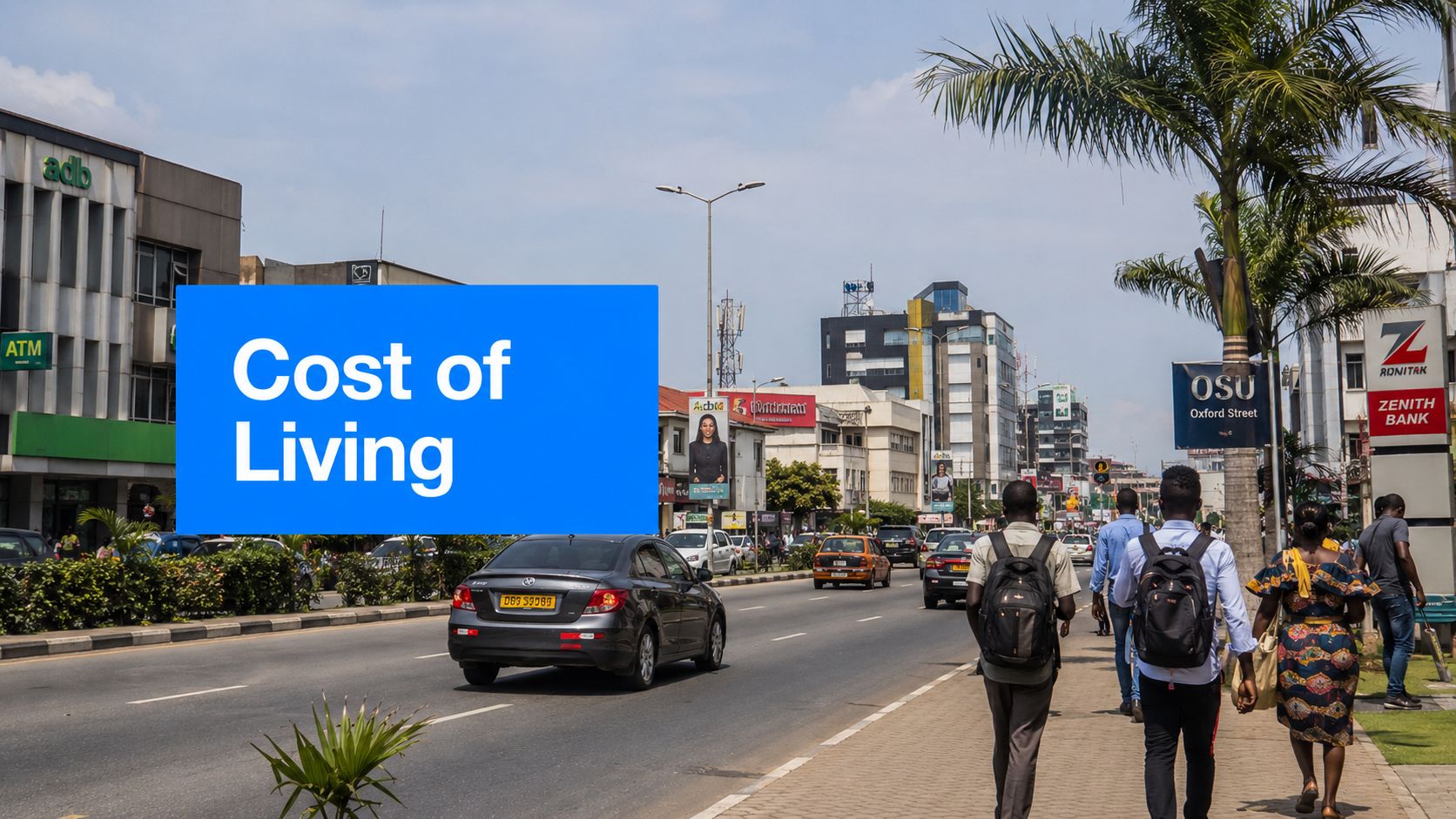
Ghana doesn't fit the usual “cheap African market” stereotype. In 2025, Business Insider Africa reported that Ghana ranked 12th out of 23 African countries for the highest cost of living, even as inflation eased, based on Numbeo data and national inflation reporting in the same coverage (Business Insider Africa on Ghana's cost-of-living ranking and inflation trend).
That single data point changes how professionals should think about a move. The right question isn't whether Ghana is cheap. It's which part of Ghana you'll live in, and which expenses can move against you after you arrive. National averages flatten the two things that matter most in practice: the gap between Accra and lower-cost cities, and the fact that utilities, transport, and imported goods don't behave like fixed line items for long.
For job seekers, remote workers, and internationally mobile professionals, that makes the cost of living in Ghana less of a price list and more of a budgeting problem. Housing can dominate one household's finances. Internet and utilities can surprise another. A role that looks attractive on headline salary can feel tight once rent enters the picture. A lower salary in a secondary city can sometimes leave more room than a higher one in the capital.
This guide treats Ghana the way a market analyst would. It focuses on budget structure, city choice, and expense volatility, then translates that into practical decisions you can use.
Table of Contents
- Your Guide to the Real Cost of Living in Ghana
- Understanding Ghana's 2026 Economic Climate
- A Detailed Breakdown of Monthly Expenses
- City Showdown Accra vs Kumasi vs Takoradi
- Salary Benchmarks for In-Demand Professionals
- Sample Monthly Budgets for Three Lifestyles
- Practical Cost-Saving Tips for New Arrivals
- Frequently Asked Questions About Living in Ghana
- 1. Is Ghana affordable for foreign professionals?
- 2. What is the biggest cost driver in Ghana?
- 3. Is Accra much more expensive than the rest of Ghana?
- 4. Are groceries cheap in Ghana?
- 5. Is internet reliable enough for remote work?
- 6. Should I budget in cedi or in a foreign currency?
- 7. How much emergency buffer should I keep?
- 8. Is Ghana cheaper than the United States?
- 9. What kind of salary package should I negotiate?
- 10. Is Ghana a good option for remote workers?
Your Guide to the Real Cost of Living in Ghana
Most cost guides answer the wrong question. They tell you what “Ghana” costs, as if a national average captures what you'll spend. It doesn't. The cost of living in Ghana changes sharply by city, neighborhood, and how dependent you are on imported goods and infrastructure-linked services.
That's why housing matters more than headline salary. A compensation package that looks strong on paper can tighten fast if you choose a premium area in Accra. By contrast, someone earning less but living outside the capital may keep more cash flow available for savings, travel, or family support.
A second mistake is treating monthly costs as static. In Ghana, food, transport, rent, utilities, and internet don't all move in the same way. Some are relatively predictable once you settle in. Others can shift with inflation, supply conditions, or your dependence on imported products.
A more useful way to budget
A practical relocation budget in Ghana should answer three questions:
- Where will you live: Accra usually creates the highest housing pressure, while secondary cities tend to reduce that burden.
- What will you consume locally: The more you rely on local markets, local dining, and locally anchored services, the more resilient your budget tends to be.
- How much flexibility do you need: If your income is fixed but your essential costs move, you need slack in the plan.
Bottom line: In Ghana, location choice often changes your budget more than lifestyle tweaks do.
That's the core lens throughout this guide. Instead of piling up generic averages, the analysis focuses on the budget categories that can materially change your financial outcome after a move.
Understanding Ghana's 2026 Economic Climate
Inflation slowed to 18.4% in May 2025, down from 21.2% in April, but that improvement does not make budgeting in Ghana straightforward. For relocation planning, the more useful question is where prices remain exposed to volatility and how sharply costs change between Accra and other cities.
That distinction matters because a lower inflation rate only shows that prices are rising more slowly than before. It does not reverse earlier increases, and it does not reduce the pressure created by city-specific rent levels, utility instability, or dependence on imported goods. As noted earlier, Ghana still sits relatively high in regional cost comparisons even after inflation eased.

Why the 2026 climate matters for your budget
For professionals considering a move, Ghana's cost structure is better understood as two separate systems.
The first is location-driven. Accra carries a premium because it concentrates corporate jobs, international schools, expat-targeted housing, and higher demand for imported products and private services. Secondary cities such as Kumasi or Takoradi often reduce pressure on housing and some service costs, even when day-to-day spending patterns look similar on paper.
The second is volatility-driven. Some expenses stay relatively stable once you settle into a neighborhood and routine. Others can shift faster because they depend on fuel, imported supply chains, exchange-rate pressure, or infrastructure reliability. That is why two households with similar salaries can experience very different monthly cash flow.
Averages miss both patterns.
Which costs are most exposed to change
For 2026 planning, four categories deserve closer attention than headline inflation:
- Housing: The largest gap is usually between Accra and elsewhere, not between modest and premium lifestyles within the same city.
- Utilities: Bills can move with usage, service quality, and backup power needs, especially for households that cannot tolerate outages.
- Imported groceries and household goods: Spending rises quickly if you rely on foreign brands, specialty retail, or expat-oriented supermarkets.
- Transport: Your monthly cost depends less on national inflation than on commute distance, fuel exposure, and whether you use ride-hailing, public transport, or a private car.
This is also why relocation budgets built from static national averages often fail in practice. A candidate who chooses central Accra and shops mainly for imported goods is exposed to a very different cost profile from someone living in Kumasi with a more local consumption pattern.
A good cross-check is to compare your assumptions with relocation frameworks such as Koru's guide to monthly expenses, then pressure-test the variable categories rather than relying on one blended monthly number.
The practical takeaway is simple. Build your Ghana budget around city choice and volatility risk first, then adjust lifestyle spending after that.
For salaried professionals, that usually means keeping extra room for utilities, transport, and import-sensitive purchases, especially if compensation is fixed and does not include housing support.
A Detailed Breakdown of Monthly Expenses
The cleanest starting point comes from broad household estimates. Wise's 2026 Ghana estimates put a single person at about £501 per month excluding rent, and a family of four at about £1,821 excluding rent. A 1-bedroom apartment in the city centre averages £377.13 per month, compared with £199.49 outside the centre. Basic utilities for an 85m² apartment average £46 per month, and internet averages £33 per month (Wise cost-of-living estimates for Ghana).
Those figures immediately show the central truth of the cost of living in Ghana. Rent isn't a side cost. It's often the cost that determines whether your budget feels comfortable or constrained.
What a baseline monthly budget looks like
Here's a practical summary using the verified benchmarks above.
| Expense category | Benchmark |
|---|---|
| Single person monthly costs excluding rent | £501 |
| Family of four monthly costs excluding rent | £1,821 |
| 1-bedroom apartment in city centre | £377.13 |
| 1-bedroom apartment outside centre | £199.49 |
| Basic utilities for 85m² apartment | £46 |
| Internet | £33 |
For Accra specifically, Numbeo estimates monthly costs for a single person at $761.3 excluding rent and for a family of four at $2,836.8 excluding rent, which reinforces how much more expensive the capital can feel than broad national estimates suggest (Numbeo cost-of-living data for Accra).
Housing, utilities, food, and dining
Housing is where small decisions create large downstream effects. Moving outside the city centre doesn't just lower rent. It can change the total shape of your budget by freeing room for savings, coworking, private transport, or occasional travel.
Food costs sit on a second axis. The verified consumer benchmarks show:
- Inexpensive restaurant meal: about £4
- Mid-range three-course meal for two: about £31
Those prices make Ghana look affordable at first glance. For many professionals, everyday local dining can indeed be manageable. But that doesn't mean the whole food budget is low. Imported groceries and premium urban shopping habits can push spending up in a way that restaurant snapshots don't capture.
For readers building a working relocation spreadsheet, Koru's guide to monthly expenses is a useful companion because it helps structure recurring categories rather than focusing only on headline rent.
Practical rule: Build your Ghana budget in layers. Start with rent, then add utilities and internet, then model food in two versions, one local-leaning and one import-heavy.
A final point matters for compensation planning. Comparing salaries without isolating housing can produce the wrong conclusion. Two offers with similar gross pay can lead to very different living standards if one requires you to self-fund premium urban rent and the other doesn't.
City Showdown Accra vs Kumasi vs Takoradi
The biggest budgeting mistake in Ghana is treating every city as a smaller version of Accra. They aren't interchangeable. Accra is the country's most expensive reference point. Kumasi and Takoradi often offer a different cost structure, especially on housing and day-to-day convenience spending.
Verified city-level commentary points in the same direction. Expat-focused and local discussion consistently show that Accra carries a higher housing burden, while cities such as Sunyani and Kumasi can be materially cheaper. One Ghana-focused discussion explicitly describes Accra as “too much” compared with Sunyani and Kumasi, which captures the practical reality better than a national index does (local discussion highlighting the Accra versus secondary-city gap).
Where the biggest cost gap shows up
The most concrete city-specific data point in the verified set is from Accra. Expat Arrivals lists a 1-bedroom city-centre apartment in Accra at GHS 10,100, alongside basic utilities at GHS 840 and an uncapped internet plan at GHS 370. That's enough to show why city choice is the main budgeting lever for professionals considering Ghana.
| Expense Category | Accra (Capital City) | Kumasi (Cultural Hub) | Takoradi (Oil & Gas Hub) |
|---|---|---|---|
| Housing pressure | Highest. Verified Accra city-centre rent benchmark is substantial | Generally lower than Accra, based on local and anecdotal comparisons | Often below Accra, though location and industry demand matter |
| Utilities and internet | Can be a meaningful burden in expat-oriented areas | Usually easier to manage within a moderate budget | Mixed, with neighborhood and housing type driving outcomes |
| Dining and everyday spending | Wide spread between local and expat-style consumption | Better value for many locally anchored lifestyles | Moderate, often between Accra's premium market and lower-cost inland cities |
| Best fit | Corporate professionals, expats, multinationals, people who need central access | Remote workers, families, professionals prioritizing lower fixed costs | Energy-sector workers, professionals wanting a commercial city with lower pressure than Accra |
How to choose the right city for your budget
For most professionals, the decision is less about prestige and more about cost concentration.
- Choose Accra if your work depends on proximity to embassies, major offices, international schools, or a dense professional network.
- Choose Kumasi if you want lower fixed costs and can work with less need for capital-city access.
- Choose Takoradi if your role connects to the commercial and industrial economy but you still want some distance from Accra's rent intensity.
The useful conclusion isn't that Accra is “bad value.” It's that Accra demands a salary structure that can absorb urban housing and service costs. If your compensation doesn't do that, a secondary city may produce a much stronger financial outcome.
Salary Benchmarks for In-Demand Professionals
Cost data becomes useful only when paired with earnings. The challenge here is evidence discipline. The article brief includes salary figures for several professions in the required visual asset, but those figures are part of the visual specification rather than the verified data set. So the safest way to use them is to present the infographic as provided and keep the written analysis qualitative.

How to read salary numbers against living costs
The right way to evaluate a Ghana offer is net-of-housing, not headline pay. That means asking:
- Will the employer provide housing support or an allowance?
- Is the role based in Accra or a secondary city?
- Are utilities, transport, or internet partially covered?
- Is compensation fixed in local currency, foreign currency, or a mix?
Those details matter because fixed costs can behave very differently from gross salary expectations. A package that looks competitive can feel thin once urban rent and infrastructure-linked services are fully self-funded.
Professionals comparing roles across markets can use GoHires' salary database as a starting point for wider compensation benchmarking, especially when Ghana is one option among several destinations.
What this means for relocation decisions
Three patterns tend to separate good offers from weak ones.
First, city matters as much as title. A mid-level role in Accra may leave less disposable income than a similar role elsewhere if housing support is absent.
Second, benefits matter more than they appear. Internet support, transport assistance, and flexible work arrangements can materially change your effective budget.
Third, salary comparisons should reflect lifestyle assumptions. If you plan to live centrally, use premium connectivity, and consume imported goods regularly, you need to benchmark against that version of the cost of living in Ghana, not a stripped-down national average.
Compensation only tells the truth after you map it to place, rent, and routine.
Sample Monthly Budgets for Three Lifestyles
Budget examples work best when they illustrate trade-offs rather than pretending to predict everyone's exact spend. Ghana can be meaningfully cheaper than the United States overall, but verified comparative coverage also notes that utilities, internet, and imported groceries can be disproportionately costly in Accra, which is why a budget based only on averages often fails once real life starts (LivingCost comparison between Ghana and the United States).

Remote worker in a lower-cost city
A solo remote worker in Kumasi usually has one big advantage. Housing pressure is lower than in Accra. That creates room to spend on reliable internet, occasional coworking, and a moderate leisure budget without pushing the whole plan off balance.
This is often the strongest setup for someone paid remotely. Lower fixed costs can make income feel more durable, especially when prices shift.
Couple in Accra with a comfort-first budget
A couple living in Accra faces a different equation. Rent takes a bigger share, and comfort-oriented choices add up quickly. Reliable internet, frequent dining out, and regular ride-hailing can all be reasonable choices, but they turn the budget into an urban-professional budget rather than a Ghana-average budget.
For comparison across other destinations, this guide to the cost of living in Mexico is useful because it shows how much location and imported consumption shape outcomes in another popular relocation market.
Family budget with room for volatility
For families, the safest budgeting model is conservative. Even before schooling decisions enter the picture, family life amplifies exposure to grocery, utility, and transport variability. If your household depends on imported foods, larger housing, and stable home connectivity, your margin for error needs to be wider than a single person's.
A good family budget in Ghana doesn't aim for theoretical efficiency. It aims for resilience. That means leaving room for costs that don't stay still.
Practical Cost-Saving Tips for New Arrivals
Newcomers rarely overspend because one item is outrageously priced. They overspend because several manageable decisions stack up in the wrong direction at once. A slightly better apartment, imported groceries “for convenience,” too many ride-hailing trips, and an underestimated internet setup can turn an otherwise workable budget into a frustrating one.
Where newcomers overspend first
The first trouble spot is usually housing. If you choose your apartment based only on appearance or neighborhood reputation, you can lock in unnecessary fixed costs before you understand the city's trade-offs.
The second is consumption style. Many professionals arrive with a temporary mindset and shop accordingly. That often means paying more for imported goods, convenience retail, or expat-oriented services than they need to.
Live locally first. Upgrade later if your routine genuinely requires it.
How to control the biggest budget drivers
A few habits have outsized impact:
- Stress-test rent before signing: Compare commute, internet reliability, and neighborhood services, not just the apartment itself.
- Split food into two baskets: Keep local staples and fresh produce in one budget line, imported items in another. That shows what's optional.
- Treat transport as a policy choice: Decide in advance when you'll use ride-hailing and when you won't.
- Budget internet as essential infrastructure: If you work remotely, don't hide this cost under miscellaneous spending.
- Keep a contingency fund: Variable essentials can move. Your budget should expect that.
If you're planning a cross-border move and want practical guidance on communication, documents, and day-one logistics, Translate AI for international moves is a useful read alongside financial planning.
Professionals comparing relocation options should also weigh Ghana against other remote-work destinations using broader decision criteria like connectivity, living costs, and employer fit. GoHires' guide to the best countries for remote workers is a helpful reference point for that wider comparison.
Frequently Asked Questions About Living in Ghana
1. Is Ghana affordable for foreign professionals?
It can be, but affordability depends heavily on city and housing choice. Accra creates the most pressure. Secondary cities often provide a more forgiving budget structure.
2. What is the biggest cost driver in Ghana?
For most professionals, it's housing. Rent changes the viability of everything else, from transport choices to savings capacity.
3. Is Accra much more expensive than the rest of Ghana?
Yes, in practical terms. Verified city commentary and Accra-specific benchmarks show that the capital sits in a different budget bracket from lower-cost cities.
4. Are groceries cheap in Ghana?
Local staples and local dining can be manageable. Imported groceries are the category to watch, especially in Accra.
5. Is internet reliable enough for remote work?
Many professionals do work remotely from Ghana, but internet should be treated as a core budget item, not an afterthought. Service quality and resilience can vary by building and neighborhood.
6. Should I budget in cedi or in a foreign currency?
Do both. Use a stable reference currency for planning, then map your actual spending in cedi. That makes it easier to see whether local price shifts are squeezing your budget.
7. How much emergency buffer should I keep?
Use a qualitative rule rather than a fixed universal number. If your lifestyle depends on premium rent, imported groceries, or high connectivity, keep a larger buffer than someone living more locally in a secondary city.
8. Is Ghana cheaper than the United States?
Overall, verified comparative coverage says yes. But that doesn't mean every line item feels cheap. Utilities, internet, and imported goods can still surprise newcomers.
9. What kind of salary package should I negotiate?
Focus on net value. Housing support, remote flexibility, transport help, and internet coverage can be as important as salary headline.
10. Is Ghana a good option for remote workers?
It can be, especially if you're thoughtful about city choice and don't default to Accra unless your work or lifestyle really requires it.
If you're comparing Ghana with other relocation markets, salary paths, or remote-work destinations, Go Hires offers structured career intelligence to help you evaluate roles with more than just headline pay. Use it to benchmark opportunities, understand market realities, and make a move that works financially as well as professionally.