

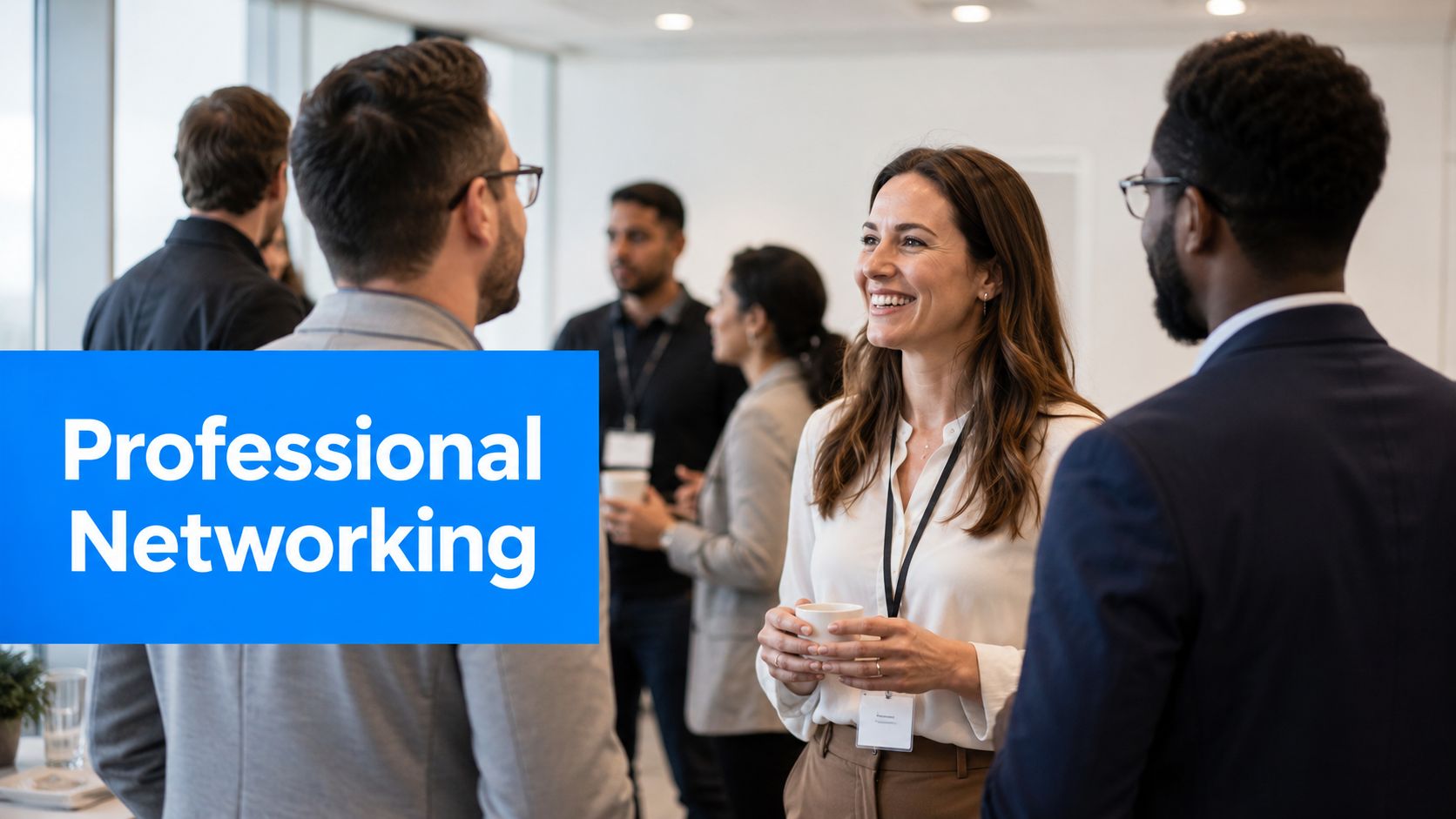
In a world of endless Zoom calls and LinkedIn requests, you might wonder if professional networking events are still worth the effort. The answer is a resounding yes. A single, well-chosen event can often unlock more opportunities than sending out a hundred online job applications. This guide will walk you through how to find the right events, make a lasting impression, and turn those new contacts into tangible career growth.
Table of Contents
- Why Networking Events Still Matter in 2026
- Finding Events That Align With Your Career Goals
- Walk in with Confidence: Your Pre-Event Playbook
- Navigating the Room with Purpose and Poise
- The Art of the Follow-Up to Build Real Connections
- Frequently Asked Questions About Professional Networking
- 1. How do I find the right events to attend?
- 2. What's the best way to introduce myself?
- 3. I'm an introvert. How can I network without feeling drained?
- 4. How do I join a conversation that's already in progress?
- 5. What if I forget someone's name?
- 6. How do I politely exit a conversation?
- 7. Are virtual events as effective as in-person ones?
- 8. Physical business cards or digital? What's the etiquette in 2026?
- 9. What's the best way to follow up without being annoying?
- 10. How often should I attend networking events?
Why Networking Events Still Matter in 2026
Let’s be honest—walking into a room full of strangers can be nerve-wracking. But the real value of these events is something a digital profile can't replicate: genuine human connection. A handshake and a face-to-face conversation build trust and create a lasting impression that sets you apart.

Think of these gatherings as strategic investments in your career, not just social obligations. They are your direct line to the "hidden job market," where the best opportunities are often found through word-of-mouth long before they're ever advertised.
The Power of a Real Connection
While digital tools are incredibly useful, the strongest professional relationships are still built on face-to-face interaction. The data speaks for itself. A staggering 80% of professionals around the world consider networking crucial for their career growth.
This isn't just a feeling; it translates into real jobs. In the UK, for example, 39% of workers found their current role through their network. This is precisely why events remain a cornerstone for anyone serious about building career momentum. To dig deeper, you can explore more networking statistics and their career impact.
A single conversation at a networking event can open doors faster than a dozen emails. It's not just about who you know; it's about who knows you, trusts you, and is willing to advocate for you.
Tangible Career and Financial Payoffs
Attending professional networking events delivers more than just good conversations; it leads to measurable results. For those just starting out, the impact is especially powerful. Nearly 1 in 2 Gen Z professionals have landed a job directly through a networking event.
Beyond getting your foot in the door, consistent networking pays off in the long run. Research shows that growing your professional network by 50% correlates with a 3.8% increase in salary. Every new connection isn't just a contact—it's a potential step toward a more successful and financially rewarding career.
Finding Events That Align With Your Career Goals
Let's be honest—not all professional networking events are worth the price of admission, or even your time. To get the best return on your efforts, you need to shift from a scattergun approach to a highly targeted one. The goal is to be in rooms (virtual or physical) with the right people, whether you’re looking for a new job, pivoting industries, or sourcing clients.
While platforms like Eventbrite and LinkedIn are good for a quick search, the real gold is often found in niche, industry-specific forums and communities.
Pinpointing High-Value Opportunities
To uncover these hidden gems, you need to get creative with your search terms. Forget generic queries like "business events."
Instead, try something much more specific:
- "Fintech leadership summit London"
- "Renewable energy professionals meetup Dubai"
- "AI in healthcare virtual conference"
This kind of focused searching helps you bypass the noisy, crowded events and zero in on where the real decision-makers in your field are gathering. If you're an international job seeker, remember that every country has its own professional ecosystem. For instance, our guide on how to network for jobs in Canada offers specific tips for navigating that particular market.
Once you have a shortlist, it's time to play detective. Scrutinize each event's agenda, speaker list, and attendee profile. Do the topics resonate with your expertise? Are the speakers the kind of leaders you’d want to learn from and connect with? A quality event will be transparent about who attends.
The goal is to attend events where the conversations are more valuable than the complimentary coffee. A well-chosen niche conference with 50 attendees is often more powerful than a generic trade show with 5,000.
Choosing the Right Networking Event
Picking the right event format is just as critical as picking the right topic. Each type of gathering offers a different experience and caters to different career goals. Understanding the pros and cons of each will help you decide where to invest your time and money.
Here’s a quick breakdown to help you compare your options.
| Event Type | Best For | Pros | Cons |
|---|---|---|---|
| Large Industry Conferences | Getting a broad overview of your industry, generating leads, and seeing the "big picture." | Access to a huge range of people and companies all in one place. | Can feel overwhelming, making it hard to have deep conversations. Often expensive. |
| Niche Seminars or Workshops | Diving deep into a specific skill or topic and connecting with true peers. | High-quality, focused attendees. Far easier to make meaningful connections. | Limited scope. May not offer broad exposure outside of a specific niche. |
| Virtual Summits | Networking globally and learning from international experts without the travel costs. | Accessible from anywhere. Often provides session recordings for on-demand viewing. | Can be harder to build genuine rapport. "Zoom fatigue" is a very real factor. |
| Local Meetups or Roundtables | Building a strong local network, finding mentors, and becoming part of a community. | Low cost and minimal time commitment. Helps build consistent, long-term relationships. | The attendee list can be unpredictable. May lack the formal structure of a larger event. |
Ultimately, the best event for you depends entirely on what you want to achieve. A mix of different formats—perhaps one large conference a year supplemented by smaller local meetups—is often a winning strategy.
Walk in with Confidence: Your Pre-Event Playbook
The difference between a great networking experience and a stressful one often comes down to what you do before you even walk in the door. The people who make the best connections at professional networking events don’t just wing it; they arrive with a plan. A little prep work can transform your anxiety into focused, confident action.
Your playbook should always start with a bit of homework. Take a look at the event's agenda, the speaker lineup, and especially the list of attending companies. This isn't about memorizing every detail, but about identifying a shortlist of 3-5 people or organizations you are genuinely interested in connecting with. This simple step gives you a clear sense of purpose.
Set Your Goals and Nail Your Introduction
Once you have your shortlist, you need to know what success looks like for you. Keep it simple and measurable. Forget vague goals like "meet new people."
Instead, try something specific:
- Have two meaningful conversations with people from your target companies.
- Learn one new industry trend from a speaker or another attendee.
- Secure one follow-up meeting or a coffee chat.
Next, think about how you'll introduce yourself. Ditch the stiff "elevator pitch" and aim for something that feels natural and opens a door for conversation. For instance: "Hi, I'm Alex. I work in UX design, and I was really interested in the talk on AI-driven user experiences." If you're on the introverted side, having a few go-to lines can make all the difference. This a guide for introverted brand builders has some fantastic strategies for approaching these moments with confidence.
This visual guide shows a simple strategy for identifying events that fit your professional objectives.
The key takeaway here is to filter every opportunity through the lens of your specific career goals. This ensures every event you attend is a strategic investment of your time and energy.
Finally, sort out the small-but-mighty details. Make sure your LinkedIn profile is polished and up-to-date—it’s your digital handshake, after all. For more on that, check out our tips on how to use LinkedIn effectively to land a job in Canada. Also, decide on your business card strategy. A digital QR code is modern and efficient, but a classic physical card can still make a memorable impact. Honestly, having both on hand is the smartest move.
Navigating the Room with Purpose and Poise
So you’ve arrived at the professional networking event. Now the real work—and the fun—begins. A successful night isn't about how many business cards you can collect; it's about the quality of the conversations you start. The goal is to move past the awkward small talk and spark a real dialogue that benefits everyone involved.

Resist the urge to ask the default, "So, what do you do?" Instead, try leading with open-ended questions that get people talking and sharing a story, not just reciting their job title. This simple shift can turn a forgettable exchange into a memorable interaction.
Sparking Genuine Dialogue
Great conversation starters are never about you. They show you're genuinely curious and actually want to learn about the other person.
Give some of these a try:
- "What was your biggest takeaway from the last session?"
- "What's a project you're working on right now that you're really excited about?"
- "I saw on the guest list you're with [Company Name]. I've been following their work on [Industry Trend]. How have you found that experience?"
Once the conversation is flowing, listen more than you speak. Active listening is your secret weapon. It helps you find common ground and spot opportunities to help, which is how strong professional relationships are built. For those building a career in a new country, our guide on networking tips for immigrants in Canada offers more specific advice.
The best networkers make you feel heard, not sold to. Your primary goal in any conversation should be to understand the other person's challenges and aspirations. Value will always follow understanding.
Real-Life Example: Entering and Exiting Conversations Gracefully
Knowing how to join a group or politely excuse yourself is an underrated skill. It lets you manage your time effectively so you can meet more people without ever seeming rude or getting stuck in one long conversation.
Joining a group: Look for small groups of 2-3 people with open body language. Wait for a natural pause in their chat, then step in.
- Real-Life Scenario: At a marketing conference, you see two people chatting animatedly. You stand nearby and hear the words "customer retention." You wait for a pause and say, "Excuse me, I couldn't help but overhear you talking about retention, a topic I'm passionate about. Mind if I join? I'm [Your Name], by the way."
Exiting a conversation: When you feel the conversation has run its course or you see someone else you need to talk to, make your exit polite and clear.
- Real-Life Scenario: After a good five-minute chat, you say, "It has been great speaking with you, David. I want to make sure I connect with a couple more people before the night is over, but I really hope you enjoy the rest of the event! I'll connect with you on LinkedIn."
At virtual events, the same rules apply, just in a digital format. Be active in the chat, ask good questions during Q&A sessions, and participate in breakout rooms. Your active presence online is the virtual equivalent of confident body language in a physical room. Master these on-the-ground tactics, and you’ll turn networking from a source of anxiety into a repeatable skill.
The Art of the Follow-Up to Build Real Connections
Leaving professional networking events with a stack of business cards or a few new LinkedIn requests is a great start, but it's just that—a start. Those new contacts are only potential opportunities. The real work of turning a brief conversation into a meaningful professional relationship happens in the days that follow.
My best advice? Act fast. A quick message sent within 24 hours lands with far more impact than one sent a week later when the memory of your chat has faded. The initial goal isn't to ask for a favor; it's simply to reinforce the connection and stay top of mind.
Crafting a Memorable Follow-Up
Let's be honest: generic connection requests are easy to ignore. To actually stand out, your message needs to be personal. Mentioning a specific detail from your conversation shows that you were genuinely engaged and not just collecting contacts. Some of the best advice on this comes from playbooks for expert networking for founders, which stress the importance of personalization.
Just look at the difference a little effort makes:
| Follow-Up Type | Example Message | Impact |
|---|---|---|
| Generic | "Hi Sarah, it was nice to meet you at the tech summit. I'd like to connect." | This will get lost in a sea of similar requests. It shows zero effort and is instantly forgettable. |
| Personalized & Valuable | "Hi Sarah, great to meet you at the tech summit last night. I really enjoyed our chat about the future of AI in UX design. Following up on our conversation, I thought you might find this recent McKinsey report on generative AI interesting. I'd love to stay connected." | This is memorable. It reminds her who you are, what you discussed, and provides immediate value, showing you valued the conversation and are a thoughtful professional. |
A personalized follow-up is not just good manners—it’s a strategic move. It separates you from 90% of the other people they met and lays the foundation for real rapport.
Nurturing Connections for the Long Term
Once you've made that initial contact, your goal shifts from making an impression to building a relationship. This doesn't mean you need to be in constant contact. Instead, focus on providing value through occasional, thoughtful touchpoints.
Here are a few simple ways to do that:
- Share a relevant resource: A few weeks after you connect, send over an article or report that relates to your conversation. A simple "Saw this and thought of our chat" goes a long way.
- Make a helpful introduction: If you meet someone who could benefit from their expertise (or vice versa), offer to make a warm introduction.
- Acknowledge their work: See on LinkedIn that they launched a new project or got a promotion? A quick congratulatory message shows you're paying attention.
These small, consistent actions build trust over time. They help position you as a valuable, supportive contact in their network, not just another name on a list.
Frequently Asked Questions About Professional Networking
Even the most seasoned professionals have questions. Here are answers to the 10 most common queries to help you navigate your next professional networking event with confidence.
1. How do I find the right events to attend?
Focus on quality over quantity. Use specific keywords on platforms like LinkedIn Events and Eventbrite (e.g., "SaaS marketing summit" instead of "business event"). Also, check industry association websites and newsletters, as they often list high-value, niche gatherings.
2. What's the best way to introduce myself?
Ditch the generic "elevator pitch." Instead, craft a conversational opener relevant to the event. For example: "Hi, I'm Maya. I work in sustainable finance and was really intrigued by the panel on ESG reporting. What brought you here today?" It's engaging and opens a natural dialogue.
3. I'm an introvert. How can I network without feeling drained?
Set small, achievable goals, like having three quality conversations. Arrive early to get comfortable before the crowds. Find a quieter spot near the edge of the room to have one-on-one chats, which are often less overwhelming than joining large groups. It’s okay to take short breaks if you need to recharge.
4. How do I join a conversation that's already in progress?
Look for a group of 2-3 people with open body language. Stand nearby and listen for a natural pause. Then, step in with a simple, "Mind if I join you? I overheard you talking about [topic], and it sounded interesting."
5. What if I forget someone's name?
It happens to everyone. Just be honest and humble. A simple, "I'm so sorry, my brain just blanked. Could you remind me of your name?" is perfectly acceptable and much better than fumbling awkwardly.
6. How do I politely exit a conversation?
Have a graceful exit line ready. Try: "It has been great speaking with you! I have a goal to meet a few more people tonight, but I'd love to connect on LinkedIn. I hope you enjoy the rest of the event!" It's clear, professional, and respectful.
7. Are virtual events as effective as in-person ones?
They can be, but they require more proactivity. Turn your camera on, use the chat to ask insightful questions, and actively participate in breakout rooms. Follow up with speakers and other attendees on LinkedIn afterward to solidify the connection.
8. Physical business cards or digital? What's the etiquette in 2026?
Both have their place. A digital QR code linking to your LinkedIn is efficient and modern. However, a well-designed physical card can still make a memorable impression. The best strategy is a hybrid approach: offer a physical card but also be ready to connect digitally on the spot.
9. What's the best way to follow up without being annoying?
The key is to add value. Send a personalized email or LinkedIn message within 24 hours. Reference a specific part of your conversation and, if possible, share a relevant article or resource you discussed. The goal is to reinforce the connection, not make an immediate "ask."
10. How often should I attend networking events?
This depends on your goals. If you're actively job searching, aim for 1-2 highly relevant events per month. If you're looking to maintain your network, one high-quality event per quarter is often sufficient to stay connected and build relationships without burning out.
Navigating global career opportunities requires clear intelligence and strategic planning. At Go Hires, we provide the data-driven insights and market analysis you need to make confident decisions about your international career path. Explore how GoHires can support your global career ambitions.




2 Comments
Pingback: Oracle Layoffs 2026: Where AI and Cloud Jobs Are Growing - GoHires
Pingback: AI Is Flooding Job Applications: How to Stand Out When Recruiters Are Overwhelmed - GoHires