


Working from a cozy home office or a lively coffee shop in Toronto sounds ideal, but remote work comes with its own set of misunderstandings and opportunities. For Canadian freelancers, career changers, and those exploring flexible job options, the difference between structured remote roles and freelancing often gets blurred. This guide highlights the main features of remote employment, clarifies common misconceptions, and reveals what truly matters for success in the Canadian virtual workforce.
Table of Contents
- What Is Remote Work and What It’s Not
- Common Types of Remote Work Models
- Key Features and Technology Essentials
- How Remote Work Impacts Careers and Lifestyle
- Legal, Tax, and Employer Considerations
- Avoiding Common Pitfalls in Remote Employment
Key Takeaways
| Point | Details |
|---|---|
| Understanding Remote Work | Remote work is a structured employment model that emphasizes results over location and schedule, requiring effective digital communication tools and mutual trust. |
| Types of Remote Work Models | Diverse remote work models, including full-time remote, part-time, and hybrid arrangements, cater to various professional needs and challenges. |
| Technological Essentials | Robust technology, such as secure collaboration platforms and AI productivity tools, is crucial for successful remote work environments. |
| Legal and Tax Implications | Navigating legal and tax complexities is essential for both employers and employees in remote work situations, necessitating clear policies and compliance strategies. |
What Is Remote Work and What It’s Not
Remote work represents a flexible employment model where professionals complete their job responsibilities outside traditional office environments, often utilizing digital technologies to collaborate and communicate. Understanding remote work arrangements reveals a nuanced landscape far beyond simple location independence.
Contrary to common misconceptions, remote work is not synonymous with freelancing or independent contracting. It encompasses structured employment where employees remain full-time team members of organizations, just working from different physical locations. These arrangements can range from completely virtual setups to hybrid models where workers split time between home and corporate offices. Most importantly, remote work requires robust technological infrastructure, clear communication protocols, and mutual trust between employers and employees.
The fundamental characteristics of remote work include:
- Location flexibility
- Digital communication tools
- Performance based on output rather than physical presence
- Potential for global talent recruitment
- Reduced overhead costs for organizations
Remote work differs from traditional employment by prioritizing results over rigid schedules. Employees are evaluated based on their productivity, deliverables, and impact rather than hours spent at a physical desk. This shift represents a fundamental reimagining of workplace dynamics, driven by technological advancements and changing workforce expectations.
Pro tip: Invest in high-quality digital communication tools and establish clear performance metrics to succeed in remote work environments.
Common Types of Remote Work Models
Remote work has evolved into multiple dynamic models, reflecting the diverse needs of modern professionals and organizations. Six primary remote work arrangements have emerged, each offering unique advantages and challenges for workers and employers alike.
These remote work models encompass a wide spectrum of employment arrangements. Full-time remote employment represents a structured approach where employees work entirely online for a single organization, maintaining consistent engagement and responsibilities. Freelancing offers maximum flexibility, allowing professionals to manage their own client relationships and project portfolios. Hybrid models have gained significant traction, enabling workers to split time between home and office environments, balancing collaborative in-person interactions with the convenience of remote work.
The comprehensive landscape of remote work models includes:
- Full-time remote employment
- Part-time remote work
- Freelance and contract work
- Digital nomad arrangements
- Hybrid workplace models
- Remote consulting positions
Each model presents distinct benefits and challenges. Hybrid work strategies have particularly transformed workplace dynamics, offering organizations and employees unprecedented flexibility in designing work arrangements that maximize productivity and employee satisfaction.
Here’s a comparison of primary remote work models and their unique focuses:
| Remote Model | Typical Employee Status | Key Benefit | Main Challenge |
|---|---|---|---|
| Full-time remote | Salaried employee | Stability and structure | Risk of isolation |
| Part-time remote | Salaried or hourly | Flexibility for life needs | Less team integration |
| Freelance/Contract | Independent contractor | Autonomy over projects | Variable income, few benefits |
| Digital nomad setup | Self-employed/Contract | Work from anywhere | Managing legal/tax compliance |
| Hybrid workplace | Salaried employee | Balance of home/office | Office commute still required |
| Remote consulting | Independent contractor | Project diversity | Client acquisition effort |
Pro tip: Carefully assess your professional goals, work style, and personal preferences when selecting a remote work model to ensure optimal career alignment and personal fulfillment.
Key Features and Technology Essentials
Remote work technology has transformed dramatically, creating sophisticated ecosystems that enable seamless professional collaboration. Technological infrastructure for remote work now demands comprehensive digital readiness beyond simple communication tools.

The essential technological components for effective remote work include robust collaboration platforms, secure networking solutions, and intelligent productivity tools. Virtual private networks (VPNs) and advanced cybersecurity measures have become critical, protecting sensitive organizational data across distributed workforce environments. Artificial intelligence powered assistants are emerging as game changers, helping professionals manage workflows, schedule tasks, and optimize individual productivity with unprecedented precision.
Key technological requirements for successful remote work encompass:
- High-speed, reliable internet connectivity
- Secure cloud-based collaboration platforms
- Virtual private network (VPN) access
- AI-powered productivity management tools
- Advanced cybersecurity protection
- Integrated communication systems
- Digital performance tracking software
Remote work technology trends indicate a future where technological solutions will increasingly prioritize not just operational efficiency, but also employee mental health and work-life balance. Organizations are investing in tools that provide holistic support, recognizing that technology must serve human needs beyond mere task completion.
Pro tip: Regularly audit and update your digital toolkit, ensuring your technology stack remains current, secure, and aligned with your professional workflow requirements.
How Remote Work Impacts Careers and Lifestyle
Remote work fundamentally transforms professional trajectories and personal experiences, creating unprecedented opportunities and challenges for workers across diverse backgrounds. Remote work’s complex impact on well-being extends far beyond traditional employment models, reshaping how individuals conceptualize career growth and lifestyle integration.
The professional landscape has dramatically shifted, offering expanded opportunities particularly for marginalized groups. Career mobility now transcends geographic limitations, enabling professionals to pursue roles without relocation constraints. Women, individuals with disabilities, and those with caregiving responsibilities especially benefit from flexible work arrangements that previously excluded them from traditional workforce participation. These transformative models allow for more personalized career development strategies that accommodate individual life circumstances.
Key lifestyle and career impacts of remote work include:
- Geographic independence in job selection
- Reduced commutation expenses
- Enhanced work-life balance
- Increased accessibility for diverse workforce populations
- Potential for global career opportunities
- Improved personal time management
- Reduced workplace discrimination barriers
Global workforce transformation studies reveal that remote work is not merely a temporary trend but a permanent restructuring of professional engagement. This shift necessitates adaptable skill sets, continuous learning, and proactive personal branding to remain competitive in an increasingly digital employment ecosystem.
The table below summarizes how remote work transforms professional and personal life aspects:
| Aspect | Traditional Office Job | Remote Work Evolution |
|---|---|---|
| Location flexibility | Fixed, on-site | Work from any location |
| Career advancement | Often local/regional | Accessible globally |
| Work-life balance | Commuting impacts | Greater scheduling flexibility |
| Team diversity | Limited by geography | Increased global inclusion |
| Expenses | High for both parties | Reduced for workers and employers |
Pro tip: Develop a robust digital portfolio and continuously upgrade your technological skills to remain competitive in the evolving remote work landscape.
Legal, Tax, and Employer Considerations
Remote work introduces complex legal and tax implications that require careful navigation for both employers and employees. Taxes in Canada for remote workers demand strategic understanding to ensure compliance and financial optimization.
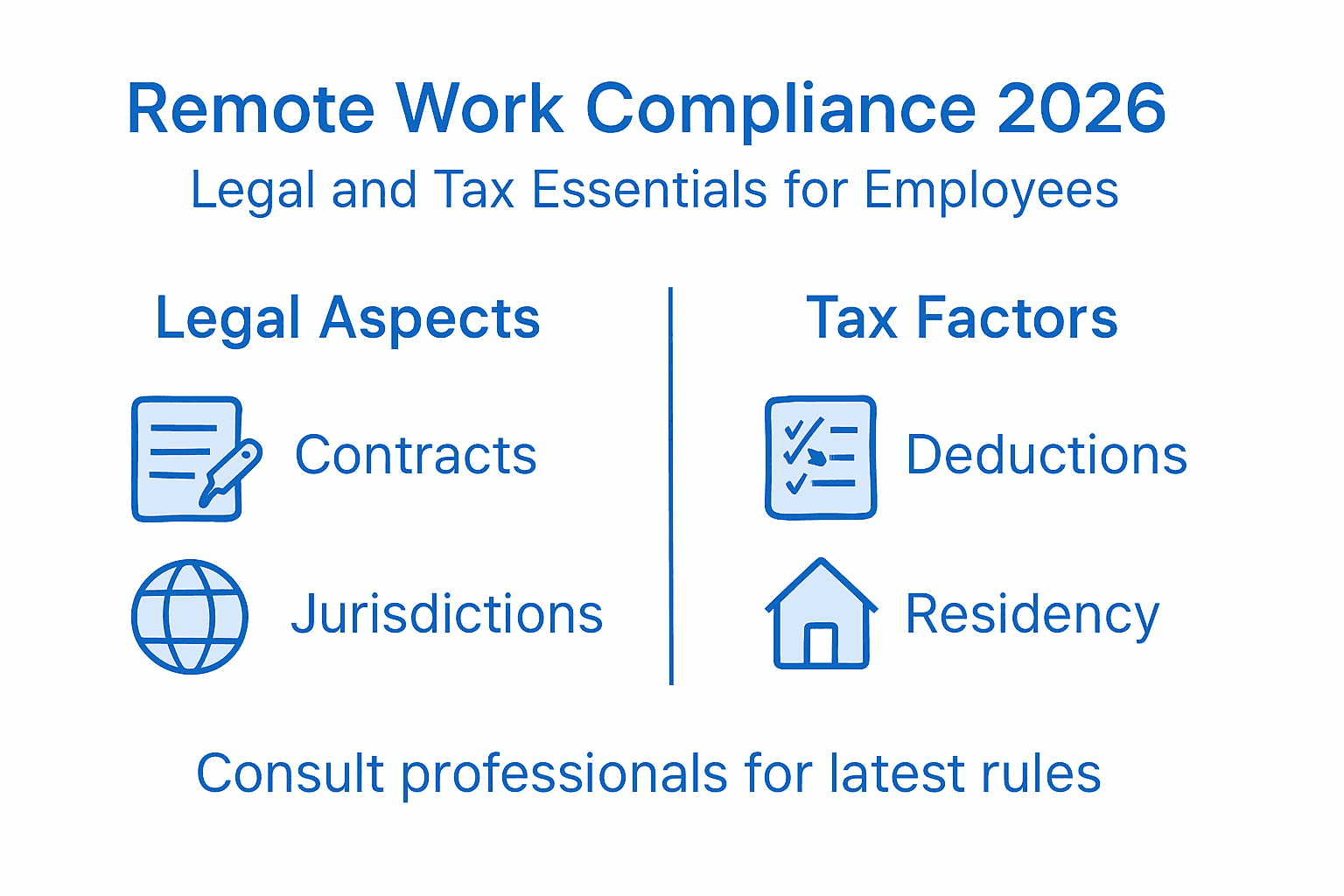
Employment classification becomes increasingly nuanced in remote work environments. Organizations must distinguish between traditional employees, independent contractors, and hybrid workers, each carrying unique legal obligations. Taxation varies significantly based on work location, with provincial and federal regulations creating intricate compliance landscapes. Canadian employers must establish clear policies addressing permanent establishment risks, worker classification, data privacy protections, and cross-provincial employment regulations.
Key legal and tax considerations include:
- Provincial tax jurisdiction differences
- Worker classification requirements
- Permanent establishment risks
- Data privacy and security obligations
- Cross-border employment regulations
- Compensation and benefits structuring
- Workplace safety responsibilities
Employers must proactively develop comprehensive remote work frameworks that balance legal compliance, employee protection, and organizational flexibility. This requires ongoing consultation with legal professionals who specialize in employment and tax law, ensuring adaptive strategies that protect both organizational interests and worker rights.
Pro tip: Consult with a tax professional specializing in remote work to develop a personalized compliance strategy that addresses your specific employment scenario.
Avoiding Common Pitfalls in Remote Employment
Remote work presents unique challenges that can derail professional effectiveness and personal well-being. Common challenges in remote agile work reveal critical pitfalls professionals must strategically navigate to maintain productivity and engagement.
Communication breakdown represents the most significant risk in remote work environments. Without intentional strategies, teams can experience diminished collaboration, reduced trust, and increased misunderstandings. Digital collaboration requires deliberate infrastructure, including clear communication protocols, regular virtual check-ins, and transparent performance tracking. Successful remote professionals invest in robust digital communication tools and develop strong asynchronous communication skills.
Key pitfalls to proactively address include:
- Inadequate communication infrastructure
- Professional isolation
- Blurred work-life boundaries
- Technology and connectivity challenges
- Reduced team cohesion
- Performance tracking difficulties
- Mental health and burnout risks
Remote work implementation challenges emphasize the importance of psychological safety and intentional team-building. Organizations and individuals must develop adaptive strategies that prioritize human connection, maintain clear expectations, and create supportive virtual work environments.
Pro tip: Establish a consistent daily routine, create a dedicated workspace, and schedule regular virtual social interactions to combat isolation and maintain professional momentum.
Discover Your Ideal Remote Work Opportunity Today
Remote work offers incredible flexibility and the chance to redefine your career and lifestyle. Yet challenges like navigating diverse remote work models and finding the right position that matches your goals can feel overwhelming. Whether you seek full-time remote employment, freelance roles, or hybrid options, understanding the right fit is crucial to unlocking your potential.
Find remote jobs tailored to your skills and preferences on Gohires. Our platform connects you with Canadian employers offering diverse remote and flexible roles so you can benefit from location independence and enhanced work-life balance. Ready to take control of your career and avoid common pitfalls in remote work? Start exploring new opportunities now on Gohires.com and turn your remote work aspirations into reality.
Frequently Asked Questions
What is remote work?
Remote work is a flexible employment model where professionals complete their job responsibilities outside traditional office settings, utilizing digital tools for collaboration and communication.
How does remote work differ from freelancing?
Remote work is not the same as freelancing; it typically involves structured employment with an organization, while freelancing allows more autonomy and control over client relationships and project choices.
What are the essential technologies for effective remote work?
Key technologies for remote work include high-speed internet, secure cloud-based collaboration platforms, virtual private networks (VPNs), and AI-powered productivity management tools.
What are the common pitfalls to avoid in remote work?
Common pitfalls in remote work include inadequate communication, professional isolation, blurred work-life boundaries, and technology challenges. It’s crucial to establish clear communication protocols and maintain a structured routine.