


Starting a career in Canada often begins with securing a formal job offer from a Canadian employer. For international students, understanding exactly what makes a job offer legitimate and eligible for a work permit is crucial. A genuine job offer must detail duties, pay, and be in writing from a bona fide Canadian business, not an embassy or consulate. This guide helps you grasp the process, requirements, and key documentation needed for work permits, so you can move forward confidently in your Canadian job search.
Table of Contents
- Job Offer Meaning in Canadian Employment
- Types of Job Offers in Canada
- Requirements for Valid Job Offer for Work Permits
- Work Permit Process for International Students
- Rights, Responsibilities and Common Pitfalls
Key Takeaways
| Point | Details |
|---|---|
| Job Offer Definition | A job offer is a formal written document outlining terms of employment, including duties and compensation, essential for work permits and residency. |
| Types of Job Offers | Job offers in Canada are categorized as temporary or permanent, each impacting immigration paths differently. |
| Requirements for Valid Offers | To secure a work permit, job offers must meet specific criteria, including written documentation from an authorized employer and compliance with NOC standards. |
| Rights and Responsibilities | International students must understand their rights under Canadian law, ensure job offer legitimacy, and comply with work permit conditions to avoid pitfalls. |
Job Offer Meaning in Canadian Employment
In Canadian employment, a job offer represents a formal written communication from an employer detailing specific employment terms and conditions. Canadian immigration authorities define this document as a critical instrument that outlines critical employment parameters including job responsibilities, compensation, and work expectations.
A legitimate job offer in Canada must meet several specific requirements. The document needs to be an official, recent written communication from a Canadian employer, explicitly stating key employment details such as job title, salary, work duration, and specific job duties. Notably, these offers cannot originate from embassies or consulates and must represent genuine employment opportunities with bona fide Canadian businesses. For international students and immigrants, these job offers play a pivotal role in work permit applications and potential permanent residency pathways.
Employers must provide comprehensive documentation that meets stringent Canadian labor standards. This includes obtaining a Labour Market Impact Assessment from Employment and Social Development Canada, which confirms the job offer’s legitimacy and ensures that hiring a foreign worker will not negatively impact the Canadian labor market. The assessment validates that the employment terms align with prevailing wage standards, working conditions, and national employment regulations.
For international students and skilled workers, understanding the nuanced requirements of a Canadian job offer is crucial. These documents must demonstrate full-time employment, specify a minimum one-year commitment, and provide clear evidence of the employer’s intent to hire. Successful job offers not only facilitate work permits but can significantly enhance immigration prospects through programs like Express Entry.
Pro tip: Ensure your job offer includes detailed documentation of job responsibilities, exact salary, and specific employment terms to maximize your chances of successful work permit approval.
Types of Job Offers in Canada
In the Canadian employment landscape, job offers are categorically divided into two primary types: temporary and permanent job offers. Canadian immigration sources highlight critical distinctions between these employment classifications that significantly impact international students’ career and immigration prospects.
Temporary job offers represent short-term employment opportunities with defined durations and specific work permit requirements. These offers typically last for a predetermined period, often ranging from several months to a few years, and are commonly utilized by employers seeking specialized skills or seasonal workforce needs. International students frequently leverage temporary job offers as initial entry points into the Canadian labor market, allowing them to gain professional experience and potentially transition to more permanent employment arrangements.
In contrast, permanent job offers provide long-term employment commitments and are intrinsically linked to potential permanent residency pathways. Immigration experts emphasize that these offers must meet stringent criteria, including full-time employment status, compliance with National Occupational Classification (NOC) codes, and comprehensive documentation. Permanent job offers carry substantial weight in immigration programs like Express Entry, often providing significant additional points that enhance candidates’ chances of obtaining permanent residency.
Understanding these job offer types requires careful consideration of individual career goals, immigration strategies, and specific employer requirements. While temporary offers provide immediate work opportunities, permanent offers represent more comprehensive long-term career and immigration potential. Each classification comes with unique documentation, legal requirements, and implications for international students seeking to establish their professional careers in Canada.
Pro tip: Carefully document all job offer details and verify compliance with Canadian immigration regulations to maximize your employment and residency opportunities.
Here’s a comparison of temporary versus permanent job offers in Canada:
| Criteria | Temporary Job Offer | Permanent Job Offer |
|---|---|---|
| Duration | Specific contract, limited term | Ongoing, long-term commitment |
| Immigration Impact | Entry to Canadian workforce | Major boost for permanent residency |
| Documentation Required | Short-term contract, work permit docs | Full-time contract, NOC compliance |
| Typical Candidates | Seasonal, students, short-term workers | Skilled workers, PR applicants |
Requirements for Valid Job Offer for Work Permits
Navigating the complex landscape of Canadian work permits requires a comprehensive understanding of the job offer requirements. Comprehensive immigration guidelines outline specific criteria that international students must meet to secure a legitimate work permit, including detailed documentation and stringent employment conditions.
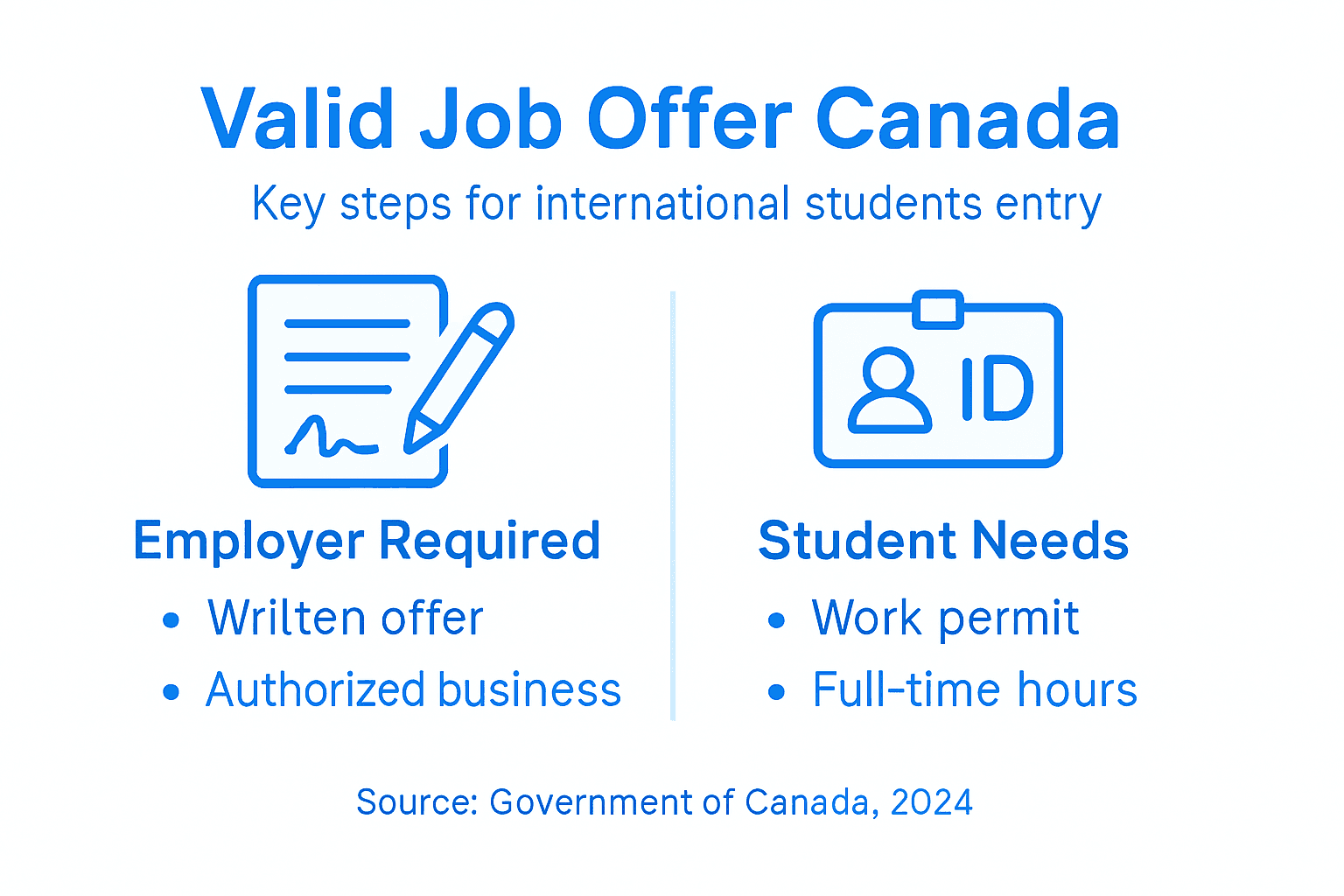
A valid job offer for Canadian work permits must satisfy multiple critical parameters. These include being a written document from an authorized employer, specifying full-time employment of at least 30 hours per week, and guaranteeing continuous work for a minimum of one year following visa issuance. The offer must precisely align with specific National Occupational Classification (NOC) TEER categories and demonstrate compliance with Immigration, Refugees and Citizenship Canada (IRCC) regulations.
Employers must either obtain a positive Labor Market Impact Assessment (LMIA) or qualify for LMIA exemption to support the job offer. Official Canadian immigration sources mandate that job offer letters comprehensively detail pay rates, potential deductions, specific job duties, and precise work conditions. International students must ensure their prospective employers submit a formal offer of employment through the official Employer Portal, which generates a crucial offer of employment number essential for work permit applications.
Beyond documentation, successful work permit applications require strategic alignment between the job offer, the student’s educational background, and Canadian labor market needs. Careful attention to detail, thorough documentation, and understanding of the intricate requirements can significantly enhance an international student’s prospects of obtaining a work permit and potentially transitioning to permanent residency.
Pro tip: Meticulously review and cross-verify all job offer documents to ensure complete alignment with Canadian immigration work permit requirements.
Work Permit Process for International Students
Navigating the Canadian work permit landscape requires international students to understand a complex and structured application process. Canadian immigration regulations outline specific requirements that international students must meticulously follow to secure legal employment opportunities within the country.
The work permit process begins with obtaining a valid job offer that meets stringent Canadian employment standards. Students must secure a comprehensive employment contract that details job responsibilities, salary, and work conditions. Critically, the job offer must align with the National Occupational Classification (NOC) standards and potentially require a positive Labor Market Impact Assessment (LMIA). International students from different provinces may face additional requirements, with Quebec mandating a separate provincial acceptance certificate.

Documentation plays a pivotal role in the work permit application. Students must compile a robust application package that includes their job offer letter, employment contract, educational credentials, and proof of financial sustainability. The application typically requires submission through Immigration, Refugees and Citizenship Canada (IRCC), with careful attention to demonstrating compliance with work permit regulations. Some students may qualify for work permits through specific programs like the Post-Graduation Work Permit (PGWP), which provides unique pathways for recent international graduates.
Successful work permit applications demand strategic planning and comprehensive understanding of Canadian immigration policies. International students must carefully evaluate their eligibility, prepare thorough documentation, and ensure their employment opportunities align with Canadian labor market needs. The process requires patience, attention to detail, and a proactive approach to meeting all regulatory requirements.
Pro tip: Begin preparing your work permit documentation well in advance and consult with immigration professionals to ensure complete compliance with Canadian regulations.
Below is a summary of steps and critical documents needed for international students to obtain a Canadian work permit:
| Step | Purpose | Key Documents |
|---|---|---|
| Secure Job Offer | Meet employment standards | Signed job offer letter |
| Employer Verification | Prove legitimacy, meet LMIA criteria | LMIA approval, Employer Portal code |
| Application Submission | Apply for permit with IRCC | Full application package |
| Proof of Eligibility | Show student meets permit criteria | Academic credentials, financial proof |
Rights, Responsibilities and Common Pitfalls
Navigating the Canadian employment landscape requires international students to understand their legal rights and critical responsibilities. Canadian immigration verification processes are rigorous and demand strict compliance with employment regulations, ensuring that both employers and employees maintain high standards of professional conduct.
Employees have fundamental rights protected under Canadian labor laws, including fair wages, safe working conditions, and protection against workplace discrimination. International students must be aware that their work permits are conditional and require adherence to specific employment terms. Employers are legally obligated to provide transparent job descriptions, fair compensation, and a work environment that aligns with national employment standards. IRCC thoroughly investigates employment offers to confirm their authenticity and alignment with legitimate business needs.
Common pitfalls for international students include accepting fraudulent job offers, misrepresenting qualifications, or failing to maintain work permit compliance. Potential risks include immediate permit revocation, future immigration restrictions, and potential legal consequences. Students must carefully verify employer credentials, understand their specific work permit conditions, and maintain meticulous documentation of their employment relationship. Verifying an employer’s legitimacy, understanding contract terms, and maintaining transparent communication with immigration authorities are crucial strategies for avoiding potential complications.
Successful navigation of Canadian work permit regulations requires proactive engagement, thorough understanding of legal obligations, and consistent adherence to immigration guidelines. International students should view their work permit as a privilege that demands responsible and ethical professional conduct, with potential long-term implications for their career and immigration prospects.
Pro tip: Create a dedicated file documenting all employment-related communications and maintain regular contact with your employer to ensure ongoing compliance with work permit regulations.
Unlock Your Canadian Employment Journey Starting Today
Navigating the complexities of a valid Canadian job offer and work permit can feel overwhelming. Whether you are an international student seeking a permanent or temporary position, understanding the specific requirements around job responsibilities, salary, and employer legitimacy is crucial. Do not let confusion or uncertainty hold you back from securing the right job offer that aligns with your immigration goals.
Take control of your career with Gohires.com where Canadian job seekers and employers connect seamlessly. Explore a vast range of full-time, part-time, and temporary job listings tailored to the Canadian market. Gain access to verified opportunities and resources that help you prepare strong applications that meet Canadian immigration standards. Start browsing today at Gohires.com to find authentic job offers that can boost your work permit application and set you on the path to permanent residency. Your Canadian work journey begins now.
Frequently Asked Questions
What is a job offer in the context of Canadian employment?
A job offer in Canadian employment is a formal written communication from an employer that outlines specific employment terms and conditions, including job responsibilities, compensation, and work expectations.
What are the requirements for a valid job offer for work permits in Canada?
A valid job offer must be a written document from an authorized employer, specify full-time employment of at least 30 hours per week, guarantee continuous work for a minimum of one year, and align with specific National Occupational Classification (NOC) categories.
What types of job offers can international students receive in Canada?
International students can receive temporary job offers, which are short-term and typically last several months to a few years, or permanent job offers, which provide long-term employment commitments and are often linked to pathways for permanent residency.
What are the rights and responsibilities of international students with work permits in Canada?
International students have rights such as fair wages and safe working conditions, but they must also adhere to the terms of their work permits. Employers are obligated to provide clear job descriptions and comply with Canadian labor standards.