

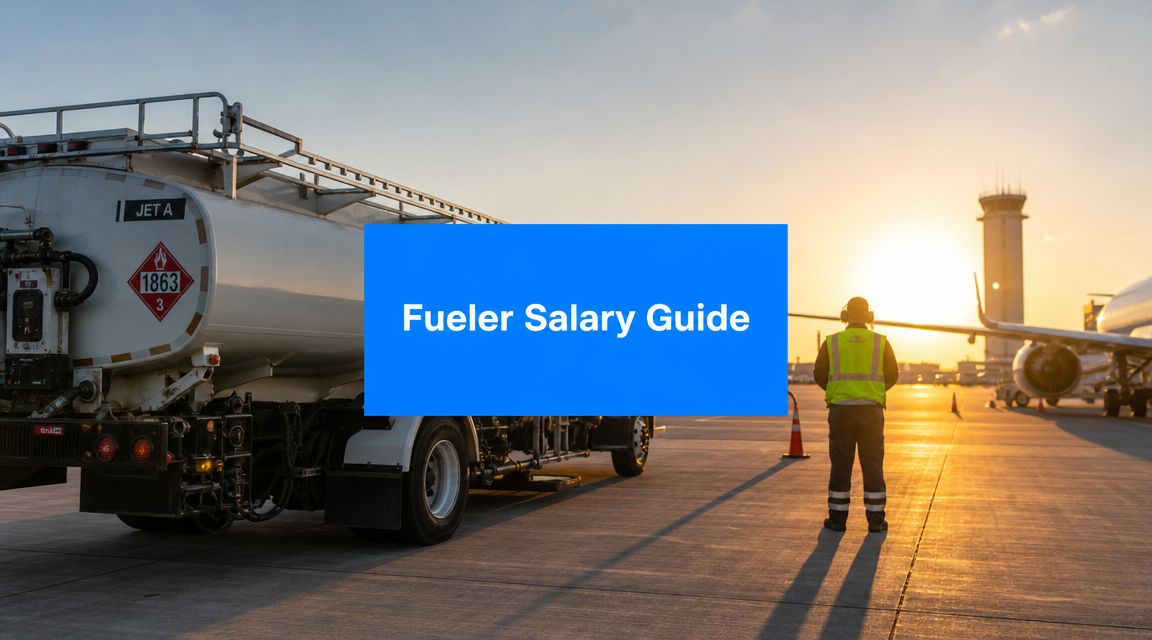
One number should make any job seeker pause. Reported U.S. pay for aircraft fuelers ranges from about $34,395 per year on Zippia to roughly $80,187 on Salary.com, depending on how the source defines pay and what it includes (Zippia salary overview). That spread is too large to treat as a simple “average salary” problem.
Aircraft fuelers sit close to the operational core of aviation. They fuel and defuel aircraft, handle equipment, work around tight turnarounds, and operate in weather, noise, and safety-critical conditions. Yet many salary pages flatten that complexity into one headline figure.
For job seekers, that creates a practical problem. A low hourly quote can understate what a busy schedule produces over a year. A high annual number can overstate what a new hire should expect in a smaller market. The essential question isn't “What's the average?” It's “How is this role paid, and what would I likely take home in my market, on my shift pattern, at my experience level?”
Table of Contents
- Decoding the Aircraft Fueler Salary Puzzle
- Understanding Your Pay Structure Hourly vs Annual
- Aircraft Fueler Salary Benchmarks A Global Comparison
- Key Factors That Influence Your Paycheck
- Career Path and Upskilling to Increase Your Salary
- Benefits Overtime and Negotiation Strategies
- Frequently Asked Questions About Aircraft Fueler Salaries
Decoding the Aircraft Fueler Salary Puzzle
Aircraft fueler pay can look inconsistent because salary sites often combine different pay definitions into one headline number. A lower figure may reflect base wages in a narrower sample. A higher figure may include overtime, shift premiums, or broader compensation estimates. For job seekers, the useful question is not which number is correct. It is which number matches the way the job is paid.
That distinction matters in airport operations more than in many other entry-level roles. Fueling work is tied to flight schedules, weather disruptions, safety procedures, and staffing gaps across nights, weekends, and peak travel periods. Those conditions create wider gaps between posted pay and take-home pay than a single national average suggests. If you want a better framework for reading these differences, labor market information gives you the right context.
Why one average fails
One average hides several moving parts:
- Pay type is inconsistent: Some employers advertise an hourly base rate. Others refer to annual pay or total compensation.
- Schedules change earnings: Overtime, split shifts, overnight work, and irregular operations can add meaningful income.
- Regional markets price the same job differently: Large hub airports, high-cost metros, and smaller regional fields do not follow one pay pattern.
- Job titles are not standardized: Aircraft fueler, refueler, and line service technician may overlap in duties while sitting on different pay bands.
A better way to read aircraft fueler salary data is to treat it as a range shaped by labor demand, airport complexity, and time worked. That is the same logic analysts use in other skilled-trades comparisons, including electrician career earnings, where overtime and local market conditions can shift annual income far more than a national median suggests.
Practical rule: If a salary source does not specify whether it shows hourly wage, annual base pay, or total compensation, the figure is incomplete.
Aircraft fueling also rewards traits that broad salary pages rarely measure well. Employers pay for safety compliance, procedural consistency, turnaround speed, and dependable shift coverage. That is often where the earning pattern becomes visible. Workers with the same title can end up in meaningfully different income brackets because the paycheck reflects operating conditions, not just the label on the job posting.
Understanding Your Pay Structure Hourly vs Annual
A posted pay number can mislead by tens of thousands of dollars a year if you do not know whether it refers to an hourly rate, annual base pay, or total compensation. For aircraft fuelers, that distinction shapes take-home pay more than the headline figure itself.

Why hourly and annual figures diverge
Aircraft fueling is usually staffed around shift coverage, operational peaks, and irregular demand. That means pay is often built from a base hourly wage first, then expanded by actual hours worked, overtime rules, shift premiums, and benefits. A salary page that shows one annual figure may compress all of that into a single number. A job ad that shows only an hourly rate leaves out the same context from the other direction.
The result is simple. Two aircraft fuelers with similar base rates can finish the year with very different earnings.
That is why annual comparisons can look inconsistent. Some sources appear to describe base pay. Others blend in overtime or broader compensation. If you are comparing offers, the practical question is not which format is better. It is which parts of pay are fixed, which are variable, and which are likely in your target airport market.
How to break an offer into usable numbers
Read an aircraft fueler offer in four layers instead of one:
Base pay
Start with the guaranteed figure. If the employer quotes hourly, calculate the annualized amount at standard full-time hours. If the employer quotes annual salary, ask whether the role is exempt or tied to a fixed schedule.Time-related earnings
Extra income often comes from overtime, holiday coverage, night shifts, or last-minute operational demand. These earnings can be meaningful, but they are not always dependable month to month.Benefit value
Health insurance, retirement contributions, paid time off, and airport-specific perks affect total compensation even though they do not appear in the wage line. Job seekers comparing frontline aviation roles with supervisory tracks should also review how compensation structures change in related roles such as an aviation manager salary breakdown.Income stability
A lower posted rate with predictable hours can outperform a higher hourly offer if the schedule is inconsistent. Cash flow matters, especially in jobs tied to weather disruptions and flight volume.
A useful rule is to separate guaranteed pay from probable pay. Guaranteed pay covers your minimum earnings. Probable pay includes the extra hours and premiums that workers at that airport regularly pick up.
If an employer gives you an hourly rate, ask for a realistic weekly schedule, average overtime frequency, and whether shift differentials are common or occasional.
Use this framework to compare formats:
| Pay format | What it measures clearly | What you still need to verify |
|---|---|---|
| Hourly pay | Your base rate for each hour worked | Weekly hours, overtime frequency, and premium shifts |
| Annual salary | Fixed pay over a year | Whether extra hours are expected and how benefits compare |
| Total compensation | Broader value of wages plus benefits and incentives | Which portions are guaranteed versus conditional |
The main analytical mistake is comparing one employer's hourly base with another employer's total annual package. Those are different units. A cleaner comparison is hourly base versus hourly base, then annualized earnings versus annualized earnings, then total compensation versus total compensation. Once you line up the categories, the stronger offer is usually easier to spot.
Aircraft Fueler Salary Benchmarks A Global Comparison
A global comparison breaks down fast if it relies on one headline average. For aircraft fuelers, the stronger benchmark is the spread between base hourly pay, annualized earnings, and location-specific compensation patterns. The United States is the only market in this dataset with verified figures strong enough to anchor that comparison. For Canada, the United Kingdom, Australia, and the United Arab Emirates, the evidence is thinner, so the honest approach is to separate confirmed numbers from market interpretation.
What the U.S. benchmark actually shows
The U.S. benchmark is useful because it shows dispersion. Earlier in the article, verified U.S. estimates showed that aircraft fueler pay can vary materially between lower and higher ends of the market, with premium metro areas producing much stronger compensation than the national midpoint. That matters more than a single average because job seekers are not applying to a country. They are applying to a specific airport, employer, and shift system.
Regional spread changes the decision calculus. A role with a moderate posted wage in a stable, high-volume airport can outperform a higher advertised rate in a market where hours are inconsistent or premium shifts are scarce. Readers comparing aviation pay with other skilled trades often use the same framework when reviewing electrician career earnings. The comparison works because both fields can look average on paper and then separate sharply by region, specialization, and working pattern. For wider cross-role context, a complete salary database across occupations and markets helps define what competitive pay looks like in practice.
2026 International Aircraft Fueler Salary Ranges Annual
| Country | Entry-Level Range (Local Currency) | Experienced Range (Local Currency) | Average Range (USD Equivalent) |
|---|---|---|---|
| United States | Often quoted hourly rather than annual | Often quoted hourly rather than annual | Verified annual figures reported across sources range from about $34,395 to about $80,187 |
| Canada | Varies by airport, employer, and shift structure | Varies by airport, employer, and shift structure | Qualitative only. Reliable comparative data not verified here |
| United Kingdom | Varies by airport operator and ground handling setup | Varies by airport operator and ground handling setup | Qualitative only. Reliable comparative data not verified here |
| Australia | Varies by major hub versus regional market | Varies by major hub versus regional market | Qualitative only. Reliable comparative data not verified here |
| United Arab Emirates | Varies by employer package and airport assignment | Varies by employer package and airport assignment | Qualitative only. Reliable comparative data not verified here |
This table is intentionally conservative. A sparse table built on verified coverage is more useful than a polished one filled with weak conversions and copied estimates.
The international pattern is still clear. Large hub airports usually create more room for overtime, overnight coverage, and operational premiums than smaller fields. Employer design also matters more outside the United States because compensation may include housing support, transport, meal allowances, or rotational schedules that change take-home value without changing the base wage much.
A raw currency conversion misses that. Two offers can translate into similar U.S. dollar amounts and still produce very different real earnings once tax treatment, scheduling reliability, and included allowances are factored in.
For global job seekers, the practical question is narrower than "Which country pays the most?" A better question is which offer combines a credible base rate, predictable hours, airport volume, and a package structure that holds up after local costs are applied.
Key Factors That Influence Your Paycheck
Two aircraft fuelers in the same country can land very different pay outcomes without doing radically different work. The gap usually comes from what the employer trusts each person to handle, where they work, and how operationally valuable their flexibility is.
Experience changes what employers trust you to handle
Experience matters because this job is procedural. New hires typically spend more time proving consistency, learning fuel quality routines, handling documentation correctly, and working under closer supervision. An experienced fueler often carries more of the shift's operational weight, especially during fast turnarounds or irregular conditions.
That affects pay even when the job title doesn't change much. Employers tend to reward the worker who can safely manage more aircraft types, adapt quickly on the ramp, and operate with less oversight.
Employer type airport scale and credentials
The employer matters almost as much as the airport. A major airline operation, a private FBO, and a contract ground handler may all hire aircraft fuelers, but each can define the role differently. Some emphasize volume and standardized procedures. Others value premium service, customer interaction, or broader ramp responsibilities.
A straightforward understanding is:
| Factor | Why it can change pay |
|---|---|
| Airport size | Large hubs often have more complex operations, more shift coverage, and more room for premium-market pay |
| Employer model | Airlines, handlers, and FBOs structure compensation differently |
| Credentials | Safety training, equipment familiarity, and commercial driving capability can make a candidate easier to place |
| Schedule flexibility | Workers available for nights, weekends, and holidays often become more operationally valuable |
Some credentials don't guarantee a higher rate on day one, but they improve bargaining power. If a hiring manager sees that you can start with less ramp-up time, your negotiating position usually improves.
That also connects to longer-term progression. Roles with supervisory or operational pathways often pay more because they combine frontline knowledge with team coordination. For a related benchmark on higher-responsibility aviation roles, aviation manager salary insights show how compensation rises as scope broadens from task execution to operational oversight.
Employers rarely pay more for effort alone. They pay more for lower risk, stronger reliability, and broader usefulness on the operation.
One more factor gets overlooked. Geography isn't just cost of living. A premium metro market may pay more because the airport competes for labor, runs denser schedules, and faces tougher retention pressures. That creates a better paycheck for the worker who can handle the pace.
Career Path and Upskilling to Increase Your Salary
Aircraft fueling is often an entry point, not a ceiling. Workers who treat it as an operational foundation, rather than a static job title, usually build stronger earning power over time.

A practical career ladder
A common progression looks like this:
Entry-level aircraft fueler
You learn fueling procedures, safety protocols, equipment handling, and documentation accuracy.Experienced fueler or lead fueler
You become the person others trust on busy shifts. Informal leadership often starts here before the title changes.Fueling supervisor or operations coordinator
The job expands from doing the work to allocating people, managing timing, and solving operational bottlenecks.Airport operations or fuel farm management track
At this stage, your value comes from oversight, compliance, planning, and cross-team coordination.
The progression isn't automatic. Some workers stay at the frontline because they prefer shift-based operational work. Others move up by proving they can maintain safety discipline while also handling people, paperwork, and process control.
A visual overview helps make that path concrete:
Upskilling that strengthens your pay case
The most valuable upskilling usually falls into three buckets.
First, technical credibility. Employers notice workers who can handle more equipment, more aircraft servicing scenarios, and more documentation responsibility without errors.
Second, leadership readiness. If you want to move from fueler to lead or supervisor, you need more than seniority. You need to show that you can coach, coordinate, and keep a shift stable.
Third, career visibility. Good workers often undersell themselves when they start looking externally. A practical guide on how to use LinkedIn for job searching can help you translate ramp experience into language recruiters look for.
A strong advancement strategy usually includes:
Documenting your scope
Keep track of training completed, equipment used, shift coverage, and any lead responsibilities.Building supervisor-level habits early
Solve small problems, communicate clearly, and become dependable during schedule pressure.Targeting roles with broader operational exposure
Jobs that include dispatch coordination, paperwork control, or team support create a stronger runway to management.
Your next pay increase often depends less on working harder in the same role and more on proving you can reduce friction for the whole operation.
Benefits Overtime and Negotiation Strategies
Salary alone doesn't tell you whether an offer is strong. In aircraft fueling, the better question is whether the full package matches the demands of the work.

Total compensation matters more than base rate alone
A lower posted rate can still win if the role comes with steadier hours, better healthcare, retirement contributions, or useful travel-related perks. A higher base can disappoint if the schedule is unstable or the benefits are thin.
Overtime deserves special attention because airport operations don't run on a neat daytime schedule. Weather disruptions, traffic peaks, holiday movement, and staffing gaps can all create extra earning opportunities. For some workers, that makes an average-looking role perform much better over a year. For others, it creates burnout if the extra hours are effectively expected rather than optional.
A practical offer checklist:
- Base pay clarity: Is the quoted number hourly, annual, or total compensation?
- Benefits depth: What health, retirement, leave, and travel-related perks are included?
- Schedule reality: Are extra hours occasional, frequent, or embedded in the operation?
- Advancement path: Does the employer regularly promote from within?
How to negotiate without overplaying your hand
Negotiation works best when it is specific and credible. Ask for adjustments tied to your experience, flexibility, certifications, or ability to start with less training time. Don't negotiate as if every airport job is interchangeable. They're not.
A good script is calm and evidence-based. State the value you bring, reference the scope you can handle, and ask whether the offer has room on base rate, schedule preference, training support, or review timing. If you need help framing your contribution persuasively, this guide on how to prove your value and get hired is useful preparation before interviews and pay discussions.
One more negotiating point matters in this field. If base pay is fixed, ask about the pieces around it. Shift assignment, overtime access, paid training, and review cycles can change your real earnings faster than a small headline adjustment.
Frequently Asked Questions About Aircraft Fueler Salaries
The questions below cover the issues job seekers usually ask after they've seen a salary figure and realized it doesn't tell the whole story.
| Question | Answer |
|---|---|
| 1. Is aircraft fueler salary usually paid hourly or annually? | In the U.S., it's often quoted hourly, which is one reason salary research can look inconsistent across websites. |
| 2. Why do salary websites show very different numbers for the same role? | They may be measuring different things, such as hourly wage, annual base pay, or broader total compensation. |
| 3. Does location matter a lot in this career? | Yes. Major metro airports and premium-cost markets can produce very different compensation outcomes from smaller regional airports. |
| 4. Can overtime make a big difference? | Often, yes. In a round-the-clock airport environment, extra hours can materially change annual take-home pay. |
| 5. Are aircraft fueler and line service technician the same job? | Sometimes the titles overlap, but the scope can differ by employer. Some line service roles include a wider set of ramp and customer-service tasks. |
| 6. Do I need a college degree to become an aircraft fueler? | Many roles focus more on safety, reliability, physical capability, and operational training than on a formal degree. Specific employer requirements vary. |
| 7. What makes one candidate more valuable than another? | Relevant ramp experience, schedule flexibility, strong safety habits, and credentials that reduce training time all help. |
| 8. Is this physically demanding work? | Yes. The role commonly involves outdoor work, shift work, equipment handling, and sustained attention in active airside environments. |
| 9. Is aircraft fueling a dead-end job? | Not necessarily. It can lead to lead fueler, supervisor, operations coordination, and broader airport operations roles. |
| 10. What should I ask before accepting an offer? | Ask how pay is structured, what a normal schedule looks like, how overtime works, which benefits are included, and how promotion usually happens. |
If you're comparing airport roles across countries and want a clearer picture of salaries, hiring patterns, and career progression, Go Hires publishes structured career intelligence designed to help job seekers make better decisions with less guesswork.