

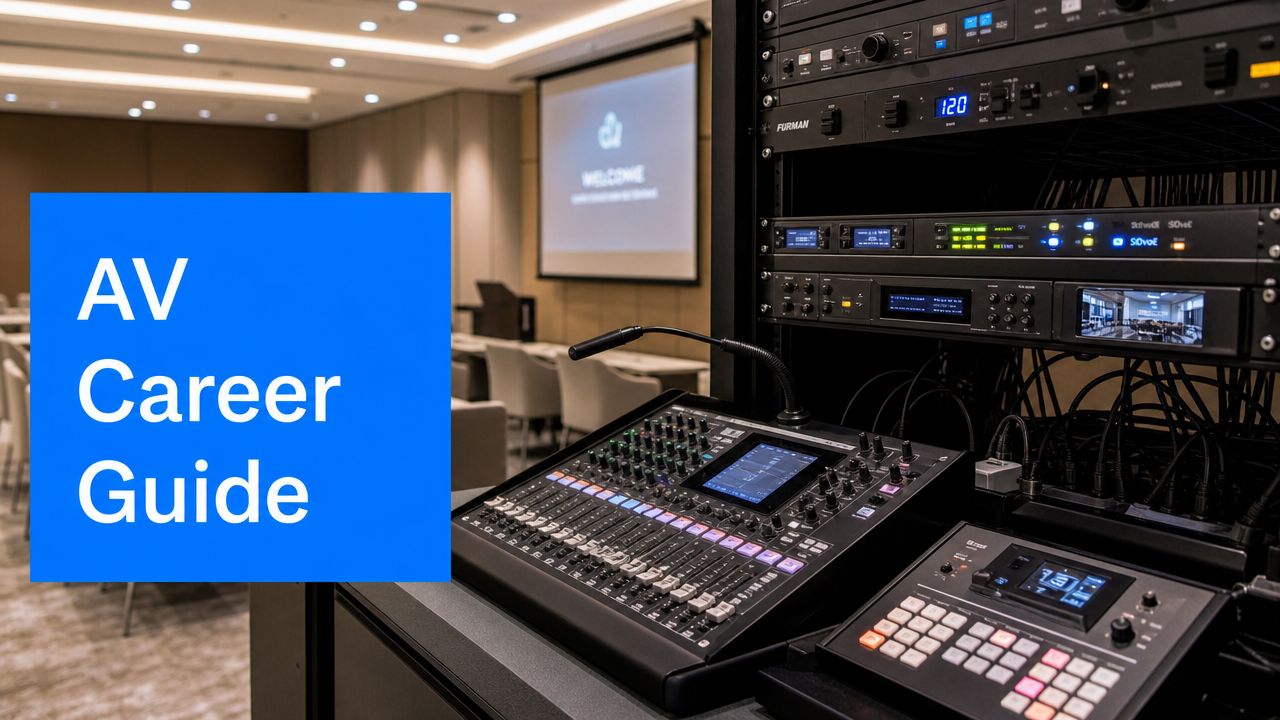
Most career advice about the Audio Visual Engineer role starts in the wrong place. It treats the job like a fancier version of event setup, as if the work is mostly projectors, speakers, and show calls. That description is outdated for a large part of the market.
In corporate campuses, universities, government facilities, and mixed-use venues, the modern AV engineer sits closer to systems integration than stagehand work. The job often includes system administration, software patching, security updates, and control-system programming, not just installation and troubleshooting, as noted in Level 3 Audiovisual's discussion of AV engineers in design. If you're aiming for a durable career, that distinction matters.
That shift changes how you should train, how you should present yourself to employers, and what kinds of jobs you should ignore. Someone who can rack gear and terminate cables is useful. Someone who can also read signal flow, support control systems, understand network dependencies, document a room standard, and commission a reliable collaboration space is much harder to replace.
The hiring market reflects that reality. Employers don't just want a person who can “make the room work.” They want someone who can design a room that still works after firmware updates, user error, conferencing platform changes, and a support handoff to internal IT.
Table of Contents
- Introduction The Modern Audio Visual Engineer
- What an Audio Visual Engineer Actually Does
- Core Skills and Essential Certifications
- Typical Employers and Key Industry Sectors
- Global Salary Benchmarks and Hiring Trends 2026
- Career Paths and Professional Progression
- How to Prepare Your Application and Ace the Interview
- Frequently Asked Questions About AV Engineering
Introduction The Modern Audio Visual Engineer
The strongest AV careers no longer sit only in ballrooms and live production trucks. They sit in meeting rooms, lecture halls, hybrid classrooms, control centers, executive briefing spaces, and standardized room fleets spread across multiple buildings. In those environments, reliability beats spectacle.
That's why the most useful way to think about an audio visual engineer is as an integrated systems and communications technologist. The role bridges displays, microphones, DSP, control processors, conferencing platforms, switching, streaming, user interfaces, documentation, and support workflows. A person in that seat has to understand where the technical failure points lie. It's rarely just “the screen won't turn on.”
Most AV failures that matter aren't single-device failures. They're handoff failures between audio, control, network, power, and user behavior.
A junior technician often sees hardware first. An engineer sees dependencies first. If a room keeps dropping remote participants, the problem could live in USB transport, DSP routing, echo cancellation design, control logic, firmware mismatch, or the way the room was documented for support. That's the mental shift.
There's also a career advantage in understanding this early. A lot of entry-level advice still points people toward basic setup experience alone. Basic setup helps, but it won't carry you into system ownership. Employers hiring for more advanced roles want someone who can reason through design intent, commissioning steps, and lifecycle maintenance.
Why the title matters less than the function
Companies use inconsistent titles. You'll see AV Engineer, Systems Engineer, AV Systems Specialist, Collaboration Engineer, Unified Communications Engineer, Media Systems Engineer, and Design Engineer. Don't get stuck on the label.
Focus on the function behind it:
- Designing signal flow
- Choosing interoperable equipment
- Supporting control and collaboration platforms
- Testing under real use conditions
- Documenting systems so others can maintain them
That's the version of the job worth building toward.
What an Audio Visual Engineer Actually Does
A real AV engineering job spans the full system lifecycle. A higher-level AV engineer is responsible for designing the signal flow to meet budget and technical requirements, building and testing the installation, and operating it on site, while translating client needs into an end-to-end architecture, according to Design and Integration's overview of the AV design engineer role.
From request to working system
The work usually starts with a use case, not with gear. A client or internal stakeholder says they need a divisible training room, a lecture capture space, or a boardroom that supports local presentation and remote calls. The engineer has to turn that vague request into something buildable.
That typically means working through several layers:
Functional intent
Who uses the room, what they do in it, what “success” looks like, and what must be simple enough for nontechnical users.System design
Signal paths, control logic, display choices, microphone strategy, DSP behavior, switching method, network dependencies, rack layout, and power planning.Documentation
Drawings, cable schedules, labeling standards, device lists, control narratives, commissioning checklists, and user-facing operating notes.Commissioning
Testing beyond power-on. That includes audio tuning, source switching validation, control-panel logic, fail-state behavior, conferencing workflows, and support handoff.
A weak engineer jumps straight to product selection. A strong one defines constraints first.
A boardroom example that shows the difference
Take a corporate boardroom. A technician can install displays, connect a camera, patch in microphones, and verify that video appears. An engineer has to ask harder questions.
Will the room run Microsoft Teams Rooms, Zoom Rooms, or a BYOD model? Does the client want a touch panel or one-button start workflow? What happens if the table layout changes? Is audio reinforcement needed locally, or only far-end capture? How will the room behave when the network team changes switch policies? Can the support desk identify faults without opening the rack?
Those questions affect every design decision.
A similar pattern shows up in streaming and overflow environments. If you're building a training room or event-capable boardroom with camera sources and external viewers, the transport path matters just as much as the cameras. For teams handling live distribution, OctoStream's RTSP to HLS streaming advice is a useful practical read because it highlights a real engineering issue: the format that works inside your production chain isn't always the format you should hand to viewers.
Practical rule: If the room works only when the designer is present, it wasn't designed well enough.
Permanent installation versus live event work
Both paths are valid, but they reward different instincts.
| Environment | What matters most | Common failure point | Best fit personality |
|---|---|---|---|
| Permanent installation | Standardization, documentation, reliability, serviceability | Poor commissioning and weak support handoff | Patient systems thinker |
| Live events | Speed, adaptability, recovery under pressure | Last-minute change and operator error | Fast operator and troubleshooter |
| Hybrid spaces | Workflow simplicity across in-room and remote users | Conferencing and signal-routing conflicts | Someone comfortable with both AV and IT |
If you want long-term institutional or enterprise work, learn to think in room standards, repeatable designs, support models, and lifecycle planning. That's where the title Audio Visual Engineer starts to mean something concrete.
Core Skills and Essential Certifications
The easiest mistake in this field is overvaluing gear familiarity and undervaluing systems thinking. Knowing Shure from Sennheiser, QSC from Biamp, or HDMI from HDBaseT is useful. It isn't enough.

The skill stack that gets people hired
A good audio visual engineer usually combines three layers of competence.
Technical hardware skills
This is the foundation. You need to understand signal flow, gain structure, loudspeaker coverage, microphone behavior, display selection, switching, cabling standards, EDID problems, and basic power discipline. You also need to troubleshoot both analog and digital paths without panicking.
That doesn't mean memorizing spec sheets. It means being able to answer practical questions such as:
- Why is the DSP not passing far-end audio
- Why does one laptop negotiate video properly and another fail
- Why does the room sound fine locally but poor on the call
- Why does the control system show a source selected while the display stays dark
Software and systems skills
This layer now decides who moves ahead. Many institutional and enterprise roles expect comfort with control systems, firmware, patching, room platforms, and network-aware AV. One university AV engineer role requires at least three years of experience designing and administering AV systems, hands-on troubleshooting of digital and analog equipment, and certifications including Crestron Digital Media Certification (DMC-E-4K) and AVIXA CTS, based on the Missouri State University AV Engineer job description.
That requirement tells you something important. Employers increasingly expect AV engineers to work with:
- Control platforms like Crestron or Q-SYS
- Conferencing ecosystems and room compute devices
- Patch and update workflows
- Networked media transport
- Security-minded support practices
For a broader hiring perspective, it also helps to review what employers screen for across technical roles in this breakdown of employer skill priorities.
Soft skills that stop projects from going sideways
Engineers who can't communicate create expensive confusion. You need to write clean documentation, explain trade-offs to nontechnical stakeholders, coordinate with electricians and network teams, and protect scope during design reviews.
Clean drawings and sane naming conventions save more time than heroic troubleshooting later.
Which certifications actually matter
Certifications aren't magic, but they do signal seriousness. In AV, they matter most when they map to the kind of work you want.
| Certification type | What it signals | Best use |
|---|---|---|
| AVIXA CTS | Broad professional baseline | Early credibility and general AV roles |
| Vendor control certification | Platform-specific competence | Roles involving programming and support |
| Digital media transport certification | Deployment familiarity | Enterprise switching and distribution environments |
| Audio networking training | Confidence with modern audio systems | Campus, corporate, and performance spaces |
If you're starting out, prioritize one broad certification and one platform-specific learning path. Don't collect random badges. Build a coherent profile that matches the jobs you want.
Typical Employers and Key Industry Sectors
A lot of newcomers assume AV careers mostly live in entertainment. That's visible work, but it isn't the whole market. Zippia reports that the largest share of audio-visual technicians works in education at 30%, followed by professional services at 12%, hospitality at 9%, and technology at 9%, in its audio-visual technician demographics and industry breakdown.
Where the work is concentrated
That breakdown matters because each sector teaches different habits.
In education, the work often revolves around lecture halls, classroom standards, capture systems, assistive listening, and supportable room fleets. Engineers in that world get strong at standardization and user simplicity because faculty and students won't tolerate complicated room startup.
In professional services, the focus shifts toward meeting equity, executive spaces, client presentation rooms, and conferencing reliability. The systems may look sleek, but the hard part is usually integration with workplace standards and support expectations.
In hospitality, AV sits closer to event operations, divisible spaces, ballroom infrastructure, digital signage, and flexible input scenarios. The systems must survive turnover, changing room setups, and nontechnical operators.
How the job changes by sector
| Sector | Typical environment | What employers value | Daily reality |
|---|---|---|---|
| Education | Classrooms, lecture halls, campus venues | Repeatable standards, supportability, documentation | Many rooms, many users, limited tolerance for downtime |
| Professional services | Boardrooms, training rooms, briefing centers | Reliability, polished UX, conferencing quality | Close work with IT, facilities, and executives |
| Hospitality | Hotels, conference centers, event spaces | Flexibility, quick resets, operator-friendly systems | A blend of permanent install and event support |
| Technology | Campuses, demo spaces, collaboration labs | Network awareness, automation, platform agility | Fast-changing standards and higher software expectations |
There's also a crossover niche in exhibitions and branded environments. Engineers who support trade-show systems, temporary displays, and interactive presentation spaces need to think about deployment speed and visitor flow as much as signal routing. For people curious about the physical realities of that environment, looking at how firms build exhibit booths gives useful context for the constraints AV has to fit inside.
One practical lesson: choose your sector based on what kind of problems you want to solve. Some people love repeatable room standards. Others want the chaos and variety of flexible event spaces. The tools overlap, but the work rhythm does not.
Global Salary Benchmarks and Hiring Trends 2026
A lot of global career content gets sloppy here. It mixes technician pay, engineer pay, installer pay, and designer pay into one number, then pretends the comparison is clean. It isn't. Titles vary too much across countries and employers.
This section works best as a planning tool, not as a promise.
The hardest verified labor signal available here is from the United States. The Bureau of Labor Statistics reports a median annual wage of $56,600 for related roles in May 2024, or about $27.21 per hour, and projects 1% employment growth from 2024 to 2034 while still expecting about 11,100 openings per year on average, mostly from replacement needs, according to the BLS profile for broadcast, sound, and video technicians. That tells job seekers something useful: even when growth is modest, recurring replacement demand keeps the field active.
A visual summary can help frame the international picture people often search for.

What the US data says clearly
The BLS number is not a perfect stand-in for every audio visual engineer job. It's still valuable because it grounds expectations in an official labor source rather than in recruiter folklore. It suggests a field with steady replacement demand, which is often healthier for entry and mid-level hiring than a boom-and-bust niche.
That said, pay moves up when you move from “equipment handling” toward “systems ownership.” Employers usually pay more for engineers who can design, commission, document, and support integrated systems than for general setup labor.
This video is useful if you want a visual overview of the field and how roles are discussed in practice.
Salary table for international planning
The following table is best treated as planning context supplied in the brief, not as verified market data from the sources above.
| Country | Entry-Level Range | Mid-Career Range | Senior/Designer Range |
|---|---|---|---|
| USA | $60k-$80k | $85k-$110k | $115k-$150k |
| UK | £35k-£50k | £55k-£75k | £80k-£100k |
| Europe | €40k-€60k | €65k-€90k | €95k-€120k |
| Asia-Pacific | $45k-$65k | $70k-$95k | $100k-$130k |
For broader role-by-role compensation research, compare those planning figures with a structured reference like the Go Hires complete salary database.
Pay usually follows a few patterns:
- Design capability pays more than basic support
- Control and programming skills pay more than pure hardware familiarity
- Enterprise and institutional complexity pays more than simple room refresh work
- Documentation and client-facing competence pay more because they reduce project risk
Career Paths and Professional Progression
The best AV careers don't move in a straight line. They widen first, then specialize.

The shift from hands-on support to systems ownership
Individuals often enter through a practical role. That could be installer, AV technician, on-site support, event tech, or media services support. Early on, the job is about dependable execution. Can you label correctly, terminate cleanly, troubleshoot calmly, and avoid creating preventable failures?
The next jump is where many people stall. To become a real audio visual engineer, you need to stop thinking only in tasks and start thinking in systems. That means understanding why the room was designed a certain way, what assumptions the design makes, and how the room should behave under normal and abnormal conditions.
A common progression looks like this:
| Stage | Main focus | What you must add to advance |
|---|---|---|
| AV Technician | Setup, support, basic troubleshooting | Documentation discipline and deeper signal-flow reasoning |
| Junior AV Engineer | Assist design, test systems, support commissioning | Control logic, platform familiarity, stakeholder communication |
| AV Engineer | Own portions of projects, troubleshoot across subsystems | Architecture thinking, standards, client-facing judgment |
| Senior AV Engineer | Lead complex projects and mentor others | Scope control, design review, escalation handling |
| Consultant or Manager | Strategy, standards, vendor coordination | Business judgment, lifecycle planning, leadership |
The promotion point usually comes when other people start trusting your design decisions, not just your hands.
What advancement really looks like
In practice, progression often happens through one of three lanes.
One lane is technical specialization. You become the person for DSP tuning, control programming, room standards, streaming workflows, or design documentation.
Another lane is project leadership. You still understand the technology, but your value shifts toward coordination, scope, risk management, and client communication.
The third lane is consulting or owner-side strategy. That's where you define standards, review integrator work, advise on room typologies, and influence procurement and lifecycle planning.
If you're early in your career, don't rush to specialize too narrowly. Broad competence helps first. Once you've seen enough failed handoffs between disciplines, you'll know where your strongest value sits.
How to Prepare Your Application and Ace the Interview
Most AV resumes undersell the work. They read like inventory lists. Employers don't hire engineers because they've touched many products. They hire them because they can solve messy system problems with discipline.
Resume bullets that sound like engineering work
Weak resume bullet:
- Managed AV equipment for meetings and events
Better versions:
- Supported commissioning of multi-room collaboration systems, including source validation, microphone testing, DSP verification, and user acceptance walkthroughs
- Produced rack documentation, labeling standards, and change notes that improved support handoff between installation and operations teams
- Troubleshot recurring room issues across displays, control panels, and conferencing peripherals, isolating failures by subsystem instead of replacing parts blindly
The difference is simple. The stronger bullet shows scope, method, and technical judgment.
A strong application package usually includes:
- A targeted resume focused on systems, not generic tech support
- A project list with short descriptions of room types and your role
- A small portfolio with sanitized drawings, rack photos, UI screenshots, or commissioning checklists
- A clear summary that states whether you're stronger in installation, design support, control, conferencing, or operations
If you need a structured framework for mock interviews and answer practice, use a dedicated resource like Go Hires interview preparation guidance.
Interview questions worth preparing for
Technical interviews in AV often reveal whether you think systematically or just memorize terms. Expect questions like these:
- Walk me through your process for troubleshooting a room with no far-end audio
- What's the difference between a control problem and a transport problem
- How would you validate a new room before handoff
- When would you choose local switching instead of networked distribution
- How do you document changes made during commissioning
- What usually causes conferencing rooms to fail after a software update
- How do you work with IT when the network team owns the switching environment
Behavioral questions matter too:
- Tell me about a design assumption that turned out to be wrong
- Describe a time a system passed bench testing but failed in the room
- How do you explain technical compromises to a nontechnical client
Bring one project you can explain end to end. Interviewers remember coherent stories more than scattered product knowledge.
A portfolio doesn't need to be glamorous. It needs to prove that you understand real environments, real constraints, and real handoffs.
Frequently Asked Questions About AV Engineering

Ten practical questions job seekers ask
1. Do I need an engineering degree to become an audio visual engineer?
Usually, no. Many employers care more about hands-on systems experience, documentation quality, troubleshooting ability, and platform knowledge. A degree can help, but a strong project record often matters more in this field.
2. Is live event experience enough to move into corporate or university AV engineering?
It can be a good start, but it usually isn't enough by itself. You need to add permanent-install thinking, room standards, commissioning discipline, documentation, and comfort with supportable long-term systems.
3. How important is networking knowledge?
It's now hard to avoid. You don't need to become a full network engineer, but you do need to understand how AV systems behave in IT-managed environments and how control, conferencing, and media transport depend on that environment.
4. Do I need to learn programming?
Some level of logic and control understanding helps a lot. You don't need to become a software developer for every AV role, but if you can work with control workflows, structured configuration, and scripted behaviors, you become more useful.
5. What certifications should I start with?
Start with one broad certification that signals baseline professionalism, then add training tied to the platforms employers in your target market use. The best certification path is the one that matches your intended role.
6. Is the job physically demanding?
Entry-level work often is. Installation, cable pulling, rack building, and field support can be physical. Design-heavy and owner-side roles usually become less physical over time, though site work still matters.
7. Can someone from IT switch into AV engineering?
Yes, and often successfully. IT professionals usually adapt well to conferencing, control, device management, and support workflows. They usually need to deepen their understanding of acoustics, signal flow, and physical system behavior.
8. What does work-life balance look like?
That depends heavily on sector. Live events and hospitality can involve irregular hours. Corporate and higher education roles are often more stable, though major cutovers, executive support, and campus events can still create long days.
9. Are remote AV jobs common?
Fully remote field roles aren't common because systems still live in physical spaces. Remote-friendly work is more realistic in design, documentation, programming, standards development, and some support functions.
10. What makes someone advance faster in this field?
Three things usually stand out: reliable troubleshooting, clean documentation, and the ability to explain technical trade-offs without drama. People advance when others trust both their technical judgment and their project behavior.
The field rewards people who stay curious. Products change. Platforms change. User expectations change. The engineers who keep moving forward are the ones who learn new tools without losing the basics of signal flow, usability, and reliability.
If you're comparing AV engineering opportunities across countries, roles, and salary levels, Go Hires is a useful place to continue your research. It helps job seekers evaluate global career paths with clearer market context, practical employment intelligence, and tools for more informed decisions.