Search “best job search apps,” and you usually get one of two lists: only the big global names, or only small Canadian boards you have never heard of. This guide covers both, so you know upfront what is a true mobile app and what is a web-first platform, and which one actually fits your search for full-time jobs near me, part-time jobs near me, or your next career move.
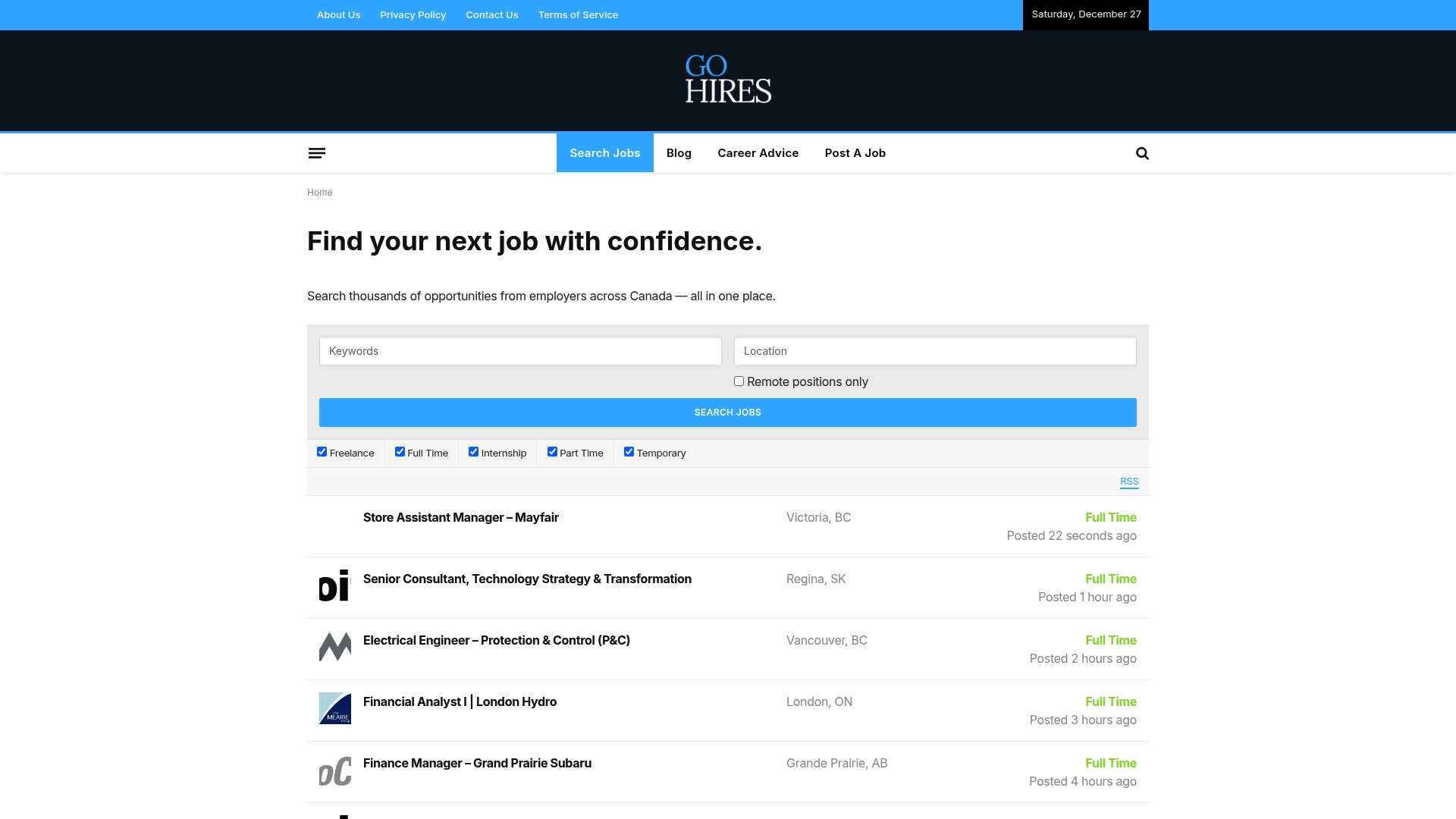
Gohires is a Canada-focused job platform built for recent graduates and young professionals who want to search real Canadian job opportunities without wading through international listings that do not apply to them. The site centralizes full-time, part-time, freelance, internship, and temporary roles, and it pairs those listings with practical career resources like resume tips and interview guides. For employers, Gohires offers a straightforward free posting option, which keeps the flow of new listings steady. Bottom line: Gohires is a web-first, usability-driven hub built to match early-career job seekers with relevant Canadian opportunities fast.
Core Features
Gohires keeps its feature set tight and focused on what actually helps a job search move forward: nationwide search with filters for keywords, location, remote work, and job type (so a search for part time jobs near me or full time jobs near me in your city returns something usable instead of noise); a career advice section with resume and interview guidance; free job posting for employers, which lowers the barrier to hiring; and aggregated listings pulled from employers across the country. The whole interface is built around two actions: finding a job and applying to it, without extra steps in between.
Pros
Wide range of job opportunities across Canada. The platform aggregates listings from many employers, so you get access to thousands of openings across multiple sectors and regions.
Career resources built in, not bolted on. Gohires pairs listings with resume tips and interview guides, so you can move from “how do I fix my resume” to “here is a job I can apply to” without leaving the site.
Free for employers to post jobs. No upfront cost for employers means a steadier stream of fresh listings for job seekers.
Search filters that actually narrow things down. Keyword, location, remote, and job type filters cut through the noise fast.
Who It’s For
Gohires works best for Canadian recent graduates and young professionals chasing entry-level or early-career roles, internships, and contract work across Canada. It also suits small businesses and local employers who want a low-friction, no-cost way to post openings to motivated candidates. If you want a clean, search-first experience that treats job search tips for recent graduates as part of the same platform instead of a separate resource, this is built for you.
Unique Value Proposition
Gohires stands out because it combines full Canadian job coverage with career support that actually sits inside the same workflow, plus a posting model that costs employers nothing. Broad, global boards will surface roles in cities and countries that do nothing for you. Gohires stays Canada-only and leans into the entry-level jobs in Canada use case that recent grads care about most. The free posting policy for employers keeps listings fresh, which directly benefits anyone job hunting right now.
Real World Use Case
Say you just graduated and need a part-time role while you keep searching for something full-time. You filter for listings near you, save a handful of postings, upload your resume once, and apply to several roles in one sitting. Meanwhile, a small employer across town posts an entry-level opening for free and shortlists applicants within days. That loop, from discovery to application to hire, is what Gohires is built around.
Pricing
Free for job seekers. Employers pay to post jobs.
Website: gohires.com
Indeed
At a Glance
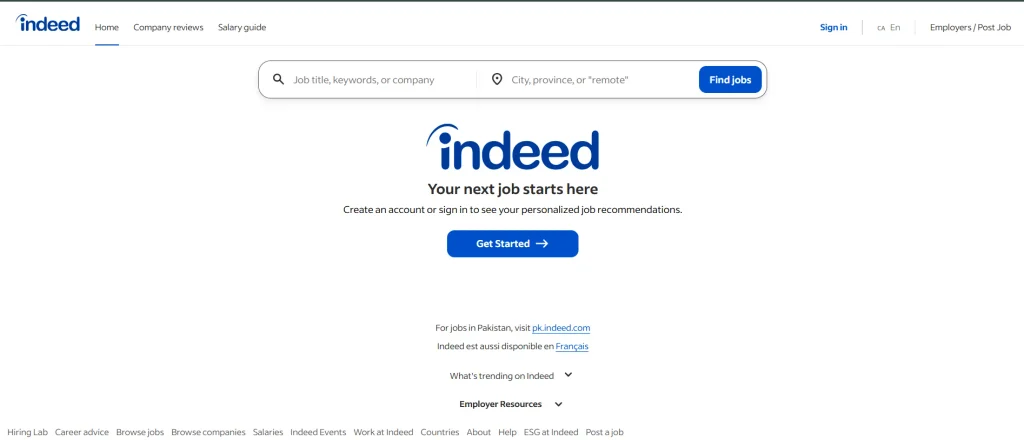
Indeed is the platform most people picture when they type “best job search apps” into Google, and there is a reason for that. It aggregates listings from company career pages, staffing agencies, and its own direct postings into one searchable feed, then lets you filter, save, and apply from a single account. For Canadian users, ca.indeed.com runs the same core experience as the US and global versions, with listings pulled specifically from Canadian employers.
Core Features
Indeed’s core job search and application tools stay free for everyone. You get keyword and location search, salary filters, company pages, one-click apply on many listings, and job alerts sent straight to your inbox. Indeed also lets job seekers turn on an optional monthly subscription that highlights their applications to employers, though this sits on top of a free experience rather than replacing it. On the employer side, Indeed runs a pay-for-performance model: posting a job is free, and employers can choose to sponsor a listing with a flexible daily budget to push it higher in search results.
Pros
Largest volume of listings in one place. Because Indeed aggregates from so many sources, you are less likely to miss a relevant opening simply because it was posted somewhere else.
Fast, low-friction applications. Many postings support one-click apply using your saved Indeed resume, which cuts down repetitive form-filling.
Free core experience. Search, apply, save jobs, and set alerts without paying anything.
Company reviews and salary estimates built in. You get a rough sense of pay and workplace reputation without leaving the app.
Cons
Almost no Canada-specific career guidance. Indeed is built as a global search tool, not a Canadian career resource. You will not find dedicated content on Canadian work permits, provincial licensing, or newcomer support the way you would on Job Bank Canada or Gohires.
Listing quality varies. Because postings come from so many sources, you will run into outdated, duplicate, or vague listings mixed in with strong ones.
Sponsored listings can crowd organic results. Paid postings often rank above unpaid ones, which means the “top of search” is not always the newest or best-fit opening.
Who It’s For
Indeed suits anyone who wants the widest possible net cast across Canadian job listings, especially if you are searching broad terms like part time jobs near me or full time jobs near me and want maximum volume before narrowing down. It also works well for job seekers who already know what role they want and just need an efficient way to apply to many postings quickly.
Unique Value Proposition
Indeed’s real strength is scale. No other platform in this comparison pulls in as many listings from as many sources, which makes it the fastest way to see what is actually open right now across a huge range of industries and cities. That volume comes at the cost of the personalized, Canada-specific guidance you get from Gohires or Job Bank Canada, so most job seekers get the best results using Indeed alongside a more Canada-focused platform rather than instead of one.
Real World Use Case
Picture someone relocating to a new Canadian city for a partner’s job. They do not yet know which neighborhoods or industries are hiring, so they run a broad Indeed search across the whole metro area, save fifteen listings that look promising, and apply to the five strongest matches using the one-click apply feature, all before lunch.
Pricing
Free for job seekers to search, apply, save jobs, and set alerts. An optional paid subscription highlights job seeker applications to employers. Employers post for free and pay only if they choose to sponsor a listing for extra visibility.
Website: ca.indeed.com
LinkedIn
At a Glance
LinkedIn is part social network, part job board, and that combination is exactly why it works differently from Indeed or Gohires. Instead of just searching listings, you are searching listings while also seeing who at that company you already know, what your mutual connections think of the role, and whether a recruiter from that company has looked at your profile recently. For professional and mid-career roles, that context often matters more than raw listing volume.
Core Features
LinkedIn’s free tier covers job search, saved searches, job alerts, applying directly through the platform, and a limited number of InMail messages each month to reach out to people outside your network. LinkedIn Premium Career, a paid upgrade that generally runs somewhere in the $30 to $40 USD range per month depending on billing cycle and region, adds more InMail credits, the ability to see who viewed your profile, salary insights tied to specific job postings, and access to LinkedIn Learning courses. None of this paid tier is required to search or apply for jobs. It exists to add extra visibility and networking reach on top of the free experience.
Pros
Networking and job search live in the same place. You can message a hiring manager directly, check who at a company you already know, and apply to the role without switching apps.
Strong for professional and mid-career roles. Recruiters actively source candidates through LinkedIn, so an updated, well-written profile can generate inbound interest without you applying to anything.
Company and industry insight built in. Company pages show employee counts, recent hires, and posts, which gives you real context before an interview.
Free tier covers the essentials. Search, apply, and message within your existing network without paying anything.
Cons
Less useful for entry-level or hourly roles. LinkedIn’s networking-heavy model favors people who already have some professional connections, which puts recent grads and hourly workers at a disadvantage compared to Gohires or Indeed.
Premium pricing can feel steep for the return. At $30 to $40 USD a month, Premium Career is a real cost, and plenty of job seekers report using it only during an active search, then canceling once they land a role.
Profile maintenance takes ongoing effort. LinkedIn rewards an active, regularly updated profile, which means it asks more upkeep than a straightforward job board.
Who It’s For
LinkedIn fits professionals building a career in a specific industry, especially anyone in mid-career or senior roles where networking and recruiter visibility genuinely move the needle. It also suits job seekers who want to research a company deeply, follow industry conversations, and build a professional presence that outlasts any single job search.
Unique Value Proposition
No other platform in this comparison combines job search with a working professional network the way LinkedIn does. That matters because a large share of roles, especially at the mid-career and senior level, get filled through referrals and direct recruiter outreach before they ever show up as a public listing. LinkedIn puts you in front of that hidden layer of hiring, which Indeed, Gohires, and Job Bank Canada, all built primarily around public listings, cannot fully replicate.
Real World Use Case
A marketing coordinator with three years of experience wants to move into a management role. She updates her LinkedIn profile, follows five companies she admires, and reaches out to a former coworker who now works at one of them. That coworker forwards her resume internally before the role is even posted publicly, and she skips the open-application queue entirely.
Pricing
Free to search, apply, and message within your network. LinkedIn Premium Career adds InMail credits, profile insights, and learning content for roughly $30 to $40 USD per month, though exact pricing varies by region and billing term, so confirm current rates directly on LinkedIn before subscribing.
Website: linkedin.com/jobs
Glassdoor
At a Glance
Glassdoor answers a different question than the other platforms on this list. Instead of “what jobs are open,” it answers “should I even want to work here.” The platform runs on anonymous employee reviews, self-reported salaries, and interview experiences shared by people who have actually been through the process at a given company. It does host job listings too, but most users treat it as a research tool first and an application tool second.
Core Features
Glassdoor’s core offering is company intelligence: anonymous reviews of management, culture, and work-life balance, self-reported salary ranges by role and location, and interview question breakdowns submitted by past candidates. It layers job listings on top of that data, so you can search openings while seeing the same company’s review score and salary range right next to the posting. Some deeper salary and review data stays locked until you contribute your own review or salary information, which keeps the database fresh but adds a small barrier for brand-new users.
Pros
Genuine transparency into company culture. Reviews come from real employees, not marketing copy, which gives you a more honest read on what a workplace is actually like.
Salary data tied to specific roles and locations. You can walk into a salary negotiation with a real sense of the market range instead of guessing.
Interview prep grounded in real experiences. Past candidates share the actual questions they were asked, which beats generic interview advice.
Job listings paired with context. Seeing a listing next to that company’s review score helps you filter out red flags before you apply.
Cons
Weaker as a pure application tool. Glassdoor’s search and apply flow feels thinner than Indeed’s or Gohires’, since the platform’s real strength sits in research, not application volume.
Some data requires a contribution first. Full salary ranges and detailed reviews for certain companies stay gated until you submit your own data, which can frustrate first-time visitors.
Review quality varies by company size. Smaller or newer employers may have only a handful of reviews, which makes the data less reliable than it looks.
Who It’s For
Glassdoor suits job seekers who want to vet a company’s reputation and pay range before investing time in an application, especially anyone who has been burned before by a workplace that looked fine on paper. It works well used alongside Indeed or Gohires rather than as your only job search app, since it is built for research more than volume.
Unique Value Proposition
Glassdoor’s real differentiator is honesty at scale. Anyone can claim a company has “great culture” in a job posting. Glassdoor exists specifically to check whether that claim holds up, using data straight from people who worked there. That single function, paired with real salary transparency, is why so many job seekers treat it as a required stop before accepting an offer, not just before applying.
Real World Use Case
Before accepting an interview invitation from a mid-size logistics company, a job seeker checks its Glassdoor page and finds a string of recent reviews mentioning high turnover in the exact department she would join. She still takes the interview, but she goes in with specific questions about team stability instead of finding out the hard way three months into the job.
Pricing
Free to search jobs and browse most reviews and salary data. Some detailed salary and review information unlocks after you contribute your own review, salary, or interview experience.
Website: glassdoor.ca
Job Bank Canada
At a Glance
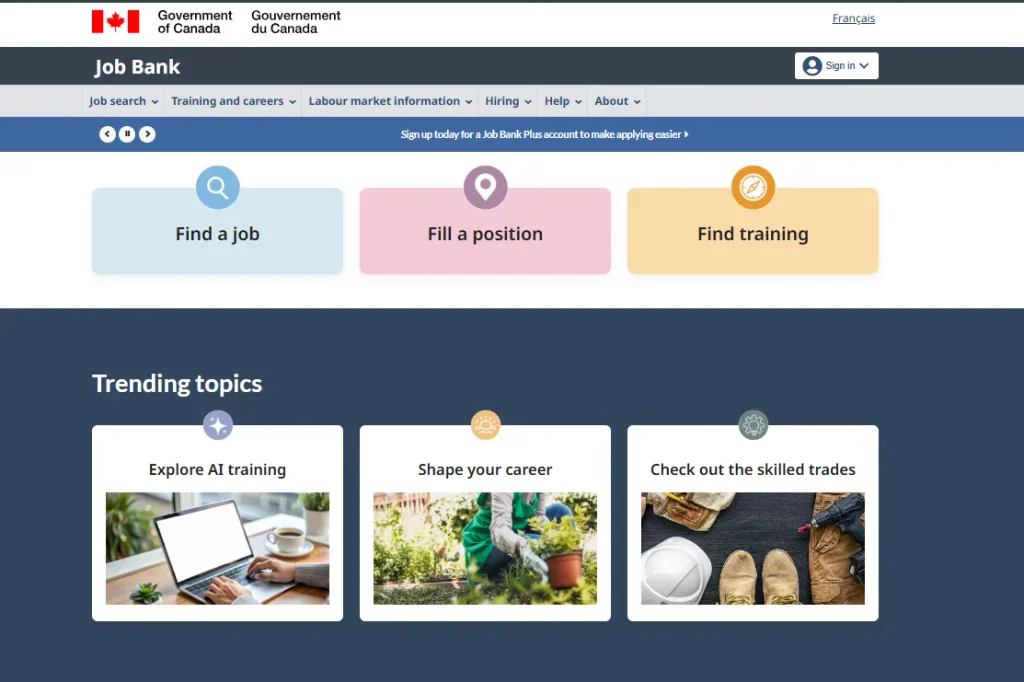
Job Bank Canada is the Government of Canada’s own employment platform, and it is the one government-run option in this comparison. It combines a large, verified pool of job postings with labour market data and career planning tools built for a wide range of Canadians, including veterans, newcomers, youth, and persons with disabilities. According to Job Bank’s own reporting on its site, the platform advertises roughly 105,000 job postings per month on average, works with over 300,000 registered employers, and sees around 14.7 million job posting views every month. That kind of volume, backed by a government source rather than a private aggregator, makes it a solid first stop for anyone job hunting across Canada.
Core Features
Job Bank Canada pairs a national job search engine with labour market information and career planning tools. You can create a free account to save searches and set up alerts, run a job transition tool to explore related career paths based on your current skills, and access dedicated resources for veterans, newcomers, youth, and persons with disabilities. Employers can also post openings and search for candidates directly, which makes the platform a genuine two-way system rather than a one-directional listing site.
Pros
Government-backed listings you can trust. Postings go through Job Bank’s own verification process, which cuts down on the outdated or duplicate listings you sometimes find on aggregator sites.
Completely free, including registration. There is no cost to search, apply, or create an account, which matters if you are job hunting on a tight budget.
Targeted support for specific groups. Dedicated resources for veterans transitioning to civilian work, newcomers navigating Canada’s current labour market for the first time, youth, and persons with disabilities go beyond what a typical job board offers.
Labour market data alongside listings. You get context on where demand is concentrated by region and occupation, not just a list of openings.
Real volume. With over 100,000 postings advertised monthly and hundreds of thousands of registered employers, this is not a small or niche database.
Cons
Canada-only by design. If you are exploring roles outside Canada, this platform will not help you.
Primarily English and French. Those are Canada’s official languages, but job seekers who need support in another language may find coverage limited here.
Interface feels more functional than polished. Job Bank prioritizes accuracy and government reliability over the slicker design you get from private platforms like Gohires or Indeed.
Who It’s For
Job Bank Canada is ideal for Canadian job seekers who want an official, government-verified source of listings, especially recent graduates, veterans, newcomers to Canada, and anyone who wants labour market context alongside job ads. Employers who want to reach a verified pool of Canadian candidates without paying for premium placement will also find real value here.
Unique Value Proposition
Job Bank Canada’s real advantage is trust. It is the only platform in this comparison run directly by a government body, which means the postings, labour market data, and career resources come from an authoritative source rather than a private company optimizing for engagement or ad revenue. That combination of scale and reliability is hard to match anywhere else on this list.
Real World Use Case
A veteran preparing to leave military service uses Job Bank Canada’s job transition tool to see which civilian roles draw on skills from their military occupation. They browse national listings tied to that new career direction, use the veteran-specific resources to prepare a competitive application, and land three interviews within a month, all without paying a cent along the way.
Pricing
Completely free, including optional account registration for extra tools like saved searches and alerts.
Website: jobbank.gc.ca
Other Canadian Job Boards Worth Knowing
HiJob is a simple Canadian board built around posting, applying, and resume management. It suits early-career job seekers who want a no-frills option, though its listings stay mostly Canada-only and some features sit behind registration.
CanadaHires offers unlimited free job postings that stay live for 60 days, plus paid promotion tiers for employers wanting extra visibility, historically starting around $99 and scaling up. Confirm current pricing directly on the site, since promotional tiers change.
Full Comparison of Job Search Platforms for Canadians
Feature / Platform
Gohires
Indeed
LinkedIn
Glassdoor
Job Bank Canada
Focus Area
Entry-level jobs and career resources in Canada
High-volume global aggregator
Networking plus job search
Company research and reviews
Government-verified listings
Primary Features
Nationwide search, free employer posting
One-click apply, company reviews
InMail, recruiter visibility
Salary data, reviews
Labour market data, job transition tool
Best For
Entry-level roles, small business hiring
Widest net across listings
Mid-career networking
Vetting a company first
Verified listings with context
Pricing
Free for job seekers
Free core; optional subscription
Free; Premium ~$30–$40/mo
Free; some data gated
Completely free
Canada Focus
Canada-only
Global, strong Canadian coverage
Global
Global
Canada-only
Find Your Perfect Canadian Job With Confidence
If your goal is entry-level or part-time work across Canada, backed by real resume and interview support, Gohires is built for exactly that. Search thousands of jobs by keyword, location, remote status, or type, including freelance and internships. Employers post for free here too, so fresh opportunities keep showing up, and our career advice section helps you get application-ready without leaving the site.
Ready to move your job search forward? Visit Gohires to start searching and apply directly today.
Frequently Asked Questions
What is the best job search app for Canadians in 2026?
There is no single winner. Indeed gives the widest listing volume, LinkedIn suits networking and mid-career roles, Glassdoor helps you research a company first, and Job Bank Canada and Gohires focus specifically on the Canadian market. Most job seekers combine two or three of these.
Is Indeed or LinkedIn better for finding a job in Canada?
Indeed wins on volume and speed, which suits entry-level and high-turnover roles. LinkedIn wins for professional and mid-career roles where a connection or recruiter message gets your resume seen early. Start with Indeed if you are early-career; build your LinkedIn profile too if you already have industry contacts.
Are there job search apps specifically for Canada?
Yes. Job Bank Canada is the government’s own platform, and Gohires is a private platform built the same way, both focused entirely on Canadian listings without international noise.
Do job search apps cost money?
Rarely for job seekers on the core experience. Costs mostly show up as optional subscriptions, like LinkedIn Premium, or on the employer side through sponsored listings and premium boosts.
What’s the difference between a job board and a job search app?
A job board is typically web-first and browsing-focused, while a job search app is built primarily for mobile use with push alerts and quick apply. Indeed and LinkedIn work as true apps. Job Bank Canada and Gohires are web-first but still work well on mobile.



1 Comment
Pingback: Top Job Boards in Canada 2026: Full Comparison Guide