


Landing that first professional role as a recent Canadian graduate feels both exciting and daunting. In a market where employers scan dozens of applications for each position, your resume is often your only chance to stand out. More than a simple list of past activities, a resume is a targeted, persuasive document that showcases your best assets and positions you as the ideal candidate. Mastering the art of an impactful resume gives you the edge needed to secure interviews and move your career forward.
Table of Contents
- Defining The Resume And Its Purpose
- Main Types Of Resumes And Core Differences
- How Resumes Impact Hiring In Canada
- Essential Elements Of A Successful Resume
- Current Resume Trends For Canadian Graduates
- Common Pitfalls And How To Avoid Them
Key Takeaways
| Point | Details |
|---|---|
| Resume Purpose | A resume is a strategic document focused on showcasing your qualifications and achievements relevant to a specific job, acting as a marketing tool rather than a comprehensive career history. |
| Resume Format | Choose the appropriate resume format (chronological, functional, or combination) based on your career situation to effectively highlight your strengths. |
| ATS Compatibility | Ensure your resume is optimized for Applicant Tracking Systems by including relevant keywords and maintaining a clean, professional format to improve visibility. |
| Customization is Key | Tailor your resume for each job application by aligning your experiences and skills with the specific requirements of the position to enhance your chances of getting noticed. |
Defining the Resume and Its Purpose
A resume is a concise, targeted document that summarizes your education, work experience, and skills relevant to a specific job opportunity. Think of it as your professional introduction before you ever shake hands with a hiring manager. Unlike a full biography or portfolio, a resume distills your background into a focused snapshot designed for quick consumption. A resume summarizes your abilities, education, and experience to help differentiate you from other candidates. For Canadian job seekers, this document becomes your gateway to landing interviews in a competitive employment market.
The primary purpose of your resume goes beyond simply listing what you’ve done. Your resume must be user-centered and persuasive, designed to be skimmed quickly by busy recruiters and hiring managers who often spend less than 30 seconds on an initial review. In Canada’s job market, where employers receive dozens of applications for single positions, your resume needs to immediately answer the question: “Why should we interview this person?” This means every line should contribute to demonstrating your value for the specific role. Rather than being a comprehensive career history, your resume functions as a marketing document that highlights your strongest assets and makes the case for why you’re the right fit.
For recent Canadian graduates entering the workforce, understanding this distinction matters significantly. You might assume your resume should capture everything you’ve accomplished. That approach creates bloated documents that fail to catch attention. Instead, successful resumes strategically choose which experiences, skills, and accomplishments to include based on the job description. A resume showing five relevant projects from a summer internship outperforms one listing ten generic responsibilities from the same role. When crafting your resume with proper formatting and structure, you’re essentially building a persuasive argument tailored to each employer’s needs.
What your resume cannot do alone is get you hired. A strong resume opens the door to interviews, but it won’t secure job offers by itself. Think of it as the first filter in a multi-stage hiring process. Employers use resumes to identify candidates worth interviewing. Your interview performance, references, and how you demonstrate your skills on the job ultimately determine whether you get hired. Your resume simply ensures you reach that interview stage in the first place.
Pro tip: Save different versions of your resume tailored to specific job types or industries you’re pursuing, adjusting which accomplishments and skills appear based on what each employer values most.
Main Types of Resumes and Core Differences
Not all resumes look or function the same way. The format you choose shapes how employers perceive your background and what information catches their attention first. Understanding the main resume types helps you select the approach that best showcases your qualifications for the Canadian job market. The three primary formats are chronological, functional, and combination resumes, each serving different career situations and job seeker profiles.
A chronological resume lists your work history in reverse order, starting with your most recent position. This format emphasizes career progression and shows employers exactly where you’ve worked and when. It works exceptionally well if you have consistent employment history without significant gaps. For recent Canadian graduates with internships, co-op positions, or entry-level jobs, the chronological format demonstrates how your experience builds logically toward the position you’re pursuing. However, if you switched careers multiple times or have employment gaps, this format can highlight those gaps in ways you might prefer to avoid.
A functional resume focuses on skills and abilities rather than dates and job titles. This approach groups your competencies by category, such as “Project Management,” “Customer Service,” or “Technical Skills.” Functional resumes prove particularly useful for career changers or those with employment gaps because they redirect focus away from timeline inconsistencies. For instance, if you spent two years freelancing while exploring different opportunities, a functional resume lets you highlight the concrete skills you developed rather than emphasizing the non-traditional employment path.
A combination resume merges the strengths of both approaches. This format highlights your most relevant skills at the top, followed by your work history in chronological order. It allows you to showcase specific competencies employers are seeking while also demonstrating your career progression. Many Canadian job seekers find combination resumes ideal because they balance flexibility with credibility. You can lead with skills that match the job posting, then back them up with concrete examples of where and when you developed those skills.
Choosing between these formats depends on your specific situation. If you’re a recent graduate with steady internships building toward your field, chronological works well. If you’re changing directions or have employment gaps to minimize, functional gives you control over the narrative. If you want maximum impact showing both skills and progression, combination offers that versatility. The wrong format can actually work against you by obscuring your strongest qualifications.
| Resume Type | Best For | Key Advantage | Main Limitation |
|---|---|---|---|
| Chronological | Steady career progression | Shows clear growth and timeline | Highlights gaps and job changes |
| Functional | Career changers, gaps | Emphasizes skills over timeline | Some employers distrust skill focus |
| Combination | Most job seekers | Balances skills with progression | Requires more careful organization |
Pro tip: Match your resume format to the job posting by highlighting the skills and experiences the employer emphasizes most, regardless of which format you choose.
How Resumes Impact Hiring in Canada
Your resume doesn’t arrive at a hiring manager’s desk the way it did a decade ago. In today’s Canadian job market, your resume must first pass through an invisible gatekeeper: an Applicant Tracking System, or ATS. Most Canadian employers, particularly larger organizations, rely on these automated screening tools to review hundreds or thousands of applications before a single human ever looks at your document. Understanding how this process works fundamentally changes how you should write your resume.
ATS software scans resumes for specific keywords, job titles, and formatting patterns that match the job posting. If your resume doesn’t align with what the system is programmed to find, it gets rejected automatically, regardless of how qualified you actually are. This creates a dual challenge: your resume must be readable by both ATS and human recruiters, which means balancing optimization for machines with creating content that resonates with people. For example, if a Canadian employer posts a job for a “Marketing Coordinator,” your resume needs to include that exact title somewhere in your experience section, not just similar titles like “Marketing Assistant” or “Communications Specialist.” The ATS won’t recognize the connection, and your application disappears.
Beyond ATS compatibility, Canadian employers specifically look for concrete evidence of results and impact. Rather than simply listing duties you performed, successful Canadian resumes showcase measurable achievements. If you managed a social media account, don’t write “Responsible for posting company updates.” Instead, write “Increased social media engagement by 42% over six months by implementing targeted posting strategy.” Numbers grab attention. They prove you delivered value, not just completed tasks. Clean formatting also matters significantly. Avoid unusual fonts, graphics, tables, or unconventional layouts that ATS systems struggle to parse. Simple, readable formatting with consistent bullet points and clear section headers ensures your resume survives both the machine screening and the human review.

For candidates with international experience, Canadian employers often want to see Canadian context. If you completed an internship abroad or worked in another country, emphasize how those skills transfer to the Canadian job market and highlight any Canadian experience or education you have. Cultural differences in resume presentation can work against you if you’re emphasizing duties over achievements or using formatting that doesn’t align with Canadian expectations. Your resume is your first communication with a Canadian employer, and it must immediately demonstrate that you understand what they value: measurable results, clear communication, and relevant experience presented in a format they can actually process.
Pro tip: Copy key phrases and job titles directly from the job posting into your resume where they genuinely match your experience, ensuring the ATS recognizes your qualifications and passes your application forward.
Essential Elements of a Successful Resume
A successful resume isn’t just a list of jobs you’ve held. It’s a strategic document constructed from specific elements that work together to catch attention, pass automated screening, and compel hiring managers to invite you for an interview. Understanding what belongs in your resume and how to present it matters as much as what you’ve actually accomplished.
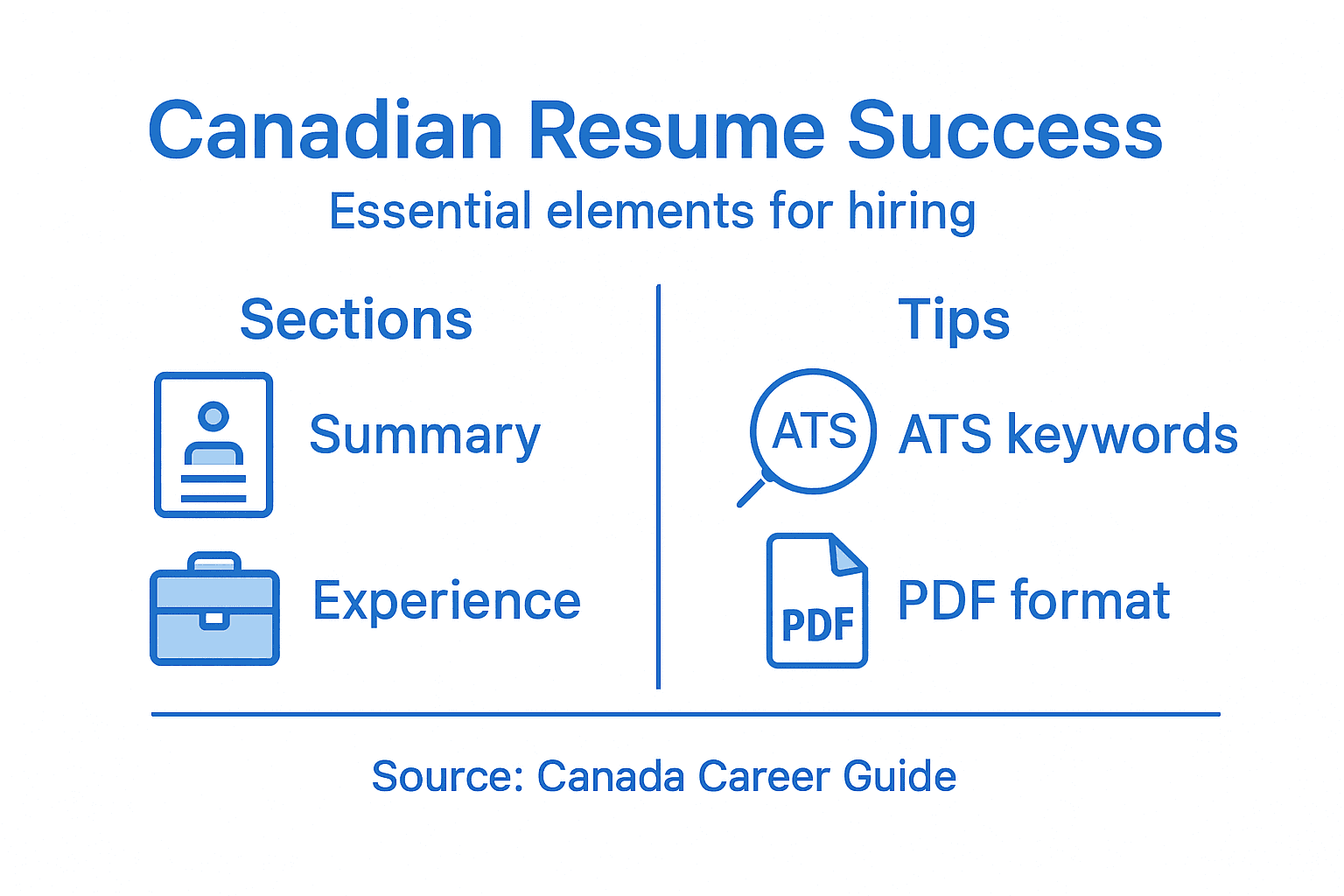
Start with clear formatting and structure that makes your resume instantly scannable. Hiring managers spend seconds, not minutes, reviewing each application. Use consistent fonts, adequate white space, and logical section breaks with clear headings. Avoid fancy graphics, unusual colors, or complicated layouts that distract from your content or confuse ATS systems. Your contact information should appear at the top, followed by sections like Professional Summary, Experience, Education, and Skills. Action verbs and compelling bullet points describing accomplishments transform ordinary descriptions into compelling evidence of your value. Instead of “Worked on marketing projects,” write “Launched three digital marketing campaigns that generated 250,000 impressions and increased website traffic by 35%.” That difference matters enormously.
Your Professional Summary should be four lines or fewer, highlighting your key qualifications and career goals relevant to the specific role. Rather than generic statements like “Hard-working professional seeking growth,” create a targeted summary: “Marketing professional with three years of digital campaign experience and proven ability to increase brand engagement across social platforms. Strong track record of delivering results that exceed targets by 20 percent plus.” Next comes your Experience section, organized in reverse chronological order, where you emphasize achievements over duties. For each role, include your job title, company name, dates employed, and accomplishments with measurable results. The Skills section should reflect the keywords and competencies highlighted in the job posting. If the posting mentions “project management,” “data analysis,” and “client communication,” ensure those terms appear in your resume when you genuinely possess them. Finally, your Education section lists degrees, institutions, graduation dates, and relevant coursework or honors.
Avoid common mistakes that weaken resumes. Never use personal pronouns like “I,” “me,” or “we”—let your accomplishments speak for themselves. Be concise. Aim for one page if you’re a recent graduate, maximum two pages if you have extensive experience. Tailor your resume for each job application, emphasizing the experiences and skills that align with what that specific employer values. Generic, one-size-fits-all resumes rarely succeed because they fail to demonstrate that you understand the role or the organization. Spelling errors, inconsistent formatting, and vague descriptions kill applications instantly. Proofread multiple times and have someone else review your work before submitting.
Pro tip: Save your resume as a PDF rather than a Word document to preserve formatting across different systems and ensure ATS software can properly read your content.
Here’s how different resume sections contribute to your job search impact:
| Resume Section | Key Contribution | Mistake to Avoid |
|---|---|---|
| Professional Summary | Captures attention in seconds | Too generic or vague |
| Experience | Demonstrates achievements clearly | Listing only duties, not results |
| Skills | Matches role-specific keywords | Misrepresenting your abilities |
| Education | Validates qualifications | Omitting relevant coursework or honors |
| Formatting | Ensures ATS and recruiter readability | Overly complex designs |
Current Resume Trends for Canadian Graduates
The resume landscape for Canadian graduates has shifted dramatically in the past few years. What worked five years ago no longer guarantees success. Today’s trends reflect a fundamental change in how Canadian employers evaluate candidates, driven by technology, market competition, and shifting workplace values. Understanding these current trends positions you ahead of other recent graduates still using outdated resume approaches.
The biggest trend is the dominance of ATS-optimized formatting combined with human readability. Canadian employers increasingly use software to screen applications, yet they still want resumes that feel natural when read by actual people. This means abandoning creative formatting in favor of clean, scannable designs with clear section headers and strategic white space. Another dominant trend is the shift from listing job duties to showcasing measurable achievements. Clean, professional layouts optimized for ATS and emphasizing accomplishments with numbers have become standard expectations rather than optional enhancements. A resume describing “managed customer service team” underperforms compared to one stating “reduced customer service response time by 28 percent while maintaining 95 percent satisfaction ratings.” Numbers make your impact tangible and memorable.
Tailoring resumes for specific positions has evolved from best practice to absolute requirement. Generic, one-size-fits-all resumes rarely succeed anymore because hiring managers can instantly spot when a candidate hasn’t customized their application. Canadian employers expect you to demonstrate that you’ve read the job posting and understand their specific needs. This means adjusting your Professional Summary, reordering your experience section, and emphasizing different accomplishments depending on the role. If you’re applying for a customer-focused position, lead with relevant customer service achievements. Applying for a technical role? Prioritize technical skills and projects. The employer should see immediately why you match their particular opening.
Another emerging trend is the strategic use of keywords throughout your resume. Because ATS systems scan for specific terminology, including relevant keywords from the job posting increases your chances of passing the initial screening. However, this must be done authentically. Never fabricate skills or experiences to match keywords. Instead, identify legitimate overlaps between what the employer seeks and what you genuinely offer, then use their terminology to describe those qualifications. Canadian graduates often underestimate how competitive the application process has become. With hundreds of applications for single positions, your resume must work harder to stand out. Vertical one-page resumes for recent graduates remain popular because they show focus and respect hiring managers’ time. Finally, professional formatting choices matter more than ever. Consistent fonts, proper spacing, and logical section organization aren’t stylistic preferences anymore. They directly impact whether ATS software reads your resume correctly and whether hiring managers can quickly identify your qualifications.
Pro tip: Create a master resume containing all your accomplishments and experiences, then customize versions for each application by selecting and reordering content based on what that specific employer values most.
Below is a quick overview of modern resume optimization strategies:
| Strategy | Purpose | Benefit |
|---|---|---|
| ATS Keywords | Pass automated screening | More interviews secured |
| Measurable Results | Show real-world impact | Stand out to recruiters |
| Customization | Align with each job | Greater response rate |
| Clean Structure | Enhance readability | Faster positive review |
Common Pitfalls and How to Avoid Them
Even well-intentioned resumes fail because of preventable mistakes. These pitfalls don’t require poor writing skills or lack of experience to occur. They happen when candidates rush, overlook details, or follow outdated advice. Recognizing and eliminating these errors can be the difference between landing an interview and never hearing back from an employer.
One of the most damaging pitfalls is submitting a resume with spelling and grammar errors. A single typo signals carelessness to hiring managers, and multiple errors can immediately disqualify you regardless of your qualifications. Canadian employers expect professional communication, and your resume is your first demonstration of that ability. Beyond spelling, many resumes suffer from missing or incomplete contact information. You’d be surprised how many candidates omit their email address or phone number, making it impossible for employers to reach them. Always include your full name, phone number, professional email address, and LinkedIn profile URL at the top of your resume. Avoid using unprofessional email addresses like [email protected]. If you don’t have a professional email, create one before submitting applications.
Another widespread mistake is using passive language or first-person pronouns. Using the first person “I” or passive voice weakens your resume’s impact and consumes valuable space. Instead of “I managed a team of five employees,” write “Managed team of five employees, resulting in 18 percent improvement in productivity.” Active voice makes your accomplishments sound more powerful and direct. Equally damaging is failing to quantify achievements. Vague descriptions like “improved sales” or “increased efficiency” mean nothing without numbers. Canadian employers want evidence. How much did sales improve? By what percentage did efficiency increase? Concrete metrics prove you delivered measurable value.
Many Canadian graduates make the critical error of using the same resume for every application. This one-size-fits-all approach fails because it doesn’t demonstrate that you understand each employer’s specific needs. Another frequent mistake is including irrelevant information or personal details. Avoid photographs, marital status, age, religious affiliation, or hobbies unless directly relevant to the position. These details belong nowhere on a Canadian resume and can actually create bias. Using graphics, unusual fonts, or creative formatting might feel impressive, but these elements often confuse ATS systems or distract from your content. Stick with professional, readable fonts like Arial or Calibri in standard sizes. Finally, inconsistent formatting undermines professionalism. If you bold job titles in one position, bold them consistently throughout. If you use bullet points for accomplishments, maintain that formatting across all positions. Small inconsistencies pile up and make your resume look careless.
| Common Pitfall | What It Looks Like | How to Fix It |
|---|---|---|
| Spelling and grammar errors | “Managedd three projects” or “Lead team meetings” | Proofread multiple times and use grammar checking tools |
| Missing contact information | No phone number or email listed | Include name, phone, email, and LinkedIn URL at the top |
| First-person language | “I developed marketing strategy” | Use active voice without pronouns: “Developed marketing strategy” |
| Vague achievements | “Improved customer satisfaction” | Add numbers: “Improved customer satisfaction scores by 34 percent” |
| Using same resume everywhere | Generic Professional Summary for all jobs | Customize each resume for the specific position |
| Personal details included | Photo, marital status, age listed | Remove all personal and irrelevant information |
| Creative formatting | Multiple fonts, colors, graphics | Use simple, professional formatting optimized for ATS |
Pro tip: Have at least two people review your resume before submitting it, as fresh eyes catch errors you might miss and can provide valuable feedback on clarity and impact.
Unlock Your Canadian Job Search Potential with Expert Resume Support
Struggling to craft a resume that cuts through ATS filters and grabs the attention of Canadian employers? This article highlights how vital resume optimization, measurable achievements, and tailored formatting are for job search success in Canada. At Gohires.com, we understand these challenges and provide a centralized platform where you can not only search thousands of job openings but also access valuable career advice on resume writing, interview tips, and more.
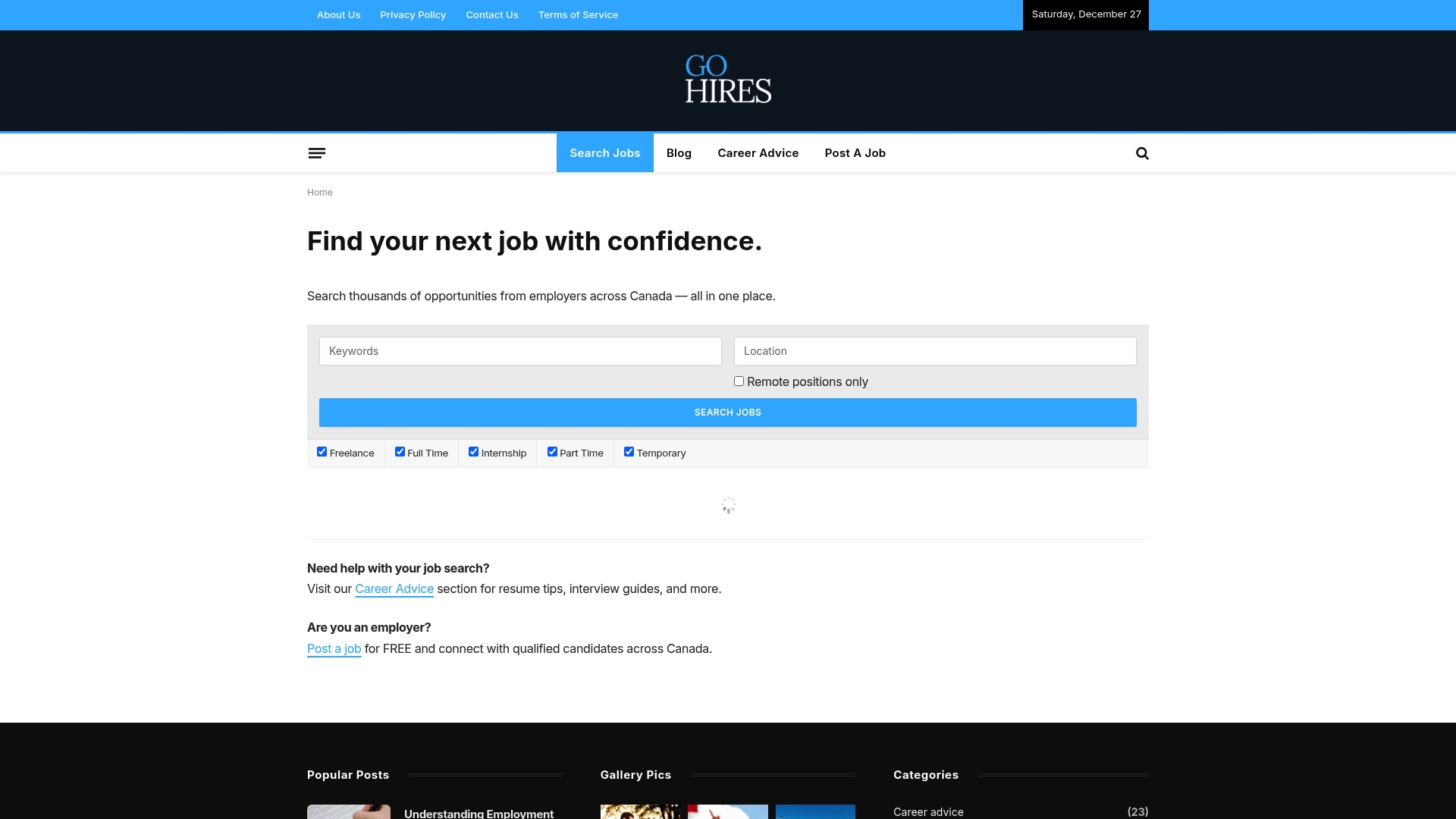
Don’t let your resume hold you back anymore. Visit Gohires.com to explore Canadian job listings that match your skills and customize your resume for each opportunity. Gain insider insights on how to present measurable results and key skills the right way with our helpful resources. Start turning your resume into an interview-winning asset today by taking control of your career on Gohires.com. Your next job is waiting.
Frequently Asked Questions
What is the primary purpose of a resume in the job search process?
The primary purpose of a resume is to provide a concise summary of your education, work experience, and skills tailored to a specific job opportunity, helping to showcase your qualifications and persuade hiring managers to invite you for an interview.
What are the main types of resumes, and how do they differ from each other?
The three main types of resumes are chronological, functional, and combination. Chronological resumes list work history in reverse order, emphasizing career progression. Functional resumes focus on skills and categorizes abilities rather than a timeline. Combination resumes highlight relevant skills followed by a chronological work history, balancing focus and progression.
How can I ensure my resume gets past Applicant Tracking Systems (ATS)?
To pass ATS, ensure your resume includes specific keywords from the job posting, uses clean and simple formatting, and avoids unusual graphics or complex layouts that ATS may struggle to read. It’s also important to tailor each resume to match what the employer values most.
What common mistakes should I avoid when writing my resume?
Common mistakes to avoid include spelling and grammar errors, using vague achievements without measurable results, submitting the same resume for every application, including irrelevant personal details, and inconsistent formatting. These can distract hiring managers and diminish your professionalism.