


Stepping into the Canadian job market as a recent graduate can feel overwhelming. With so many different paths and industries to choose from, it can be tough to know which opportunities truly offer room for growth, real stability, and rewarding work. Whether you’re interested in public service, healthcare, tech, or beyond, understanding what each entry-level path delivers is essential for making confident decisions about your future.
The right start can open doors that shape your entire career. This guide zeroes in on practical and accessible job options for new graduates, highlighting programs and fields that provide not just paychecks but real professional development. Get ready to uncover actionable insights on government entry streams, healthcare demand, tech talent strategies, and more that could accelerate your job search and launch your career in Canada.
Table of Contents
- 1. Full-Time Office Jobs In Major Industries
- 2. Entry-Level Government Positions
- 3. Healthcare Roles For New Professionals
- 4. Tech And IT Support Opportunities
- 5. Retail And Customer Service Careers
- 6. Education And Early Childhood Jobs
- 7. Remote And Freelance Entry-Level Positions
Quick Summary
| Takeaway | Explanation |
|---|---|
| 1. Focus on full-time roles in key industries | Prioritize applying for positions in finance, technology, professional services, healthcare, and government for better job stability. |
| 2. Your first job shapes career perception | Commit to your first role for 18-24 months to build valuable experience and enhance your marketability for future positions. |
| 3. Networking accelerates career growth | Engage with colleagues in informal settings to expand your professional network and discover new job opportunities. |
| 4. Certifications enhance IT career advancement | Obtain foundational IT certifications early to increase earning potential and competitiveness in the tech job market. |
| 5. Consider remote work for flexibility | Explore remote roles to eliminate commuting and create a better work-life balance, especially in initial job searches. |
1. Full-Time Office Jobs in Major Industries
Full-time office positions in Canada’s major industries offer recent graduates a stable foundation for building long-term careers. These roles typically involve working 37.5 to 40 hours per week in corporate environments, providing consistent paychecks, benefits packages, and clear advancement pathways that freelance or contract work often lacks.
When you enter the job market as a recent graduate, understanding which industries actively hire entry-level talent makes all the difference. Canada’s strongest sectors for new graduates include finance, technology, professional services, healthcare administration, and government. Each industry values different skill sets, but all share one thing in common: they reward candidates who demonstrate reliability, attention to detail, and willingness to learn on the job.
Financial services firms in Toronto, Vancouver, and Montreal consistently recruit recent graduates for roles in accounting, audit, and business analysis. These positions typically start around $45,000 to $55,000 annually and involve supporting senior professionals with research, data analysis, and client communication. Banks and investment firms also offer structured training programs that teach you industry-specific knowledge while you earn. You’ll find that the learning curve is steep those first few months, but the technical skills you gain become valuable across your entire career.
Technology companies, both established corporations and mid-sized firms, hire numerous recent graduates as software developers, quality assurance testers, and business analysts. If you studied computer science, engineering, or even business with technical electives, you likely qualify for these positions. Tech roles often pay between $55,000 and $70,000 for entry-level positions and frequently include additional perks like flexible work arrangements, professional development budgets, and collaborative team environments. The industry moves quickly, which means you’ll constantly encounter new tools and frameworks to learn.
Professional services firms like accounting, consulting, and law firms operate extensive graduate recruitment programs. Positions here might include junior auditor, management consulting analyst, or legal assistant roles. These firms deliberately hire recent graduates because they understand you need training and mentorship. You start with foundational work like client data management, document preparation, and research support, then gradually take on more complex responsibilities. The experience you gain translates directly into credentials and expertise that increases your market value significantly.
Healthcare administration offers overlooked opportunities for graduates with degrees in health sciences, business, or even general studies. Hospitals and clinics need coordinators, administrative assistants, and patient advocates. These roles typically pay between $40,000 and $50,000 annually and provide exposure to the healthcare sector’s unique challenges and rewards. If you’re interested in patient care but didn’t pursue clinical nursing or medicine, administration provides a meaningful alternative path.
Government positions at federal and provincial levels hire recent graduates for policy analysis, program coordination, and administrative roles. Government employment offers excellent job security, comprehensive benefits, and pension plans that private sector positions rarely match. The hiring process moves slowly, and you might wait two to four months from application to job offer, but the payoff justifies the patience.
One crucial insight about starting in full-time office roles is that your first position sets the tone for how potential employers perceive your career trajectory. Employers look at your work history, job tenure, and growth within organizations when evaluating you for more senior positions later. Staying in your first role for at least 18 to 24 months demonstrates commitment and allows you to accumulate meaningful accomplishments to discuss in future interviews.
When searching for these positions, finding the best jobs in your city involves using both job boards and company career pages directly. Many employers post positions on their websites before listing them on public job boards, giving you a competitive advantage if you know where to look. You should also research companies in your target industry and follow their hiring announcements through LinkedIn and industry newsletters.
The networking aspect of office jobs often surprises new graduates. Your colleagues become your professional network, and many career opportunities emerge through conversations in break rooms, team lunches, and after-work events. This social component of office work accelerates your career development in ways that remote-only positions sometimes cannot.
Pro tip: During your first three months in any full-time office role, focus on understanding how your specific company operates rather than trying to prove your worth through overwork, and document every project you complete so you have concrete examples for future performance reviews and job applications.
2. Entry-Level Government Positions
Government careers offer recent graduates something increasingly rare in today’s job market: job security, comprehensive benefits, and a clear advancement structure. Entry-level government positions in Canada provide pathways into federal, provincial, and municipal service across diverse departments and agencies.
Why consider government work? Private sector jobs sometimes feel unstable, especially during economic downturns. Government positions, by contrast, provide pension plans, extended health coverage, and employment protections that make long-term financial planning genuinely feasible. You also contribute to public service, working on initiatives that directly affect Canadian communities. This sense of purpose resonates deeply with many recent graduates who want their careers to mean something beyond profit margins.
The Canadian government actively recruits recent graduates through structured programs designed specifically for new talent. The federal government, in particular, operates multiple entry-level streams across departments. You might work in policy analysis, program coordination, data analysis, or administrative support roles. Salaries for entry-level federal positions typically range from $42,000 to $58,000 annually, depending on your education level and the specific position classification.
One standout opportunity is working with federal agencies that handle specialized functions. The Canada Border Services Agency offers the Officer Trainee Developmental Program, which explicitly targets recent graduates and provides comprehensive training in analytical, communication, and service skills necessary for border security operations. This program welcomes diverse candidates, including Indigenous peoples and recent students, making it genuinely accessible to various backgrounds. You receive structured training before handling front-line duties, meaning you’re not thrown into complex situations unprepared.
Statistics Canada represents another excellent entry-level destination. The organization recruits recent graduates for roles in social statistics, economics, mathematical statistics, financial services, human resources, and data collection. What makes Statistics Canada particularly appealing is their rotation components that build diverse experience while you learn how federal organizations operate. You work across different teams, understanding various aspects of Canada’s statistical systems, which accelerates your professional development significantly.
The government hiring process differs markedly from private sector recruitment. Expect longer timelines. An application you submit in January might not result in an interview until April or May. This slowness frustrates many candidates, but it reflects the careful vetting required for public sector employment. You’ll complete security clearances, background checks, and sometimes written exams assessing your analytical and communication abilities. The waiting period tests your patience, but the reward of landing a stable government position justifies the delay.
Another distinctive feature of government work involves job classification systems. Rather than negotiating salary individually, you fall into a predetermined pay grid based on your education, position level, and years of service. This transparency removes salary negotiation stress and ensures fairness across employees. If you have a university degree, you automatically qualify for certain classifications. If you have a graduate degree, you enter at a higher rung. This system rewards education directly.
Provinical and municipal governments offer similar entry-level opportunities. Provinces hire graduates for social services coordination, health administration, environmental monitoring, and infrastructure planning roles. These positions typically pay slightly less than federal roles but often involve working within your home community. If staying in your hometown matters to you, provincial government positions might align better with your personal priorities.
Government employers also invest heavily in developing their workforce. Your department likely offers training programs, mentorship opportunities, and tuition reimbursement for continuing education. Unlike some private employers who view training as an expense, government agencies recognize that investing in employee development strengthens public service. This commitment to professional growth creates genuine opportunities for advancement as you gain experience.
The work culture in government settings tends toward stability and collaboration rather than cutthroat competition. You’ll encounter colleagues who prioritize service delivery and sustainable work practices over burnout. This doesn’t mean government work lacks challenge or excitement, but the pace typically allows for work-life balance. If you value spending time with family, pursuing hobbies, or maintaining mental health, government employment often provides that space.
One aspect that surprises new government employees involves the permanency of positions. Many government jobs offer permanent status after a probation period, typically six months to two years depending on the role. Permanent status means your employer cannot easily lay you off or terminate you without just cause. You develop genuine job security that allows you to build a life with confidence in your income stability.
Pro tip: Start your government job applications nine to twelve months before you want to begin working, since the hiring process moves slowly, and begin building relationships with government agency recruiters through LinkedIn or job fairs to understand what specific qualifications different departments value most.
3. Healthcare Roles for New Professionals
Canada’s healthcare system faces significant staffing challenges as the population ages and demand for services increases. This shortage creates abundant entry-level opportunities for recent graduates willing to work in healthcare. Whether you studied nursing, medical laboratory science, radiography, or another health discipline, the job market actively seeks your skills right now.
The healthcare sector offers more diversity than most people realize. You might assume healthcare careers mean working as a nurse or doctor, but the reality spans medical laboratory technicians, radiology technologists, respiratory therapists, occupational therapy assistants, phlebotomists, and numerous administrative roles. Each position contributes meaningfully to patient care while offering distinct work environments and responsibilities. If you completed a diploma or degree in any health-related field, opportunities exist across multiple specializations.
Nursing positions represent the largest hiring category for new healthcare professionals. Registered nurses with recent degrees find hospitals, long-term care facilities, clinics, and community health agencies all competing for their talent. Entry-level registered nurse salaries typically range from $52,000 to $65,000 annually, with potential for significant increases as you gain experience and take on specialized roles. Licensed practical nurses enter the field at slightly lower salaries but still earn competitive compensation with excellent benefits.
What distinguishes healthcare careers from many other fields is the immediate impact you have. On your first day working in a hospital, you contribute directly to patient wellbeing. This tangible difference resonates deeply with people seeking meaningful work. You’re not pushing papers or managing spreadsheets. You’re supporting people during vulnerable moments in their lives, which creates profound job satisfaction for those suited to healthcare work.
Medical laboratory technicians and radiology technologists face particularly strong demand. These roles require specialized training but offer entry-level salaries between $45,000 and $60,000 with clear advancement pathways. Laboratory technicians analyze blood samples, cultures, and tissue specimens. Radiography technologists operate imaging equipment like X-ray machines and CT scanners. Both professions involve technical skill combined with direct patient interaction, attracting graduates who want hands-on work without requiring a four-year university degree for entry.
The reality of starting healthcare work involves acknowledging real challenges. New healthcare professionals encounter burnout and role adaptation pressures in a healthcare system stretched thin by increasing demand. Your first positions might involve shift work, including nights, weekends, and holidays. The emotional weight of caring for suffering patients affects your mental health. Physical demands like standing for twelve hour shifts or lifting patients strain your body. Healthcare work demands resilience and self-awareness about your own wellbeing.
The good news is that organizations increasingly recognize these challenges and invest in supporting new professionals. Many hospitals and healthcare facilities offer structured mentorship programs pairing experienced staff with newcomers. These mentors guide you through your first overwhelming weeks, answer questions, and help you develop confidence. Some facilities provide advanced training programs allowing you to specialize further as you gain experience. This investment in your development signals that your employer values retaining talented staff.
If you’re a recent graduate from outside Canada with healthcare credentials, opportunities exist for you as well. Canada actively recruits medical doctors and other healthcare professionals, with immigration and licensing support available for foreign credentials. The process requires language proficiency and clinical readiness assessments, but pathways exist for qualified international professionals seeking to work in Canadian healthcare.
Alied health professions offer alternative entry points for those without nursing degrees. Occupational therapy assistants, physiotherapy aides, and dental hygienists all find ready employment. These roles typically require two-year diploma programs and offer salaries ranging from $40,000 to $55,000 with strong job security. If you’re interested in healthcare but didn’t pursue a nursing or medical degree, allied health professions provide meaningful alternatives.
The work environment in healthcare differs significantly from corporate office settings. You collaborate closely with diverse teams including nurses, doctors, social workers, and technicians. This interdisciplinary collaboration creates dynamic work environments where you learn from colleagues with different expertise. Unlike siloed corporate departments, healthcare teams must communicate constantly and coordinate care seamlessly. This teamwork aspect appeals strongly to graduates who value collaboration and collective purpose.
Scheduling complexity represents a reality of healthcare work that deserves consideration. Most healthcare facilities operate twenty-four hours daily, meaning shift rotations are standard rather than exception. Your schedule might change monthly or involve rotating through day, evening, and night shifts. Some professionals thrive with shift work, appreciating the variety and different patient populations they encounter. Others struggle with sleep disruption and family life challenges. Understanding your own tolerance for scheduling variability helps you assess whether healthcare work suits your lifestyle.
Compensation packages in healthcare extend beyond base salary. Most healthcare employers offer comprehensive benefits including dental and vision coverage, life insurance, and pension plans. Union representation in many healthcare settings means standardized benefits and wage increases negotiated collectively rather than individually. This security appeals to graduates seeking predictability in their compensation and benefits structure.
Pro tip: Before accepting a healthcare position, visit the facility and observe the actual work environment during a shift, since what sounds appealing theoretically can feel very different in practice, and confirming that the specific workplace culture and pace match your personality prevents costly job changes later.
4. Tech and IT Support Opportunities
Technology and IT support roles represent some of the fastest-growing career paths in Canada for recent graduates. Unlike fields requiring specialized credentials or years of experience, tech support and entry-level IT positions welcome motivated graduates regardless of their educational background, as long as you demonstrate technical aptitude and problem-solving ability.
IT support roles range from help desk technicians who answer user calls and resolve technical issues to network support specialists who manage infrastructure and security. Help desk positions typically involve assisting employees or customers with computer problems, software installation, password resets, and troubleshooting connectivity issues. These roles serve as the entry point for most IT careers. Starting salaries for help desk technicians range from $38,000 to $48,000 annually, with rapid increases as you gain certifications and experience.
What makes tech support careers attractive is the combination of job availability and learning opportunities. Most organizations employ IT teams, meaning opportunities exist across virtually every industry and company size. Whether you work for a bank, hospital, government agency, or retail company, your IT support skills transfer seamlessly. You’re never locked into one employer or sector. This portability means you can change companies, industries, or even countries relatively easily throughout your career.
Canada actively supports growth in the technology sector through specialized programs designed to attract and retain skilled tech workers. The Canadian government recognizes that tech talent drives economic growth and innovation. Programs like Canada’s Tech Talent Strategy facilitate opportunities for tech graduates through faster hiring processes and less restrictive work permits. If you’re interested in advancing your career in technology, Canada explicitly welcomes and supports your ambitions.
Network administration represents a step above help desk work in terms of complexity and compensation. Network administrators configure and maintain computer networks, manage security systems, and ensure systems run smoothly. These positions typically require some help desk experience or relevant certifications like CompTIA Network+ or Cisco certifications. Salaries for network administrators start around $55,000 to $65,000 annually and increase significantly with experience and advanced certifications.
Systems administration involves managing servers, databases, and IT infrastructure at a deeper level. Systems administrators handle software updates, security patches, backup systems, and disaster recovery planning. This role requires more technical knowledge than help desk work but offers considerably higher compensation, typically starting at $60,000 and reaching $85,000 or more with experience. If you enjoy solving complex technical problems and managing infrastructure, systems administration provides a rewarding career path.
Cybersecurity roles have emerged as some of the most in-demand positions in Canadian tech. Organizations increasingly prioritize protecting data and systems from cyber threats. Security analysts, security engineers, and penetration testers work to identify vulnerabilities and protect organizational assets. Entry-level security positions require foundational IT knowledge plus relevant certifications like CompTIA Security+ or Certified Ethical Hacker credentials. Starting salaries exceed $60,000 and increase dramatically as you specialize further.
One advantage of IT support roles is that certifications often matter more than formal education. You might have a high school diploma and still qualify for help desk positions. From there, earning industry-recognized certifications like CompTIA A+, Network+, or Security+ opens doors to higher-paying roles. Many employers cover certification costs for employees seeking advancement, meaning you can build credentials while earning income. This certification-based progression differs from fields requiring expensive university degrees before employment.
Cloud computing represents another booming specialty within IT. As organizations migrate systems to cloud platforms like Amazon Web Services, Microsoft Azure, and Google Cloud, they need professionals who understand cloud architecture and management. Cloud engineer and cloud architect roles command premium salaries, often starting at $75,000 or higher for entry-level positions with relevant experience or certifications. If you’re interested in cutting-edge technology and earning strong compensation, cloud specialization offers excellent prospects.
The learning curve in IT support work can feel steep initially. Your first weeks handling support tickets involve learning systems, understanding company processes, and building troubleshooting skills under pressure. Angry users calling with broken systems tests your patience and communication abilities. You’ll encounter repeated questions that seemingly everyone should know the answers to already. Despite the frustration, most experienced IT professionals look back fondly on help desk roles because they developed resilience and customer service abilities.
Tech support roles increasingly offer flexibility that traditional office work lacks. Many companies allow remote work, flexible scheduling, or hybrid arrangements for IT positions. If you value working from home or having flexibility in your schedule, tech support careers often accommodate these preferences. Some help desk positions operate shift work supporting users across time zones, meaning you might work evenings or nights, but you gain schedule flexibility in exchange.
The technology sector in Canada continues expanding, creating ongoing demand for skilled professionals at all levels. Whether you’re interested in hands-on technical work, security specialization, cloud architecture, or systems management, IT careers offer growth potential that few other fields match. Your initial entry-level position opens doors to increasingly specialized and well-compensated roles throughout your career.
Pro tip: Earn at least one foundational certification like CompTIA A+ or Network+ within your first year of help desk work, since certifications dramatically increase your earning potential and make you competitive for higher-level IT positions while employers often subsidize certification exam costs.
5. Retail and Customer Service Careers
Retail and customer service positions represent the most accessible entry points into the Canadian job market for recent graduates. You don’t need specialized credentials, years of experience, or advanced degrees to start working immediately in these roles. What you need is reliability, genuine interest in helping people, and willingness to master customer interaction skills that serve you throughout your entire career.
Retail careers span far more than standing behind a cash register. Modern retail involves inventory management, visual merchandising, customer service, sales, and increasingly, digital commerce integration. Customer service roles exist across call centers, email support teams, chat platforms, and in-person interactions. Whether you work in fashion, grocery, electronics, or customer support, the fundamentals remain consistent: you solve problems, answer questions, and create positive experiences that keep customers returning.
Starting salaries in retail typically range from minimum wage up to $32,000 annually for full-time entry-level positions. This might sound modest compared to specialized technical roles, but consider the complete compensation picture. Many retail employers offer benefits including health insurance, dental coverage, and employee discounts. More importantly, retail positions provide immediate income while you pursue further education, work toward certifications, or explore different career paths. You’re not locked in permanently. Retail serves as a launching pad for other opportunities.
Management advancement within retail moves remarkably fast for driven employees. A new graduate starting as a sales associate might become a shift supervisor within six months, then assistant store manager within two years. Store managers in major retailers earn between $50,000 and $75,000 annually plus bonuses and benefits. This rapid advancement appeals to people who want to demonstrate ability and move upward quickly. Unlike fields requiring specific certifications or credentials, retail advancement depends largely on your performance, reliability, and customer feedback.
Large retailers like Loblaws offer comprehensive training programs and mentorship specifically designed to develop entry-level employees into future managers and leaders. The company emphasizes diversity and inclusion as core components of workplace culture. You work alongside people from different backgrounds, ages, and experiences, creating rich learning environments beyond basic job duties. This exposure to diverse colleagues strengthens your interpersonal skills and cultural awareness.
Call center and customer service roles offer different advantages than in-store retail work. These positions typically involve helping customers over the phone, email, or chat. You resolve billing issues, answer product questions, troubleshoot technical problems, and process orders. Call center roles allow you to work from home increasingly, offering flexibility that many new graduates value. Pay ranges from $32,000 to $42,000 for entry-level positions, with increases as you move into team lead or supervisor roles. Many companies provide comprehensive training teaching you product knowledge and customer interaction techniques before you interact with actual customers.
Customer service skills developed in retail and call center roles transfer into virtually every career field imaginable. When you interview for professional positions later, highlighting your ability to manage difficult customers, de-escalate conflicts, and maintain composure under pressure resonates with hiring managers. These soft skills matter tremendously in business. A recent graduate who spent two years handling angry customers gains credibility in the eyes of employers evaluating them for corporate positions.
The physical demands of retail work deserve acknowledgment. You’ll spend hours standing, walking, and lifting merchandise. Your feet ache by the end of shifts. During busy periods like holidays, schedules intensify and stress peaks. Some people thrive in these environments, enjoying the physical activity and fast pace. Others find it exhausting and prefer stationary roles. Understanding your own physical tolerance and work style preferences helps you assess whether retail suits you.
Retail employment teaches resilience in ways that classroom education cannot. You encounter rude customers, unreasonable demands, and frustrating situations regularly. Learning to remain professional, empathetic, and solution-focused despite difficult interactions builds character. These experiences shape your ability to handle workplace challenges throughout your career. People who succeed in retail develop thick skin and emotional intelligence that makes them effective in any role requiring human interaction.
Schedule flexibility represents a major advantage of many retail and customer service positions. If you need to attend school, pursue certifications, or manage family obligations, retail employers often accommodate non-traditional schedules. You might work evenings and weekends while attending classes during the day. Some positions offer part-time arrangements allowing you to work multiple jobs or balance multiple commitments. This flexibility makes retail ideal for recent graduates still figuring out their long-term career direction.
Technology increasingly reshapes retail work. Modern retailers use systems for inventory management, customer relationship management, and sales analysis. You learn these tools on the job, building technical competence alongside customer service skills. This blend of interpersonal and technical abilities makes you more marketable as you progress. Future roles might involve training others on systems, analyzing customer data, or managing digital operations. Your entry-level retail position teaches skills that evolve as technology advances.
Team dynamics in retail create social benefits alongside employment. You develop genuine friendships with coworkers, creating networks that extend beyond your immediate job. These relationships sometimes lead to job opportunities, business partnerships, or lifelong friendships. The camaraderie of working together toward common goals, like hitting sales targets or managing busy periods, builds bonds that make work enjoyable.
Pro tip: Document and highlight every achievement in your retail role, including customer compliments, sales records, training you completed, or responsibilities you took on, since these specific accomplishments become powerful examples when interviewing for your next position and demonstrate tangible impact rather than just general job duties.
6. Education and Early Childhood Jobs
Education and early childhood careers offer recent graduates the opportunity to directly shape young minds during their most formative years. These roles combine daily interaction with children, creative problem solving, and the genuine satisfaction of knowing you fundamentally impact human development. If you enjoy working with young people and want a career filled with meaning, education and early childhood roles deserve serious consideration.
Early childhood education encompasses positions working with infants, toddlers, and preschool-aged children. Early childhood educators and assistants create learning environments that support intellectual, physical, social, and emotional growth. Your typical day involves planning activities, supervising play, facilitating learning experiences, and collaborating with parents and colleagues. Unlike teaching older students who work from textbooks, early childhood work emphasizes hands-on exploration, play-based learning, and individual developmental needs.
The sector offers a positive job outlook across Canada with opportunities in multiple settings. You might work in licensed daycare centers, preschools, Head Start programs, or family child care homes. Some positions involve traveling to different schools as a floating educator. Others center you in one facility with the same group of children throughout the year. This variety means you can find positions matching your preferred work environment and schedule.
Entry-level early childhood assistant positions typically require a high school diploma plus some specialized training. Many provinces offer early childhood education diplomas through community colleges, which typically take two years to complete. With this credential, you qualify for assistant roles earning between $32,000 and $40,000 annually. If you pursue a bachelor’s degree in early childhood education, you qualify for lead educator or coordinator positions, earning $40,000 to $55,000 annually. The education-to-salary progression is relatively fast compared to other fields.
The work environment in early childhood settings differs markedly from corporate offices. You work in colorful, vibrant spaces designed for children, with toys, art supplies, books, and outdoor play areas. Your day involves singing songs, reading stories, mediating toy disputes, and celebrating small victories like a child learning to tie their shoes. The energy level is high. The work is physically demanding, requiring you to bend, lift, and move constantly. You go home tired but often satisfied knowing you contributed meaningfully to children’s development.
Early childhood educators and assistants play foundational roles by fostering learning readiness and inclusive environments that welcome all children regardless of background or ability. This responsibility shapes how children approach school, relationships, and problem-solving for years to come.
Elementary and secondary school positions offer different opportunities for recent graduates. If you completed a university degree in a teachable subject, you qualify for teacher education programs leading to teaching certification. Newly certified teachers start earning between $45,000 and $58,000 depending on province and qualifications. Teaching involves curriculum planning, instruction, assessment, and significant collaboration with other educators. The job comes with structured schedules, summers off, and pension plans that make long-term financial planning straightforward.
Education assistants support teachers by working with students who need additional help. These positions require high school diplomas plus sometimes specific training. Education assistants help students with learning challenges, behavior management, and daily school activities. You work closely with teachers and develop relationships with students, gaining insight into what teaching genuinely involves before committing to teacher education programs. Many education assistants pursue teaching degrees after gaining classroom experience.
Specialized education roles focus on supporting students with specific needs. School psychologists, counselors, speech language pathologists, and special education teachers all work within school systems. These positions require university degrees and sometimes additional certifications or licensure. If you’re interested in supporting students with learning disabilities, behavioral challenges, or emotional wellbeing, these specialized paths offer meaningful career options with strong job security.
After school program coordinators and youth workers support children and adolescents in community centers, recreation programs, and shelters. These roles involve planning activities, mentoring young people, and creating safe, inclusive spaces. Requirements vary but typically include some postsecondary education in child development, social work, or similar fields. Positions pay between $35,000 and $50,000 depending on organization size and responsibilities.
Administrative roles in education include school secretaries, administrative assistants, and office managers. These positions support school operations behind the scenes, handling scheduling, communication, and record keeping. You interact with students, families, and staff daily while managing critical administrative functions. Requirements typically include high school diplomas plus office skills. Salaries range from $35,000 to $48,000 with good benefits and schedule alignment with school calendars.
Librarians and library technicians work in school and public libraries, supporting student research, literacy development, and information access. These roles appeal to graduates who love books, research, and helping others find information. Librarian positions require master’s degrees, but library technician roles require fewer credentials. Both offer decent salaries and the satisfaction of fostering literacy and learning.
The most rewarding aspect of education careers involves witnessing growth and development firsthand. A struggling reader learns confidence. A shy child makes their first friend. A student discovers a passion for science. These moments create genuine purpose in your work. Many educators report that despite challenging days and significant responsibilities, knowing they positively impacted a child’s trajectory makes the career worthwhile.
Challenges in education include managing large class sizes, addressing diverse student needs, navigating family dynamics, and adapting to policy changes. The emotional labor of supporting struggling students and witnessing barriers they face can feel heavy. You’ll encounter frustration, occasional heartbreak, and the reality that you cannot help everyone despite your best efforts. Understanding these challenges helps you assess whether you possess the resilience education work demands.
Early childhood positions specifically offer opportunities to support specialized development needs. Professionals working in areas like occupational therapy or physiotherapy assistance in early learning and development settings help children with developmental delays, physical challenges, or other specialized needs access educational and social experiences. These positions combine the joy of working with young children with specialized skills that make you uniquely valuable.
The job market for education professionals remains strong. Canada faces ongoing demand for qualified educators as student populations change and retirement rates affect staffing levels. This job security appeals to graduates wanting predictability in their career prospects. Unlike fields experiencing automation or outsourcing, teaching and early childhood education remain fundamentally human-centered work that cannot be eliminated by technology.
Pro tip: Before committing to education credentials or positions, spend substantial time volunteering in schools, daycares, or youth programs to confirm you genuinely enjoy working with young people daily, since the reality of constant noise, repetitive questions, and managing behavior differs significantly from occasional interactions with children.
7. Remote and Freelance Entry-Level Positions
Remote and freelance work represents a fundamentally different career path from traditional employment. Rather than commuting to an office, working set hours for one employer, and following established hierarchies, remote and freelance positions offer flexibility, autonomy, and the ability to control your earning potential. For recent graduates seeking non-traditional career starts, these opportunities open doors that conventional job markets sometimes close.
Remote positions differ from freelance work in important ways. Remote employees work for specific companies but perform their duties from home or other locations. You receive paychecks, benefits, and employment stability similar to office-based roles, but without commuting. Freelance work involves selling your services to multiple clients on a project basis. You’re self-employed, managing your own taxes, benefits, and income stability. Understanding this distinction helps you choose what suits your personality and financial needs.
Remote entry-level positions exist across various industries and roles. Customer service representatives answer support inquiries from home using company phone systems and email platforms. Data entry specialists process information, transcribe content, and organize databases remotely. Virtual assistants handle administrative tasks for entrepreneurs and small businesses. Freelance writers create content for websites, blogs, and publications. Graphic designers develop visual materials for clients worldwide. Proofreaders and editors refine written content. Web developers build and maintain websites. Social media managers handle brand accounts and community engagement. The range of remote opportunities for new graduates continues expanding as companies embrace distributed workforces.
The appeal of remote work attracts many recent graduates for understandable reasons. You eliminate commuting time, saving hours weekly and transportation expenses. You work in comfortable spaces you control, avoiding office politics and rigid dress codes. You balance work with personal obligations more easily when flexibility exists. Geographic location matters less, meaning you access employment opportunities regardless of where you live in Canada. A recent graduate in rural Saskatchewan can work for Toronto-based companies without relocating.
Remote positions typically pay competitively with office-based equivalents for the same role. Entry-level remote customer service roles pay between $30,000 and $38,000 annually. Remote data entry positions earn $28,000 to $40,000. Virtual assistant roles range from $32,000 to $45,000 depending on experience and employer. These salaries match or exceed many in-person entry-level positions while offering location flexibility that adds tremendous lifestyle value.
Freelance work offers different financial structures. Rather than hourly wages or annual salaries, freelancers charge by project, hourly rate, or retainer agreements. A freelance writer might charge $50 to $150 per article depending on research requirements and subject matter complexity. A graphic designer might charge $500 to $2,000 for logo design. Virtual assistants charge hourly rates ranging from $20 to $50 depending on skills and experience. Freelance income varies month to month, requiring careful financial planning. Some months bring abundant work and generous income. Other months feel dry and stressful. This income variability challenges people accustomed to predictable paychecks.
The biggest advantage of freelancing is that your earning potential depends on your hustle and skill development rather than employer budgets or salary grids. As you build reputation and expertise, you raise rates and attract better clients, directly rewarding your growth.
Starting freelance careers requires building a portfolio demonstrating your capabilities. If you’re a writer, create sample articles or blog posts. If you’re a designer, develop mockups or real projects. If you’re a developer, build functioning websites or applications. Prospective clients want proof you can deliver quality work. Early in your freelance journey, you might accept lower-paying projects to build this portfolio. This investment in early career building pays dividends as you establish credibility.
Platforms for finding remote and freelance work vary significantly. Upwork connects freelancers with clients seeking specific services, though competition is intense and fees are substantial. Fiverr allows freelancers to sell predefined services at set prices. Toptal specializes in vetted freelancers for more specialized work. Indeed, LinkedIn, and FlexJobs all post remote positions regularly. Exploring remote work platforms available in Canada helps you understand which services best match your skills and goals.
Time management becomes critical when working remotely. Office environments provide external structure and boundaries. Your boss can see when you’re working. Coworkers’ presence keeps you accountable. Remote work eliminates these external controls. You must develop self-discipline, create dedicated work spaces, establish routines, and set boundaries between work and personal time. Some people thrive with this autonomy. Others struggle without external structure. Understanding your working style helps you assess whether remote work suits you.
Tax and financial responsibilities change when freelancing. As a self-employed person, you pay both employer and employee portions of payroll taxes. You must set aside income for quarterly tax payments. You’re responsible for health insurance, retirement savings, and other benefits that employed people receive from employers. You maintain detailed financial records for tax purposes. These administrative burdens surprise many new freelancers. Working with an accountant familiar with self-employment helps you navigate these complexities successfully.
Networking and client acquisition require ongoing effort in freelance careers. You cannot simply apply for jobs and wait for responses. You actively market yourself through LinkedIn profiles, portfolio websites, networking events, and direct outreach to potential clients. Building relationships with clients leads to repeat work and referrals. This business development aspect appeals to entrepreneurial personalities but exhausts people who prefer simply having jobs assigned to them.
Work-life balance requires intentionality in remote settings. The convenience of working from home sometimes becomes the curse of never leaving work. Your bedroom becomes your office. Work emails arrive constantly. Boundaries blur. Many remote workers report actually working longer hours at home than they did in offices. Setting specific work hours, creating separate work spaces, and developing shutdown routines help maintain healthy balance.
Career development in remote and freelance positions differs from traditional employment. You don’t have mentors down the hallway or managers actively coaching your growth. You’re responsible for identifying skill gaps, pursuing training, and developing expertise independently. Some remote positions offer professional development support. Many freelance arrangements provide no support structure. This self-directed development suits ambitious, motivated people but frustrates those who benefit from guided growth.
Communication skills become paramount in remote work. Without in-person interaction, you rely entirely on written communication, video calls, and digital collaboration tools. Miscommunications happen easily. Clear writing, prompt responses, and proactive communication prevent problems. People who excel at remote work tend to communicate clearly, respond reliably, and demonstrate initiative without needing direction.
The remote work landscape continues evolving as companies experiment with distributed teams. Demand for remote positions grows consistently, creating opportunities for recent graduates willing to embrace non-traditional work arrangements. If you value independence, flexibility, and the ability to structure your own career, remote and freelance positions offer pathways worth serious consideration.
Pro tip: Build your remote or freelance reputation methodically by starting with reliable, quality work for established clients rather than chasing numerous low-paying gigs, since long-term success depends on referrals and reputation more than volume of projects or clients.
Below is a comprehensive table summarizing the primary industries, roles, and skill requirements for recent graduates entering the workforce in Canada, as discussed in the article.
| Industry | Entry-Level Roles/Opportunities | Key Skills and Traits | Benefits |
|---|---|---|---|
| Finance | Accounting, audit assistance, business analysis | Reliability, attention to detail, willingness to learn | Structured training programs, strong career growth potential |
| Technology | Software development, quality assurance testing, business analysis | Technical aptitude, innovative mindset, teamwork | Competitive salaries, flexible work environments, rapid industry growth |
| Professional Services | Junior auditor, consulting analyst, legal assistant | Analytical skills, research abilities, client-focused approach | Mentorship and credential-building, marketable professional experience |
| Healthcare Administration | Clinical coordinators, administrative assistants, patient advocacy | Organizational expertise, communication skills, adaptability | Stable roles with growth potential, meaningful contributions to the healthcare sector |
| Government | Policy analysis, program coordination, administrative support | Analytical approach, resilience in lengthy processes, public-focused dedication | Excellent job security, comprehensive retirement and health benefits |
| Healthcare | Nursing, lab technician, radiology technologist | Compassion, technical proficiency, teamwork | Immediate contributions to patient care, strong demand for roles |
| Retail and Customer Service | Sales associates, customer service representatives | Reliability, interpersonal abilities, solution-oriented attitude | Flexible scheduling, skill-building in persuasion and customer relations |
| Education | Early childhood educators, teaching assistants, administrative roles | Creativity, patience, commitment to child development | Rewarding impact on young minds, alignment with educational schedules |
| Technology/IT Support | Help desk technician, cybersecurity roles, network administration | Technical competence, customer service focus, learning agility | Increasing specialization opportunities, flexible work setups |
Find Your Perfect First Job in Canada With Confidence
Starting your career as a recent graduate can feel overwhelming as you navigate unique challenges like understanding industry-specific roles, securing stable employment, and building a professional network. Whether you are aiming for full-time office jobs in finance or tech, government positions with job security, healthcare roles packed with purpose, or remote and freelance opportunities offering flexibility, locating the right job is a critical step toward long-term success. At Gohires.com, we recognize the importance of matching your specific skills and goals with the right Canadian employers eager to hire fresh talent.
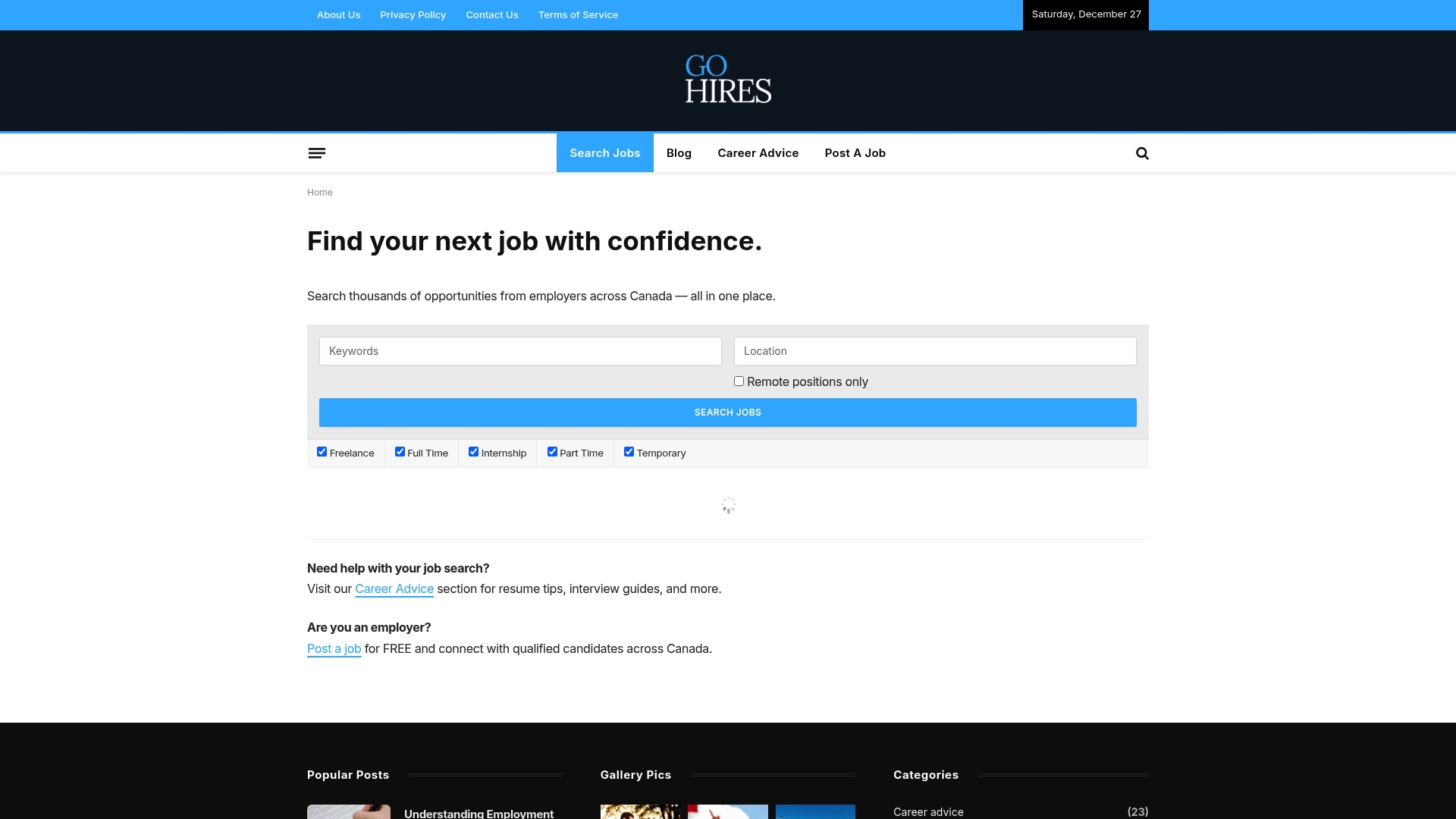
Discover thousands of job listings tailored for graduates across Canada with easy-to-use filters based on location, keywords, and employment type. Benefit from career advice that helps you polish your resume, prepare for interviews, and confidently showcase your accomplishments. Don’t let slow government hiring or competitive tech job markets slow you down. Act now to connect directly with employers looking for motivated new professionals like you. Start your journey by exploring full-time, part-time, and freelance jobs on Gohires.com today and take control of your future career.
Frequently Asked Questions
What are the top job sectors for new graduates in Canada?
Full-time positions in finance, technology, professional services, healthcare administration, and government consistently seek new graduates. Focus your job search on these sectors to increase your chances of landing a suitable entry-level role.
How can I find entry-level job postings in Canada?
Look for job ads on company career pages and popular job boards, as many employers post directly on their websites first. Check for new listings regularly to apply within days of posting for better chances.
What qualifications do I need to get a job in healthcare administration?
Typically, a degree in health sciences, business, or a related field is required for positions in healthcare administration. Pursue internships or volunteer experiences that can enhance your application and provide hands-on learning opportunities.
How long does the hiring process for government jobs usually take?
The government hiring process can take anywhere from two to four months due to security clearances and thorough vetting. To improve your chances, apply nine to twelve months before you expect to start working.
What type of training programs can I expect as a new employee in professional services?
Many professional services firms offer structured training programs that include mentorship and skills development for entry-level employees. Engage actively in these programs during your initial months to set a strong foundation for your career.
How do I build a professional network after starting a job?
Connect with colleagues through informal settings like team lunches or after-work events to build relationships. Engage actively in conversations and follow up with contacts on platforms like LinkedIn to strengthen your professional network.